Review
. 2016 Jan;20(1):47-63.
doi: 10.1016/j.tics.2015.09.003. Epub 2015 Nov 9.

The Social Regulation of Emotion: An Integrative, Cross-Disciplinary Model

Affiliations
Review

The Social Regulation of Emotion: An Integrative, Cross-Disciplinary Model

Crystal Reeck et al. Trends Cogn Sci. 2016 Jan.

Abstract

Research in emotion regulation has largely focused on how people manage their own emotions, but there is a growing recognition that the ways in which we regulate the emotions of others also are important. Drawing on work from diverse disciplines, we propose an integrative model of the psychological and neural processes supporting the social regulation of emotion. This organizing framework, the 'social regulatory cycle', specifies at multiple levels of description the act of regulating another person's emotions as well as the experience of being a target of regulation. The cycle describes the processing stages that lead regulators to attempt to change the emotions of a target person, the impact of regulation on the processes that generate emotions in the target, and the underlying neural systems.

Keywords: emotion perception; emotion regulation; empathy; mentalizing; social cognition; social support.


Figures

Figure 1
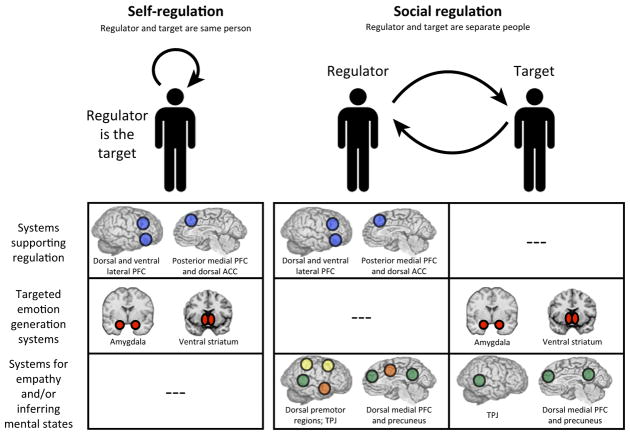
Figure 1. The Social Regulation of Emotion
(A) Unlike self-regulation, in which the regulator and the target are the same actor, the social regulation of emotion involves two separate people engaging in an iterative and dynamic cycle in which one’s actions shape the other’s responses. (B) This fundamental dissociation between agents has ramifications for the underlying neural circuitry involved. In self-regulation, systems supporting regulation and the emotion-generation systems they target reside in the same agent. In the social regulation of emotion, these processes reside in separate agents, with the control systems of the regulator responding to and acting on the emotion-generation system of the target. Importantly, this increased social complexity also places demands on relevant social cognitive systems. As a result, both parties engage mentalizing systems (depicted in green), and the regulators are more likely to mobilize regions of the action identification system (yellow) and systems for empathic sharing of the emotional states of others (orange). Abbreviations: ACC, anterior cingulate cortex; PFC, prefrontal cortex; TPJ, temporal–parietal junction.
Figure 2
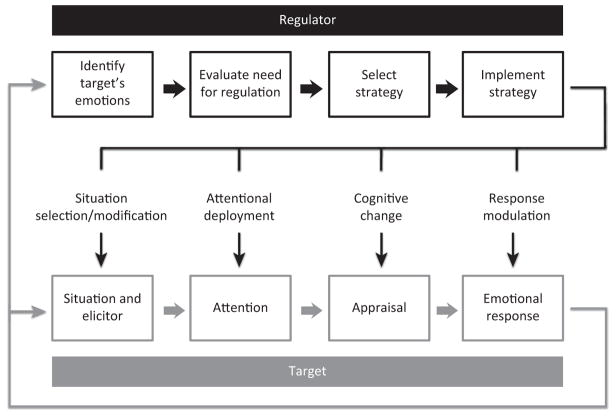
Figure 2
Managing the emotional state of others involves several core psychological processes. For the regulator (top half of panel; black lines), the cycle begins with reading the emotional state of the target. Second, the regulator must evaluate whether the current emotion differs from a desired, or goal, emotional state. If the regulator decides to intervene, they must subsequently generate candidate strategies for managing the emotions of the target and select an appropriate approach. Finally, the regulator must implement their selected strategy (see text for details of possible strategies) which can impinge on any of multiple stages in the emotion-generation sequence of the target. For the target (bottom half of panel; grey lines), the cycle begins with their perception of the stimuli/situations eliciting the emotion that kicked off the cycle, but, as time goes on, it also includes their perception of the regulator. The second step involves attention to various aspects of the initial elicitor and the regulator. The third step involves appraisals of the meaning of the elicitors – which can be shaped by the regulator’s actions – and in turn may lead the targets to appraise those actions. Finally, the target’s behavioral, physiological, and experiential manifestation of emotion may themselves be targets for regulator intervention.
Figure 3
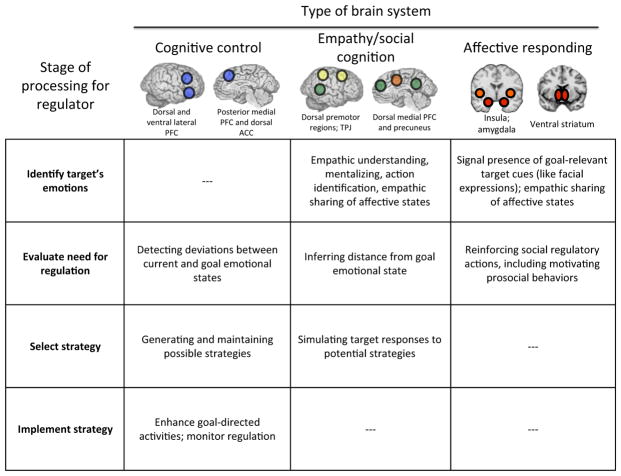
Figure 3. Neural Systems Underlying Social Regulatory Processes
When engaging in the social regulation of emotion, regulators engage a core set of three neural systems, including regions for cognitive control, social cognition, and affect generation. Each supports specific psychological processes at each stage of the social regulatory cycle. Abbreviations: ACC, anterior cingulate cortex; PFC, prefrontal cortex; TPJ, temporal–parietal junction–, minimally engaged.
Figure 4
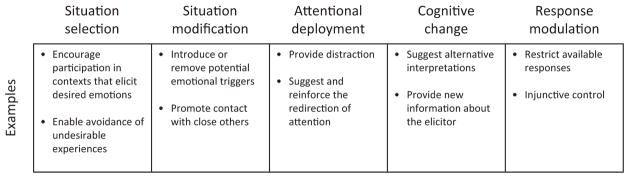
Figure 4. Examples of Social Regulatory Strategies Targeting Different Phases of the Emotion-Generation Process
Research examining the self-regulation of emotion categorizes regulatory strategies based on which phase in the emotion-generation process the strategy targets. In a similar fashion, the social regulation of emotion also involves strategies that impinge upon different phases in the emotion-generation cycle of the target. Regulators may choose to change features of the situation or elicitor, how the target directs attention to those features, the interpretation of their meaning by the target, or the outward affective behavior of the target.

References

    1. Gross JJ. Emotion regulation: conceptual and empirical foundations. In: Gross JJ, editor. Handbook of Emotion Regulation. 2. Guilford: 2014. pp. 3–20.
    1. Gross JJ. Emotion regulation: current status and future prospects. Psychol Inquiry. 2015;26:1–26.
    1. Buhle JT, et al. Cognitive reappraisal of emotion: a meta-analysis of human neuroimaging studies. Cereb Cortex. 2014;24:2981–2990. - PMC - PubMed
    1. Ochsner KN, Gross JJ. The cognitive control of emotion. Trends Cogn Sci. 2005;9:242–249. - PubMed
    1. Diaz RM, et al. The social origins of self-regulation. In: Moll LC, editor. Vygotsky and Education: Instructional Implications and Applications of Sociohistorical Psychology. Cambridge University Press; 1990. pp. 127–154.

Publication types

LinkOut - more resources