. 2016 Feb;26(2):807-819.
doi: 10.1093/cercor/bhv247. Epub 2015 Nov 12.

Individual Differences in Premotor Brain Systems Underlie Behavioral Apathy

Affiliations

Individual Differences in Premotor Brain Systems Underlie Behavioral Apathy

Valerie Bonnelle et al. Cereb Cortex. 2016 Feb.

Abstract

Lack of physical engagement, productivity, and initiative-so-called "behavioral apathy"--is a common problem with significant impact, both personal and economic. Here, we investigate whether there might be a biological basis to such lack of motivation using a new effort and reward-based decision-making paradigm, combined with functional and diffusion-weighted imaging. We hypothesized that behavioral apathy in otherwise healthy people might be associated with differences in brain systems underlying either motivation to act (specifically in effort and reward-based decision-making) or in action processing (transformation of an intention into action). The results demonstrate that behavioral apathy is associated with increased effort sensitivity as well as greater recruitment of neural systems involved in action anticipation: supplementary motor area (SMA) and cingulate motor zones. In addition, decreased structural and functional connectivity between anterior cingulate cortex (ACC) and SMA were associated with increased behavioral apathy. These findings reveal that effort sensitivity and translation of intentions into actions might make a critical contribution to behavioral apathy. We propose a mechanism whereby inefficient communication between ACC and SMA might lead to increased physiological cost--and greater effort sensitivity--for action initiation in more apathetic people.

Keywords: action initiation; anterior cingulate cortex; cingulum bundle; motivation; supplementary motor area.


Figures

Figure 1.
Figure 1.
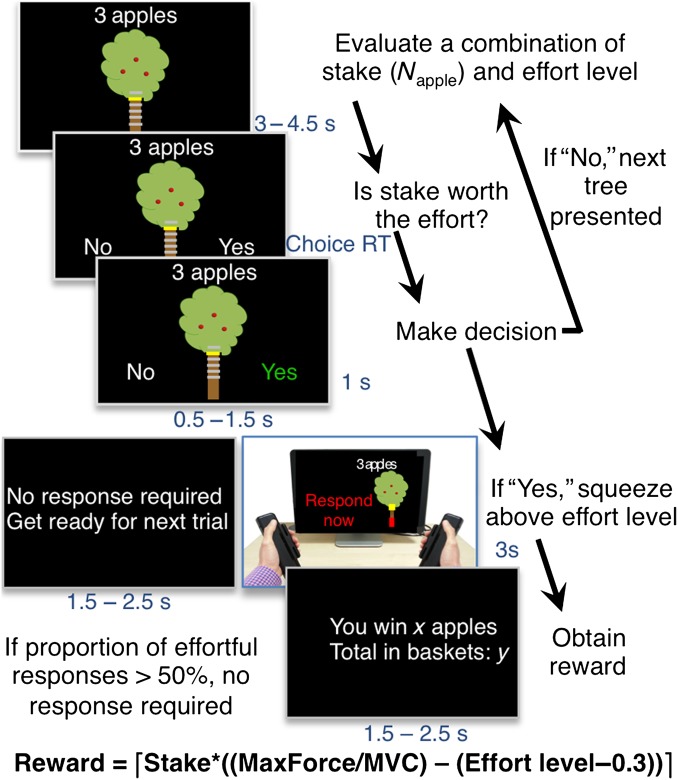
Effort- and reward-based decision-making task. Each trial starts with an apple tree showing the stake (number of apples) and effort level required to win a fraction of this stake (trunk height). There were 6 possible stakes (1, 3, 6, 9, 12, and 15 apples), and 5 possible effort levels (60%, 70%, 80%, 90%, and 100% of subject's MVC), indicated by the trunk height as well as yellow horizontal lines on tree trunk. After 3–4.5 s, participants decided whether or not they want to engage in an effortful response to gather apples (YES/NO option). Fruit gathering was performed by squeezing a force transducer with right or left hand, which translated on the screen as a red bar gradually filling the trunk. Subjects only won a percentage of the stake if they managed to reach or go beyond the top of the trunk. The expected reward was calculated on the basis of stake, effort level, and maximal force reached within 3 s. To control for the number of effortful responses produced, the selection of the YES option was also sometimes followed by a screen indicating that no response is required.
Figure 2.
Figure 2.
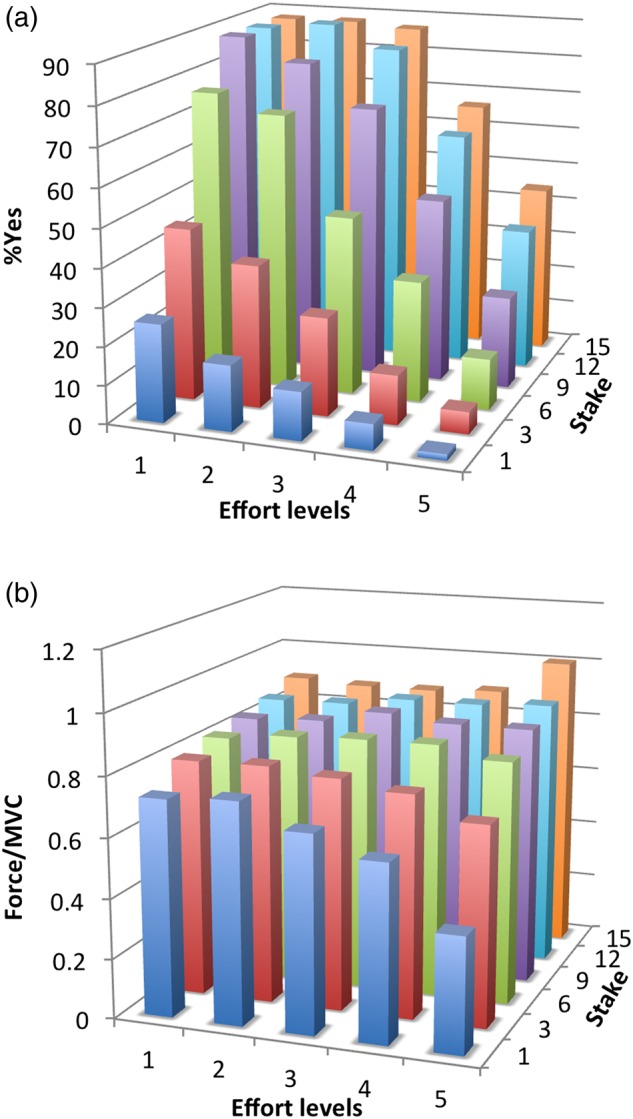
Behavior on task. (a) Percentage of accepted trials (%Yes) and (b) force exerted relative to MVC averaged across participants plotted against effort levels and stakes. Effort levels (1–5) correspond to percentage of MVC (from 60 to 100% MVC).
Figure 3.
Figure 3.
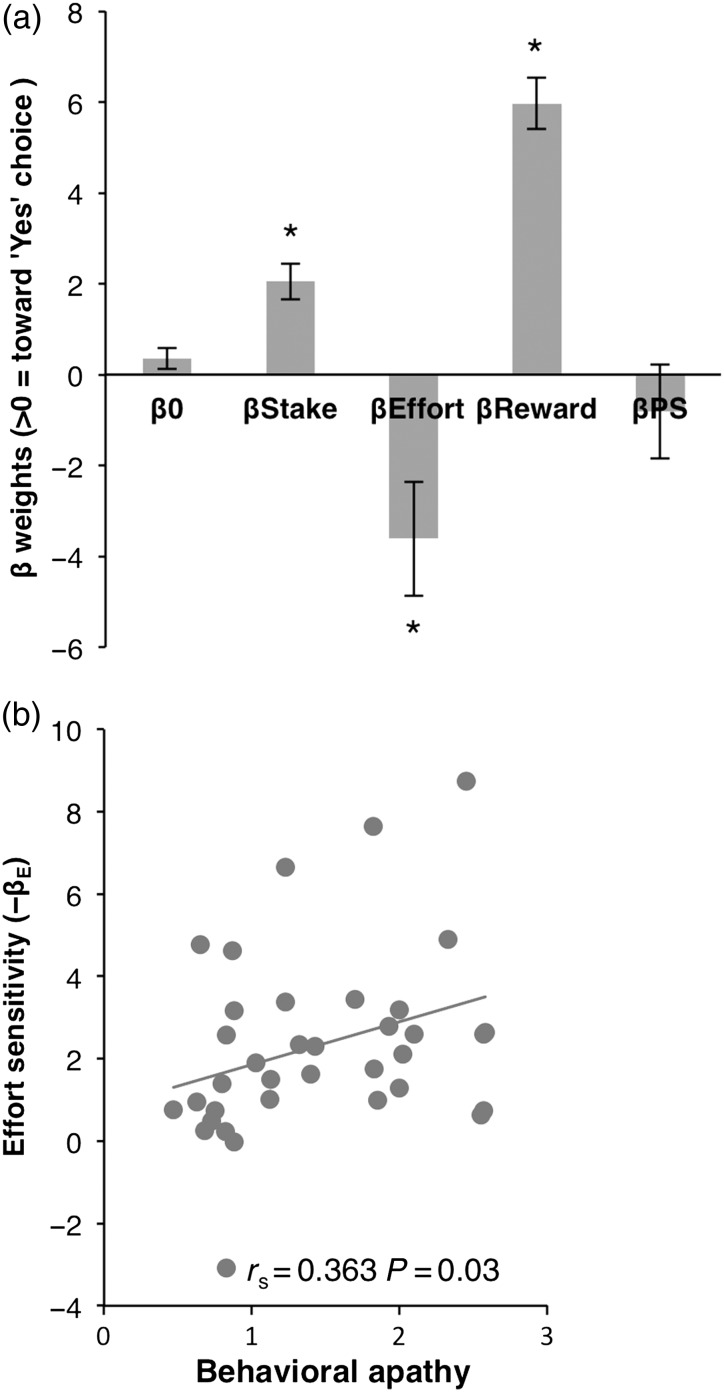
Choice probability modeling and relation with apathy traits. (a) Mean response bias (β0) and beta weights for stake, effort, expected reward, and probability of success across participants. Positive values indicate a weight toward “Yes”. *One-sample t-test, P < 0.05. (b) Correlation between behavioral apathy scores and effort sensitivity (βEffort).
Figure 4.
Figure 4.
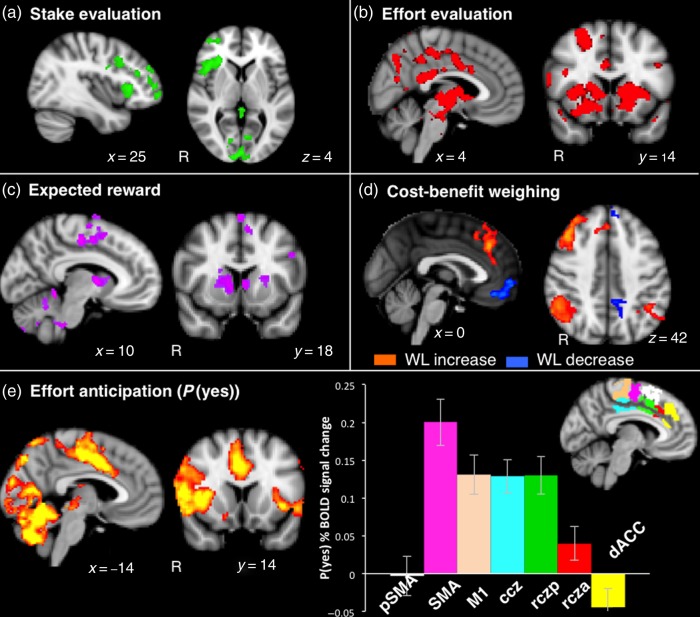
Brain regions associated with behavioral processes during the decision period. Regions showing significant increase in activation with (a) stake increase, (b) effort decrease, (c) expected reward increase, (d) cost-benefit weighing load (WL) with increase in orange and decrease in blue, and (e) increased probability of willing to engage effort, that is, probability of responding YES. Right panel shows BOLD signal increase with probability of accepting an offer for different medial frontal regions (±standard error), parceled out based on connectivity for pSMA), SMA, primary motor cortex (M1), caudal cingulate zone (ccz), posterior, and anterior rostral cingulate zones (rczp; rcza).
Figure 5.
Figure 5.
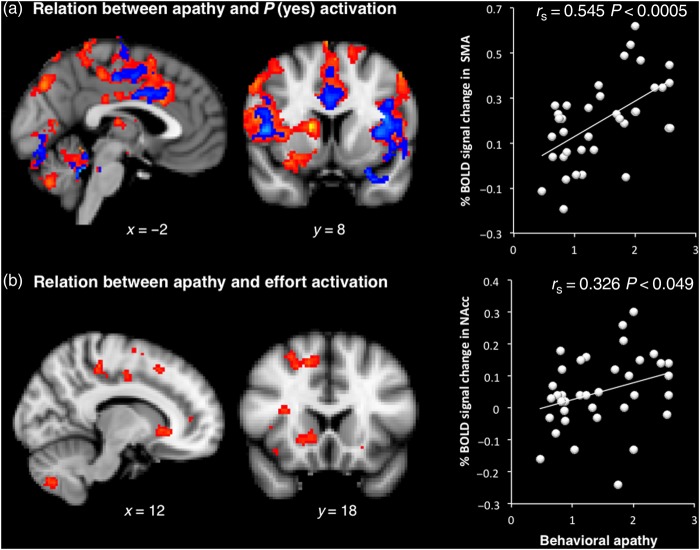
Relationship between brain function and individual differences in apathy traits. (a) Whole-brain correlation between apathy scores and BOLD signal increase with increased probability of accepting an offer controlling (blue–light blue) or not (yellow–red) for variance explained by behavioral model parameters (effort, stake, and reward sensitivity). Top right panel shows correlation between behavioral apathy scores and activation increase with P(yes) in the SMA. (b) Whole-brain correlation between apathy scores and effort-related BOLD signal change (signal increase with decreased effort). Bottom right panel shows relation between behavioral apathy scores and activation increase (as effort level decreased) in the nucleus accumbens (NAc).
Figure 6.
Figure 6.
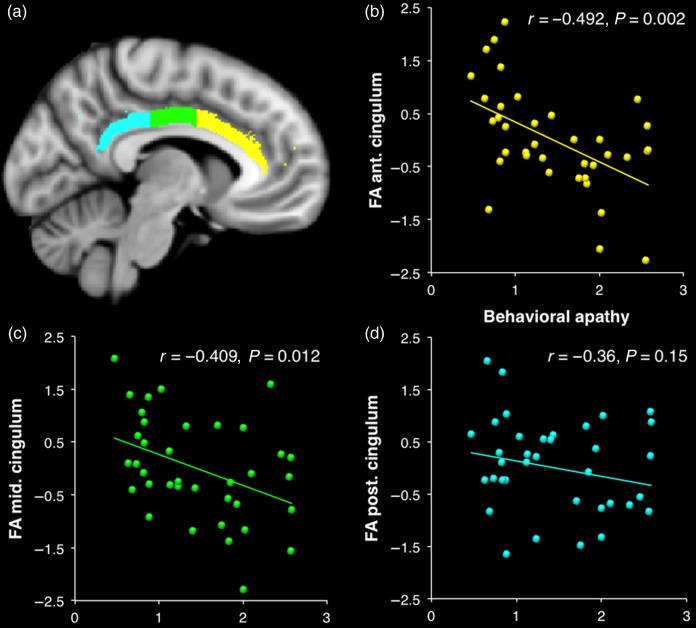
Relationship between cingulum white matter structure and apathy traits. (a) Cingulum bundle mask was parceled into 3 portions: anterior (yellow), middle (green), and posterior (blue). Correlations between behavioral apathy scores and normalized mean FA corrected for age and whole-brain white matter mean FA are plotted for the anterior (b), middle (c), and posterior (d) portions of the cingulum bundle (bilaterally).
Figure 7.
Figure 7.
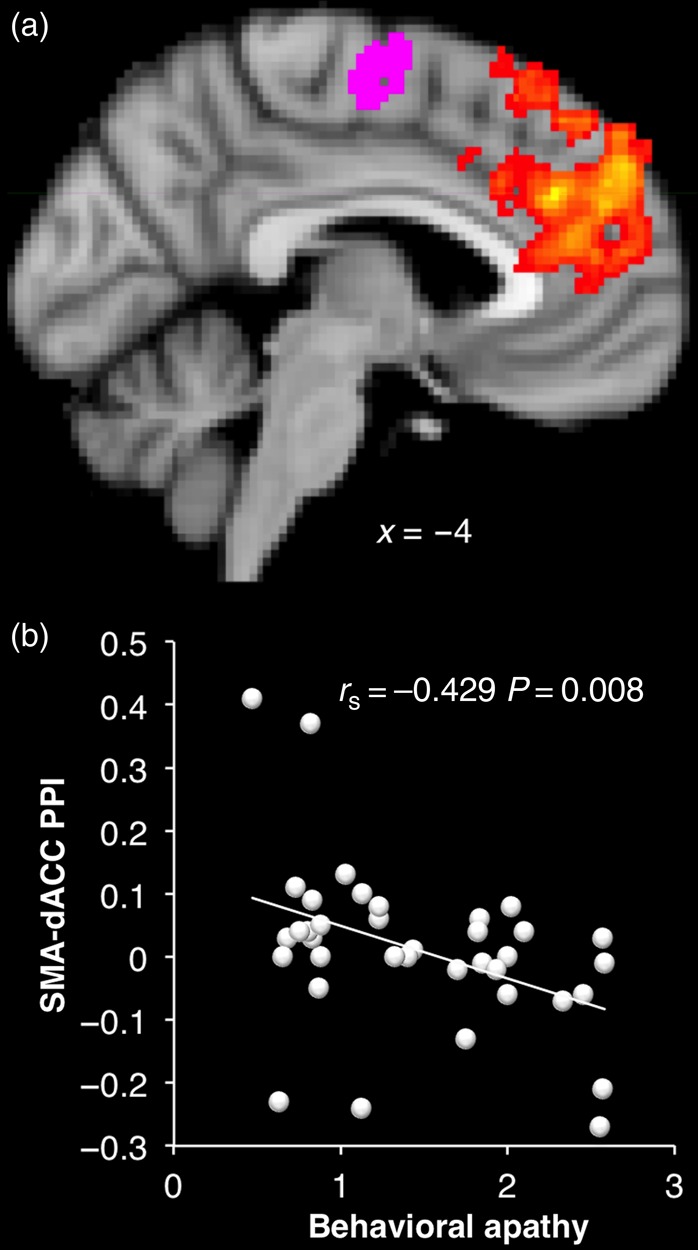
Relation between SMA functional connectivity and apathy traits. (a) In yellow–orange, regions where activity during the decision period on YES trials is more strongly correlated with activity in the SMA (purple) in more motivated individuals. (b) Correlation between behavioral apathy scores and the strength of the correlation (or functional connectivity) between the SMA and the dorsal ACC.

References

    1. Adam R, Leff A, Sinha N, Turner C, Bays P, Draganski B, Husain M. 2013. Dopamine reverses reward insensitivity in apathy following globus pallidus lesions. Cortex J Devoted Study Nerv Syst Behav. 49:1292–1303. - PMC - PubMed
    1. Apostolova LG, Akopyan GG, Partiali N, Steiner CA, Dutton RA, Hayashi KM, Dinov ID, Toga AW, Cummings JL, Thompson PM. 2007. Structural correlates of apathy in Alzheimer's disease. Dement Geriatr Cogn Disord. 24:91–97. - PubMed
    1. Apps MA, Ramnani N. 2014. The anterior cingulate gyrus signals the net value of others' rewards. J Neurosci. 34:6190–6200. - PMC - PubMed
    1. Beckmann CF, Smith SM. 2004. Probabilistic independent component analysis for functional magnetic resonance imaging. IEEE Trans Med Imaging. 23:137–152. - PubMed
    1. Beckmann M, Johansen-Berg H, Rushworth MFS. 2009. Connectivity-based parcellation of human cingulate cortex and its relation to functional specialization. J Neurosci. 29:1175–1190. - PMC - PubMed

Publication types

MeSH terms