. 2015 Nov;86(11):942-52.
doi: 10.3357/AMHP.4343.2015.

Development and Validation of the Cognition Test Battery for Spaceflight

Affiliations

Development and Validation of the Cognition Test Battery for Spaceflight

Mathias Basner et al. Aerosp Med Hum Perform. 2015 Nov.

Abstract

Background: Sustained high-level cognitive performance is of paramount importance for the success of space missions, which involve environmental, physiological, and psychological stressors that may affect brain functions. Despite subjective symptom reports of cognitive fluctuations in spaceflight, the nature of neurobehavioral functioning in space has not been clarified.

Methods: We developed a computerized cognitive test battery (Cognition) that has sensitivity to multiple cognitive domains and was specifically designed for the high-performing astronaut population. Cognition consists of 15 unique forms of 10 neuropsychological tests that cover a range of cognitive domains, including emotion processing, spatial orientation, and risk decision making. Cognition is based on tests known to engage specific brain regions as evidenced by functional neuroimaging. Here we describe the first normative and acute total sleep deprivation data on the Cognition test battery as well as several efforts underway to establish the validity, sensitivity, feasibility, and acceptability of Cognition.

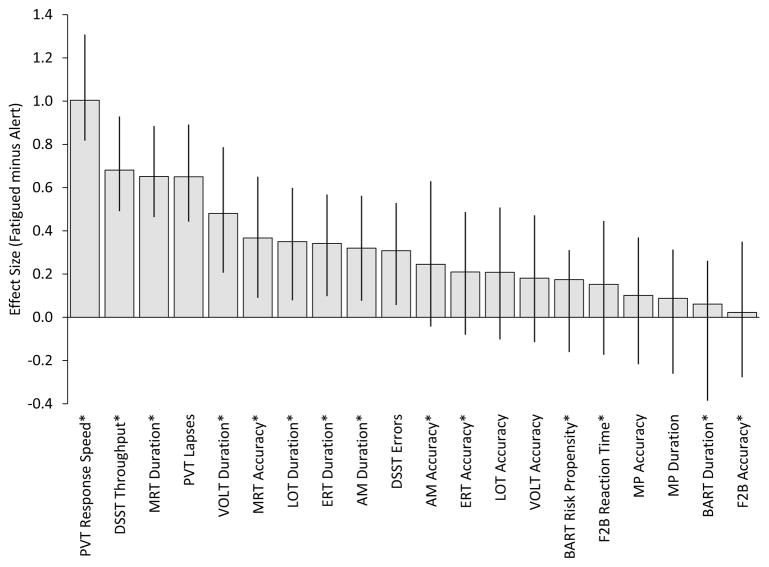
Results: Practice effects and test-retest variability differed substantially between the 10 Cognition tests, illustrating the importance of normative data that both reflect practice effects and differences in stimulus set difficulty in the population of interest. After one night without sleep, medium to large effect sizes were observed for 3 of the 10 tests addressing vigilant attention (Cohen's d = 1.00), cognitive throughput (d = 0.68), and abstract reasoning (d = 0.65).

Conclusions: In addition to providing neuroimaging-based novel information on the effects of spaceflight on a range of cognitive functions, Cognition will facilitate comparing the effects of ground-based analogues to spaceflight, increase consistency across projects, and thus enable meta-analyses.


Conflict of interest statement

All other authors declare no conflicts of interest related to the work presented in this manuscript.

Figures
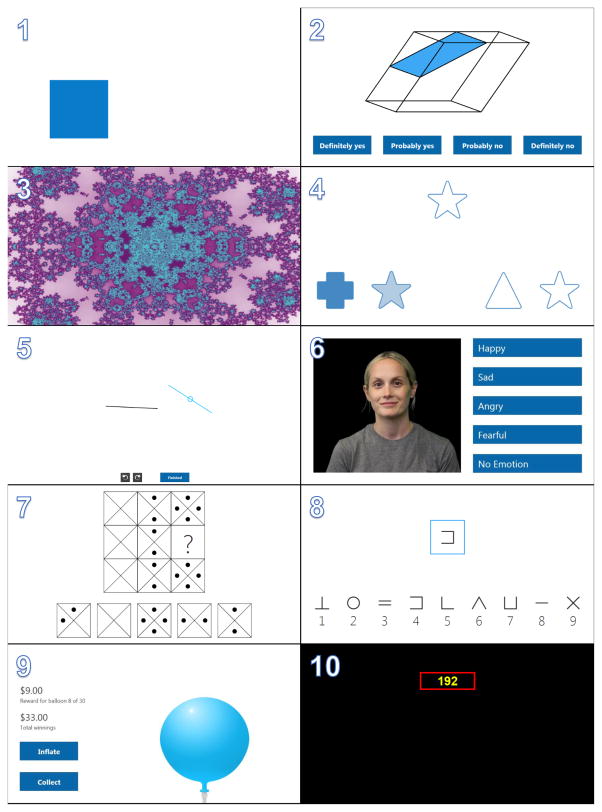
Figure 1
Figure 1
Screenshots of the 10 individual tests comprising the Cognition test battery. The tests are listed in the standard order of administration: 1) Motor Praxis (MP), 2) Visual Object Learning (VOLT); 3) Fractal 2-Back (F2B); 4) Abstract Matching (AM); 5) Line Orientation (LOT); 6) Emotion Recognition (ERT); 7) Matrix Reasoning (MRT); 8) Digit Symbol Substitution (DSST); 9) Balloon Analog Risk (BART); and 10) Psychomotor Vigilance (PVT).
Figure 2
Figure 2
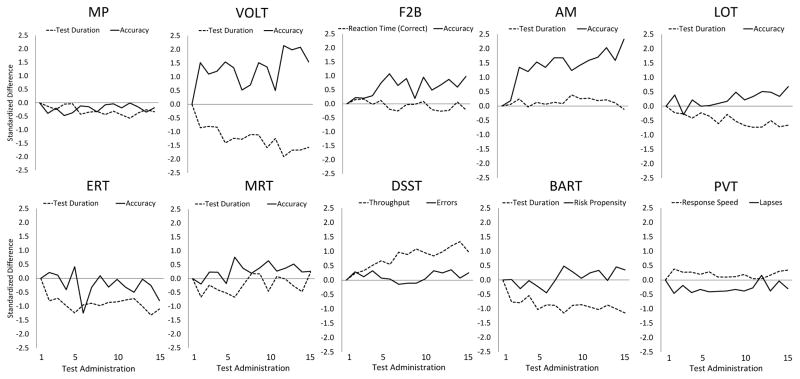
Changes in performance with repeated administration are shown for key accuracy and speed outcomes for each of the 10 Cognition tests. Data were sampled from 8 astronauts and astronaut candidates and 11 mission controllers who performed all 15 unique versions of the battery in the same order with 1–2 week intervals between test administrations. Mean and standard deviation of scores of the first test administration were used for standardization to facilitate comparisons across tests. Motor Praxis (MP); Visual Object Learning (VOLT); Fractal 2-Back (F2B); Abstract Matching (AM); Line Orientation (LOT); Emotion Recognition (ERT); Matrix Reasoning (MRT); Digit Symbol Substitution (DSST); Balloon Analog Risk (BART); Psychomotor Vigilance (PVT)
Figure 3
Figure 3
Effects of one night of acute total sleep deprivation on Cognition performance. Error bars represent 95% bootstrap confidence intervals based on 10,000 replications. * indicates that the effect size was multiplied by −1 to facilitate comparisons across variables. This study was approved by the Institutional Review Board of the University of Pennsylvania and subjects signed written informed consent prior to study participation.

References

    1. Banks S, Dinges DF. Behavioral and physiological consequences of sleep restriction. JClinSleep Med. 2007;3(5):519–28. - PMC - PubMed
    1. Barger LK, Flynn-Evans EE, Kubey A, Walsh L, Ronda JM, Wang W, et al. Prevalence of sleep deficiency and hypnotic use among astronauts before, during and after spaceflight: an observational study. Lancet Neurology. 2014;13(9):904–12. - PMC - PubMed
    1. Basner M, Dinges DF. Maximizing sensitivity of the Psychomotor Vigilance Test (PVT) to sleep loss. Sleep. 2011;34(5):581–91. - PMC - PubMed
    1. Basner M, Dinges DF. An adaptive duration version of the PVT accurately tracks changes in psychomotor vigilance induced by sleep restriction. Sleep. 2012;35(2):193–202. - PMC - PubMed
    1. Basner M, Mollicone DJ, Dinges DF. Validity and sensitivity of a brief Psychomotor Vigilance Test (PVT-B) to total and partial sleep deprivation. Acta Astronautica. 2011;69:949–59. - PMC - PubMed

Publication types