


A comparative analysis of Patient-Reported Expanded Disability Status Scale tools
- PMID: 26564998
- PMCID: PMC5015760
- DOI: 10.1177/1352458515616205
A comparative analysis of Patient-Reported Expanded Disability Status Scale tools
Abstract
Background: Patient-Reported Expanded Disability Status Scale (PREDSS) tools are an attractive alternative to the Expanded Disability Status Scale (EDSS) during long term or geographically challenging studies, or in pressured clinical service environments.
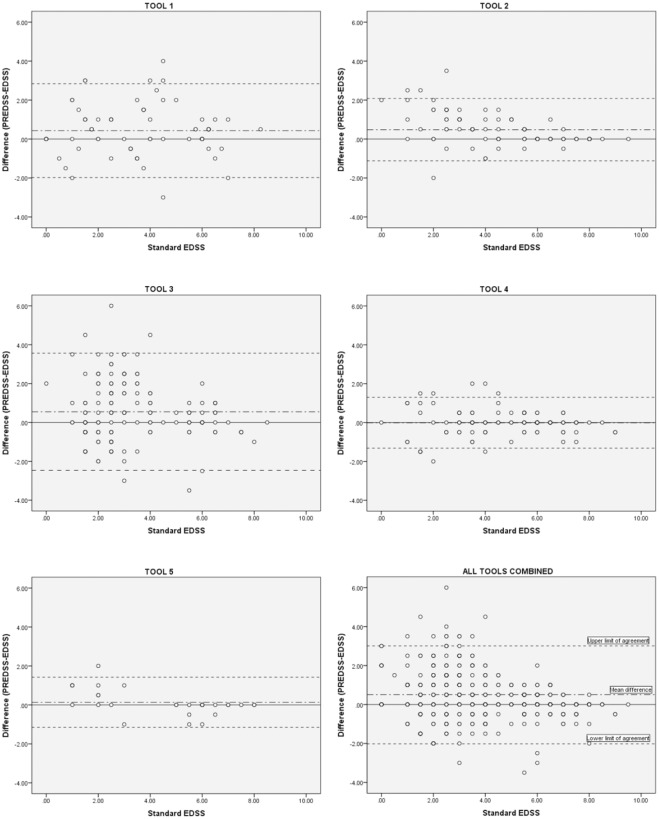
Objectives: Because the studies reporting these tools have used different metrics to compare the PREDSS and EDSS, we undertook an individual patient data level analysis of all available tools.
Methods: Spearman's rho and the Bland-Altman method were used to assess correlation and agreement respectively.
Results: A systematic search for validated PREDSS tools covering the full EDSS range identified eight such tools. Individual patient data were available for five PREDSS tools. Excellent correlation was observed between EDSS and PREDSS with all tools. A higher level of agreement was observed with increasing levels of disability. In all tools, the 95% limits of agreement were greater than the minimum EDSS difference considered to be clinically significant. However, the intra-class coefficient was greater than that reported for EDSS raters of mixed seniority. The visual functional system was identified as the most significant predictor of the PREDSS-EDSS difference.
Conclusion: This analysis will (1) enable researchers and service providers to make an informed choice of PREDSS tool, depending on their individual requirements, and (2) facilitate improvement of current PREDSS tools.
Keywords: Expanded disability status scale; Kurtzke scale; Neurostatus; Patient-reported Expanded Disability Status Scale; multiple sclerosis; patient reported; self administered.
© The Author(s), 2015.
Conflict of interest statement
The author(s) declared no potential conflicts of interest with respect to the research, authorship and/or publication of this article.
Figures
References
-
- Kurtzke JF. Rating neurologic impairment in multiple sclerosis: an expanded disability status scale (EDSS). Neurology 1983; 33: 1444–1452. - PubMed
-
- Kurtzke JF. A new scale for evaluating disability in multiple sclerosis. Neurology 1955; 5: 580–583. - PubMed
-
- Kappos L, D’Souza M, Lechner-Scott J, et al. On the origin of Neurostatus. Mult Scler Relat Disord 2015; 4: 182–185. - PubMed
-
- Bowen J, Gibbons L, Gianas A, et al. Self-administered Expanded Disability Status Scale with functional system scores correlates well with a physician-administered test. Mult Scler 2001; 7: 201–206. - PubMed
-
- Cheng EM, Hays RD, Myers LW, et al. Factors related to agreement between self-reported and conventional Expanded Disability Status Scale (EDSS) scores. Mult Scler 2001; 7: 405–410. - PubMed
Publication types
MeSH terms
LinkOut - more resources
Full Text Sources
Other Literature Sources
Medical
