


Blue-Green Algae Inhibit the Development of Atherosclerotic Lesions in Apolipoprotein E Knockout Mice
- PMID: 26566121
- PMCID: PMC4685491
- DOI: 10.1089/jmf.2015.0025
Blue-Green Algae Inhibit the Development of Atherosclerotic Lesions in Apolipoprotein E Knockout Mice
Abstract
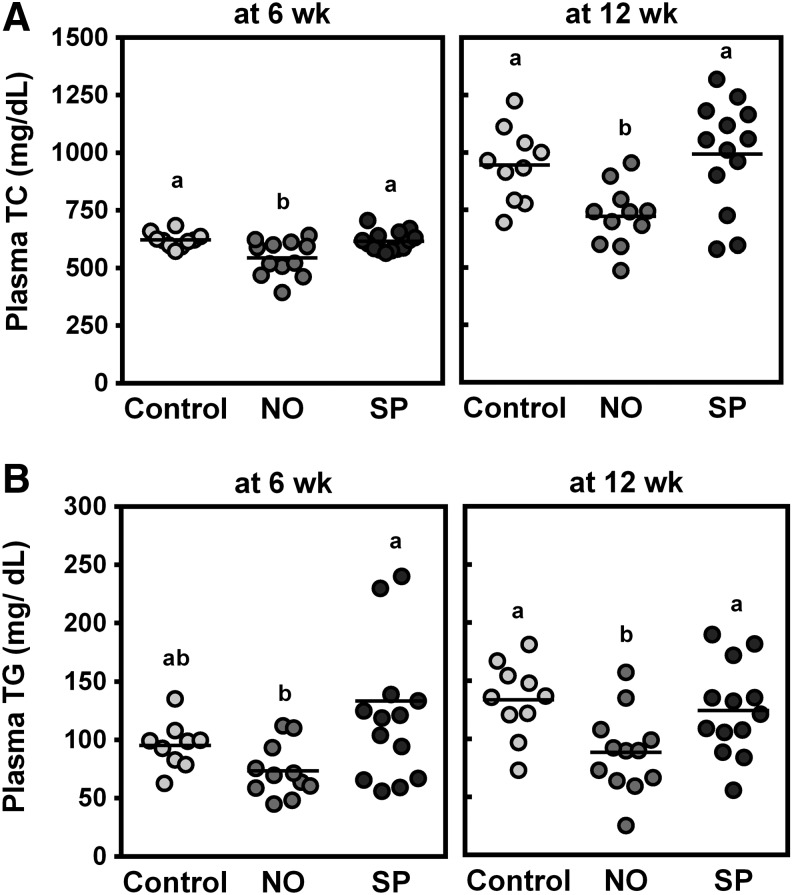
Hyperlipidemia and inflammation contribute to the development of atherosclerotic lesions. Our objective was to determine antiatherogenic effect of edible blue-green algae (BGA) species, that is, Nostoc commune var. sphaeroides Kützing (NO) and Spirulina platensis (SP), in apolipoprotein E knockout (ApoE(-/-)) mice, a well-established mouse model of atherosclerosis. Male ApoE(-/-) mice were fed a high-fat/high-cholesterol (HF/HC, 15% fat and 0.2% cholesterol by wt) control diet or a HF/HC diet supplemented with 5% (w/w) of NO or SP powder for 12 weeks. Plasma total cholesterol (TC) and triglycerides (TG) were measured, and livers were analyzed for histology and gene expression. Morphometric analysis for lesions and immunohistochemical analysis for CD68 were conducted in the aorta and the aortic root. NO supplementation significantly decreased plasma TC and TG, and liver TC, compared to control and SP groups. In the livers of NO-fed mice, less lipid droplets were present with a concomitant decrease in fatty acid synthase protein levels than the other groups. There was a significant increase in hepatic low-density lipoprotein receptor protein levels in SP-supplemented mice than in control and NO groups. Quantification of aortic lesions by en face analysis demonstrated that both NO and SP decreased aortic lesion development to a similar degree compared with control. While lesions in the aortic root were not significantly different between groups, the CD68-stained area in the aortic root was significantly lowered in BGA-fed mice than controls. In conclusion, both NO and SP supplementation decreased the development of atherosclerotic lesions, suggesting that they may be used as a natural product for atheroprotection.
Keywords: Nostoc commune var. sphaeroids kutzing; atherosclerosis; blue-green algae.
Figures


References
-
- Lakka HM, Laaksonen DE, Lakka TA, et al. : The metabolic syndrome and total and cardiovascular disease mortality in middle-aged men. JAMA 2002;288:2709–2716 - PubMed
-
- Ooi EMM, Barrett PHR, Watts GF: The extended abnormalities in lipoprotein metabolism in familial hypercholesterolemia: developing a new framework for future therapies. Int J Cardiol 2013;168:1811–1818 - PubMed
-
- Libby P, Ridker PM, Maseri A: Inflammation and atherosclerosis. Circulation 2002;105:1135–1143 - PubMed
-
- Weber C, Noels H: Atherosclerosis: current pathogenesis and therapeutic options. Nat Med 2011;17:1410–1422 - PubMed
Publication types
MeSH terms
Substances
Grants and funding
LinkOut - more resources
Full Text Sources
Other Literature Sources
Medical
Research Materials
Miscellaneous
