


Policies related to opioid agonist therapy for opioid use disorders: The evolution of state policies from 2004 to 2013
- PMID: 26566761
- PMCID: PMC4801690
- DOI: 10.1080/08897077.2015.1080208
Policies related to opioid agonist therapy for opioid use disorders: The evolution of state policies from 2004 to 2013
Abstract
Background: State Medicaid policies play an important role in Medicaid enrollees' access to and use of opioid agonists, such as methadone and buprenorphine, in the treatment of opioid use disorders. Little information is available, however, regarding the evolution of state policies facilitating or hindering access to opioid agonists among Medicaid enrollees.
Methods: During 2013-2014, we surveyed state Medicaid officials and other designated state substance abuse treatment specialists about their state's recent history of Medicaid coverage and policies pertaining to methadone and buprenorphine. We describe the evolution of such coverage and policies and present an overview of the Medicaid policy environment with respect to opioid agonist therapy from 2004 to 2013.
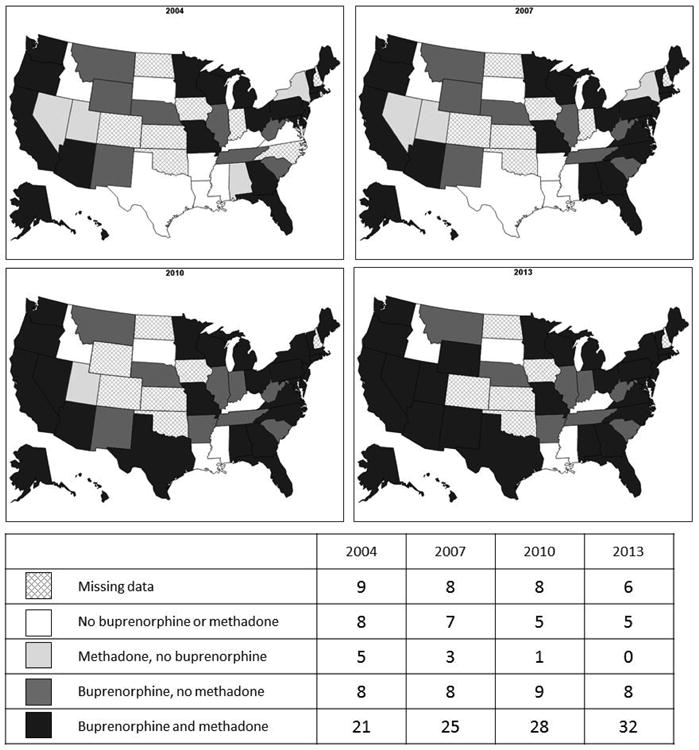
Results: Among our sample of 45 states with information on buprenorphine and methadone coverage, we found a gradual trend toward adoption of coverage for opioid agonist therapies in state Medicaid agencies. In 2013, only 11% of states in our sample (n = 5) had Medicaid policies that excluded coverage for methadone and buprenorphine, whereas 71% (n = 32) had adopted or maintained policies to cover both buprenorphine and methadone among Medicaid enrollees. We also noted an increase in policies over the time period that may have hindered access to buprenorphine and/or methadone.
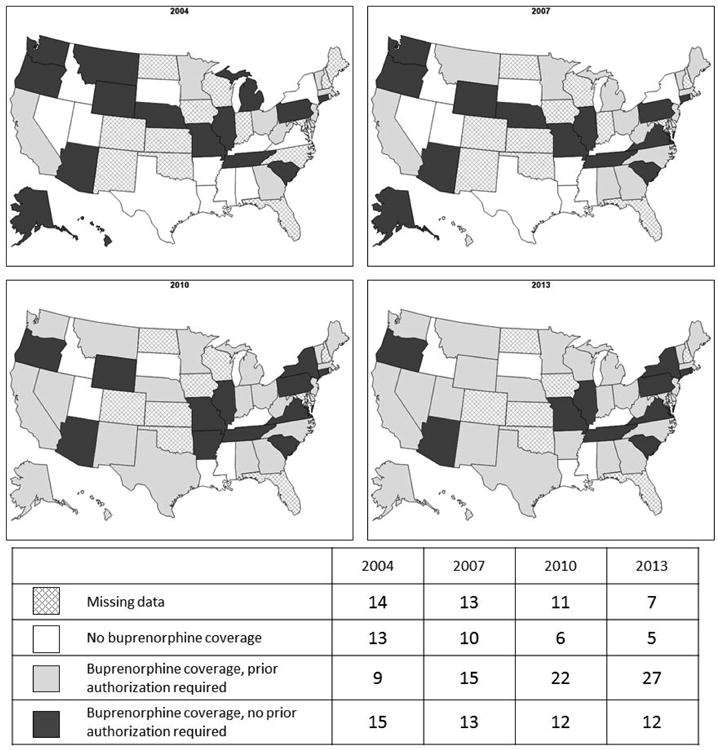
Conclusions: There appears to be a trend for states to enact policies increasing Medicaid coverage of opioid agonist therapies, while in recent years also enacting policies, such as prior authorization requirements, that potentially serve as barriers to opioid agonist therapy utilization. Greater empirical information about the potential benefits and potential unintended consequences of such policies can provide policymakers and others with a more informed understanding of their policy decisions.
Keywords: Buprenorphine; opioid use disorder; policy.
Figures
References
-
- Office of Applied Studies SAMHSA. The DASIS Report. [Accessed June 23, 2013];The national survey of substance abuse treatment services (N-SSATS) 2012 system http://www.oas.samhsa.gov/2k3/NSSATS/NSSATS.pdf.
-
- SAMHSA. HHS Publication No. (SMA) 13-4760, DAWN Series D-39. Rockville, MD: Substance Abuse and Mental Health Administration; 2013. Drug Abuse Warning Network, 2011: National Estimates of Drug-Related Emergency Department Visits.
-
- SAMHSA. Substance Use Disorders. [Accessed March 17, 2015];2014 http://www.samhsa.gov/disorders/substance-use.
-
- Fiellin DA, Pantalon MV, Chawarski MC, et al. Counseling plus buprenorphine-naloxone maintenance therapy for opioid dependence. N Engl J Med. 2006;355(4):365–374. - PubMed
-
- Fudala PJ, Bridge TP, Herbert S, et al. Office-based treatment of opiate addiction with a sublingual-tablet formulation of buprenorphine and naloxone. N Engl J Med. 2003;349(10):949–958. - PubMed
Publication types
MeSH terms
Substances
Grants and funding
LinkOut - more resources
Full Text Sources
Other Literature Sources
Medical
