


Monocyte unresponsiveness and impaired IL1β, TNFα and IL7 production are associated with a poor outcome in Malawian adults with pulmonary tuberculosis
- PMID: 26567164
- PMCID: PMC4643523
- DOI: 10.1186/s12879-015-1274-4
Monocyte unresponsiveness and impaired IL1β, TNFα and IL7 production are associated with a poor outcome in Malawian adults with pulmonary tuberculosis
Abstract
Background: Early death during TB treatment is associated with depressed TNFα response to antigenic stimulation and propensity to superadded bacterial infection. Hypothesising the role of monocyte unresponsiveness, we further compared the immunological profile between patients who died or suffered a life-threatening deterioration ('poor outcome') during the intensive phase of TB treatment with patients who had an uneventful clinical course ('good outcome') who had been recruited as part of a larger prospective cohort study of Malawian TB patients.
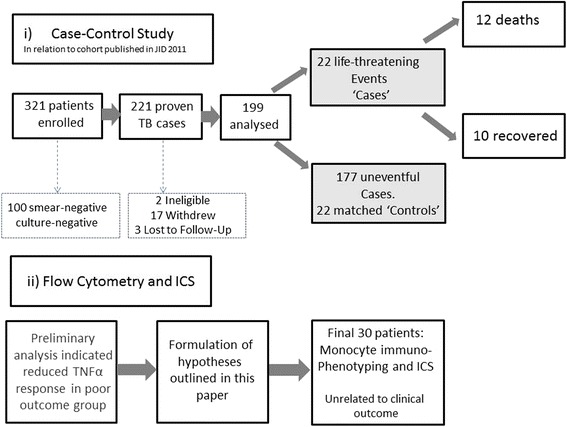
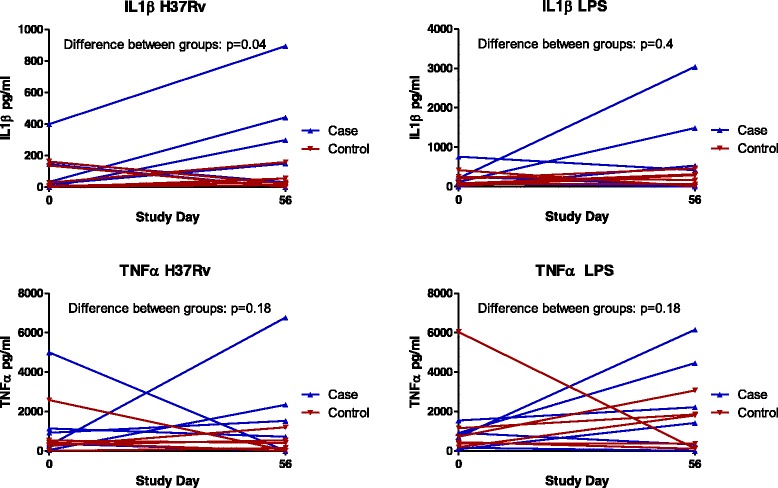
Methods: Using Luminex, IL1β, IL2, IL4, IL5, IL6, IL7, IL8, IL10, IL12, IL13, IL17, GCSF, GMCSF, MCP1, MIP1b, IFNγ and TNFα were measured in whole blood assay supernatants (stimulated with Mycobacterium tuberculosis H37Rv and LPS) and serum from 44 Malawian adult TB patients (22 of each outcome) immediately prior to commencing treatment, after 7 days and on day 56 of TB treatment. Monocyte surface expression of CD14, CD16, TLR2, TLR4, CD86 and HLADR, and intracellular TNFα were measured by flow cytometry as was intracellular TNFα response to purified TLR ligands.
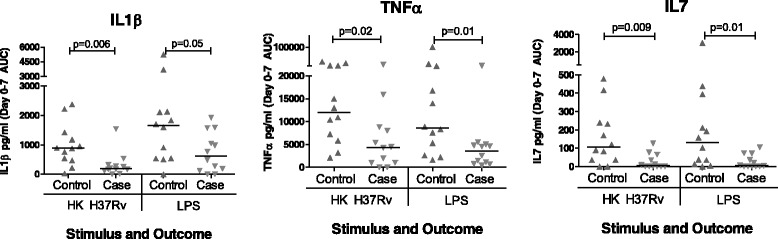
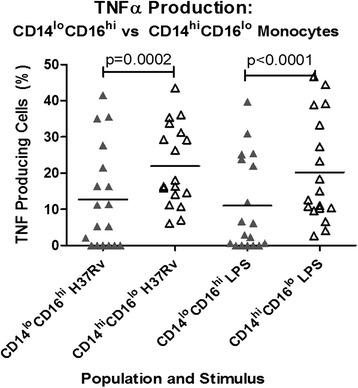
Results: Lower TB antigen-induced IL1β (p = 0.006), TNFα (p = 0.02) and IL7 (p = 0.009) were produced in the poor outcome group. TNFα was produced by 'classical' CD14(hi)CD16(lo) monocytes, with no correlation between this response and expression of monocyte surface markers. Response to TB antigens correlated with responses to the purified TLR 2, 3 and 4 ligands.
Conclusions: Dysregulated monocyte cytokine production was identified in TB patients with poor outcome. Lower TNFα responses to H37Rv paralleled lower responses to a panel of TLR ligands, suggesting an underlying perturbation in common TLR signalling pathways. Future work should explore the role of TLR polymorphisms in immune response and clinical outcome in TB patients.
Figures
References
-
- Asadullah K, Woiciechowsky C, Docke WD, Egerer K, Kox WJ, Vogel S, et al. Very low monocytic HLA-DR expression indicates high risk of infection--immunomonitoring for patients after neurosurgery and patients during high dose steroid therapy. Eur J Emerg Med. 1995;2:184–90. doi: 10.1097/00063110-199512000-00003. - DOI - PubMed
Publication types
MeSH terms
Substances
Grants and funding
LinkOut - more resources
Full Text Sources
Other Literature Sources
Research Materials
