


Host Genetic Control of the Microbiota Mediates the Drosophila Nutritional Phenotype
- PMID: 26567306
- PMCID: PMC4711117
- DOI: 10.1128/AEM.03301-15
Host Genetic Control of the Microbiota Mediates the Drosophila Nutritional Phenotype
Abstract
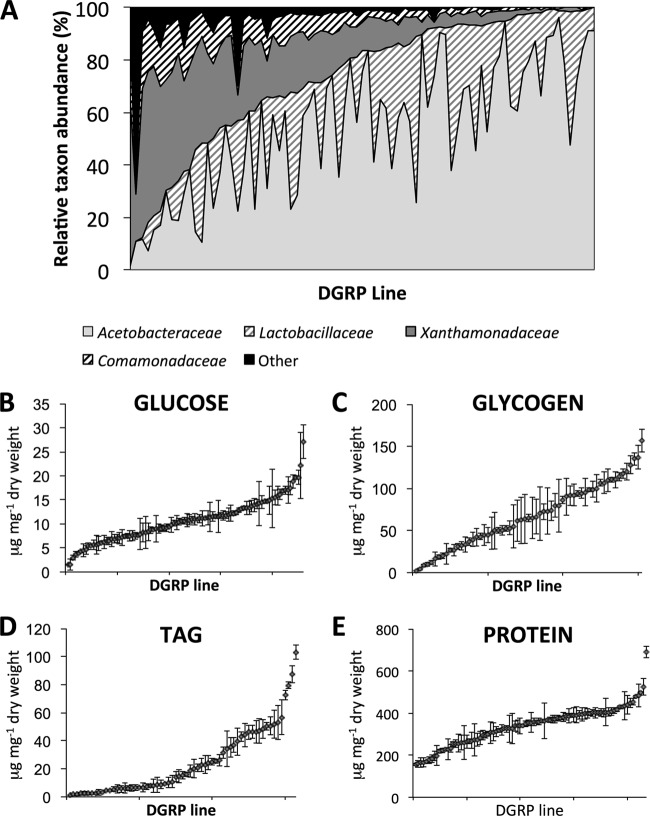
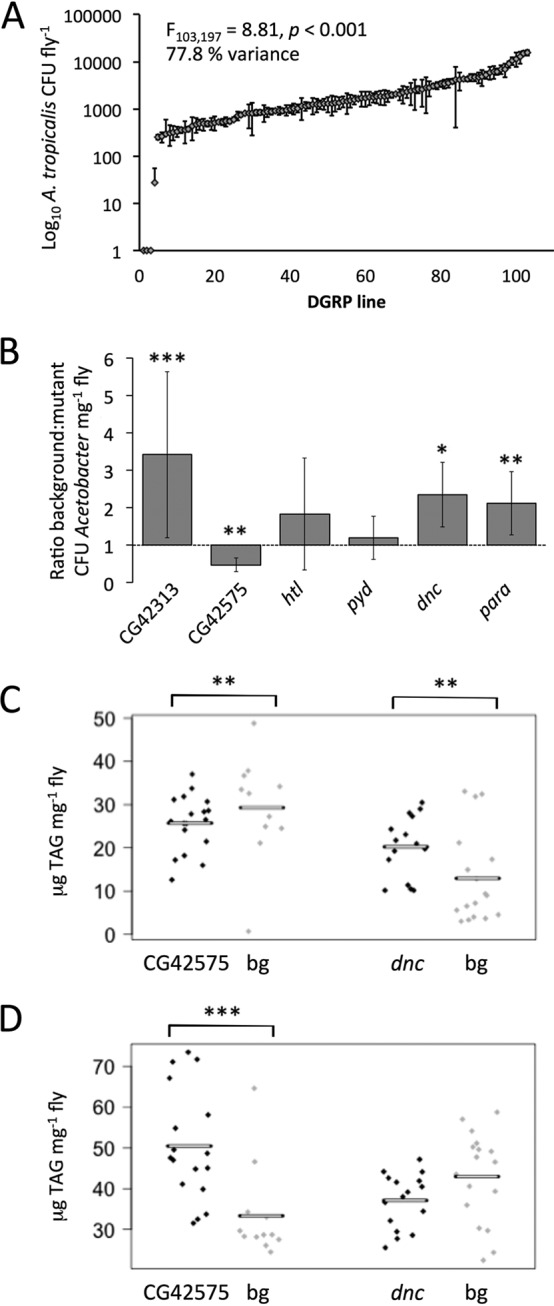
A wealth of studies has demonstrated that resident microorganisms (microbiota) influence the pattern of nutrient allocation to animal protein and energy stores, but it is unclear how the effects of the microbiota interact with other determinants of animal nutrition, including animal genetic factors and diet. Here, we demonstrate that members of the gut microbiota in Drosophila melanogaster mediate the effect of certain animal genetic determinants on an important nutritional trait, triglyceride (lipid) content. Parallel analysis of the taxonomic composition of the associated bacterial community and host nutritional indices (glucose, glycogen, triglyceride, and protein contents) in multiple Drosophila genotypes revealed significant associations between the abundance of certain microbial taxa, especially Acetobacteraceae and Xanthamonadaceae, and host nutritional phenotype. By a genome-wide association study of Drosophila lines colonized with a defined microbiota, multiple host genes were statistically associated with the abundance of one bacterium, Acetobacter tropicalis. Experiments using mutant Drosophila validated the genetic association evidence and reveal that host genetic control of microbiota abundance affects the nutritional status of the flies. These data indicate that the abundance of the resident microbiota is influenced by host genotype, with consequent effects on nutrient allocation patterns, demonstrating that host genetic control of the microbiome contributes to the genotype-phenotype relationship of the animal host.
Copyright © 2016, American Society for Microbiology. All Rights Reserved.
Figures
References
-
- McFall-Ngai M, Hadfield MG, Bosch TC, Carey HV, Domazet-Loso T, Douglas AE, Dubilier N, Eberl G, Fukami T, Gilbert SF, Hentschel U, King N, Kjelleberg S, Knoll AH, Kremer N, Mazmanian SK, Metcalf JL, Nealson K, Pierce NE, Rawls JF, Reid A, Ruby EG, Rumpho M, Sanders JG, Tautz D, Wernegreen JJ. 2013. Animals in a bacterial world, a new imperative for the life sciences. Proc Natl Acad Sci U S A 110:3229–3236. doi:10.1073/pnas.1218525110. - DOI - PMC - PubMed
-
- Venkatesh M, Mukherjee S, Wang H, Li H, Sun K, Benechet AP, Qiu Z, Maher L, Redinbo MR, Phillips RS, Fleet JC, Kortagere S, Mukherjee P, Fasano A, Le Ven J, Nicholson JK, Dumas ME, Khanna KM, Mani S. 2014. Symbiotic bacterial metabolites regulate gastrointestinal barrier function via the xenobiotic sensor PXR and Toll-like receptor 4. Immunity 41:296–310. doi:10.1016/j.immuni.2014.06.014. - DOI - PMC - PubMed
Publication types
MeSH terms
Grants and funding
LinkOut - more resources
Full Text Sources
Molecular Biology Databases
