. 2016 Feb;67(3):763-74.
doi: 10.1093/jxb/erv494. Epub 2015 Nov 12.

Integrated mapping and characterization of the gene underlying the okra leaf trait in Gossypium hirsutum L

Affiliations

Integrated mapping and characterization of the gene underlying the okra leaf trait in Gossypium hirsutum L

Qian-Hao Zhu et al. J Exp Bot. 2016 Feb.

Abstract

Diverse leaf morphology has been observed among accessions of Gossypium hirsutum, including okra leaf, which has advantages and disadvantages in cotton production. The okra leaf locus has been mapped to chromosome 15 of the Dt subgenome, but the underlying gene has yet to be identified. In this study, we used a combination of targeted association analysis, F2 population-based fine mapping, and comparative sequencing of orthologues to identify a candidate gene underlying the okra leaf trait in G. hirsutum. The okra leaf gene identified, GhOKRA, encoded a homeodomain leucine-zipper class I protein, whose closely related genes in several other plant species have been shown to be involved in regulating leaf morphology. The transcript levels of GhOKRA in shoot apices were positively correlated with the phenotypic expression of the okra leaf trait. Of the multiple sequence variations observed in the coding region among GrOKRA of Gossypium raimondii and GhOKRA-Dt of normal and okra/superokra leaf G. hirsutum accessions, a non-synonymous substitution near the N terminus and the variable protein sequences at the C terminus may be related to the leaf shape difference. Our results suggest that both transcription and protein activity of GhOKRA may be involved in regulating leaf shape. Furthermore, we found that non-reciprocal homoeologous recombination, or gene conversion, may have played a role in the origin of the okra leaf allele. Our results provided tools for further investigating and understanding the fundamental biological processes that are responsible for the cotton leaf shape variation and will help in the design of cotton plants with an ideal leaf shape for enhanced cotton production.

Keywords: Cotton (Gossypium spp.); fine mapping; homeodomain leucine-zipper class I transcription factor; non-reciprocal homoeologous recombination; okra leaf morphology; targeted association analysis..


Figures

Fig. 1.
Fig. 1.
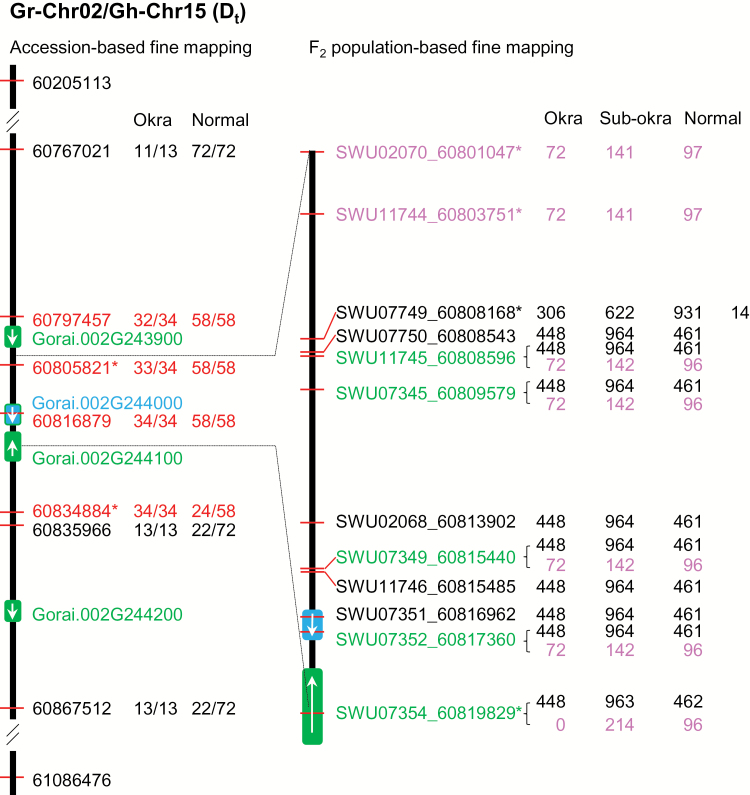
Fine mapping of the okra leaf locus in G. hirsutum. The okra leaf locus was mapped previously on Chr15 of G. hirsutum corresponding to the region between 60 205 113 and 61 086 476 on Chr02 of G. raimondii using an F7 recombinant inbred line population (Zhu et al., 2014). In this study, two strategies that used G. hirsutum accessions or F2 populations were used to fine map the okra leaf locus. In the accession-based approach, the okra leaf locus was first narrowed down to the region (~69kb) between 60 767 021 and 60 835 966 using 85 G. hirsutum accessions showing normal (n=72) or okra leaf (n=13) shape. Using SNP markers located within the ~69kb region and another set (n=92) of G. hirsutum accessions, the okra leaf locus was further mapped to the interval (between 60 805 821 and 60 834 884) with just two annotated genes, Gorai.002G244000 and Gorai.002G244100. In the F2-based genetic linkage analysis, the okra leaf locus was narrowed down to an ~12kb region (between SWU07749 and SWU07354) using two F2 populations. This interval contains only a single gene, i.e. Gorai.002G244000. The black vertical bars represent the chromosome. Green and blue boxes represent annotated genes. White arrows indicate the transcriptional direction of the genes. The numbers in the first column next to the black bars represent the coordinates of the SNP markers used in the CottonSNP63K (in black) and KASP (in red) assays, or of the SSR markers used in genotyping of the F2 populations. SSR markers in black and pink were unique to the RIL034×Yumian1 and RIL090×Jinnong08 populations, respectively, while those in green were common to the two populations. For the accession-based fine mapping, the numbers before and after the forward slash represent the number of G. hirsutum accessions with a consistent phenotype and genotype at the corresponding SNP position and the total number of G. hirsutum accessions showing okra or normal leaf shape, respectively. For the F2-based fine mapping, the number of plants with a genotype consistent with okra, subokra, and normal leaf shape are shown. For marker SWU07749, 14 plants did not have genotyping results. The markers with an asterisk (*) are the delimited ones for the okra leaf locus.
Fig. 2.
Fig. 2.
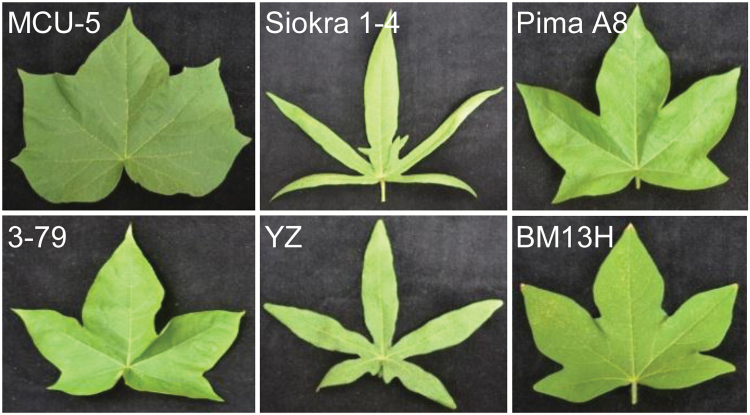
Representative mature leaves of some of the accessions used in this study. MCU-5 (normal) and Siokra 1-4 (okra) belong to G. hirsutum (AD1); Pima A8 and 3-79 (both are subokra) belong to G. barbadense (AD2); and YZ (okra) and BM13H (subokra) belong to G. arboreum (A2).
Fig. 3.
Fig. 3.
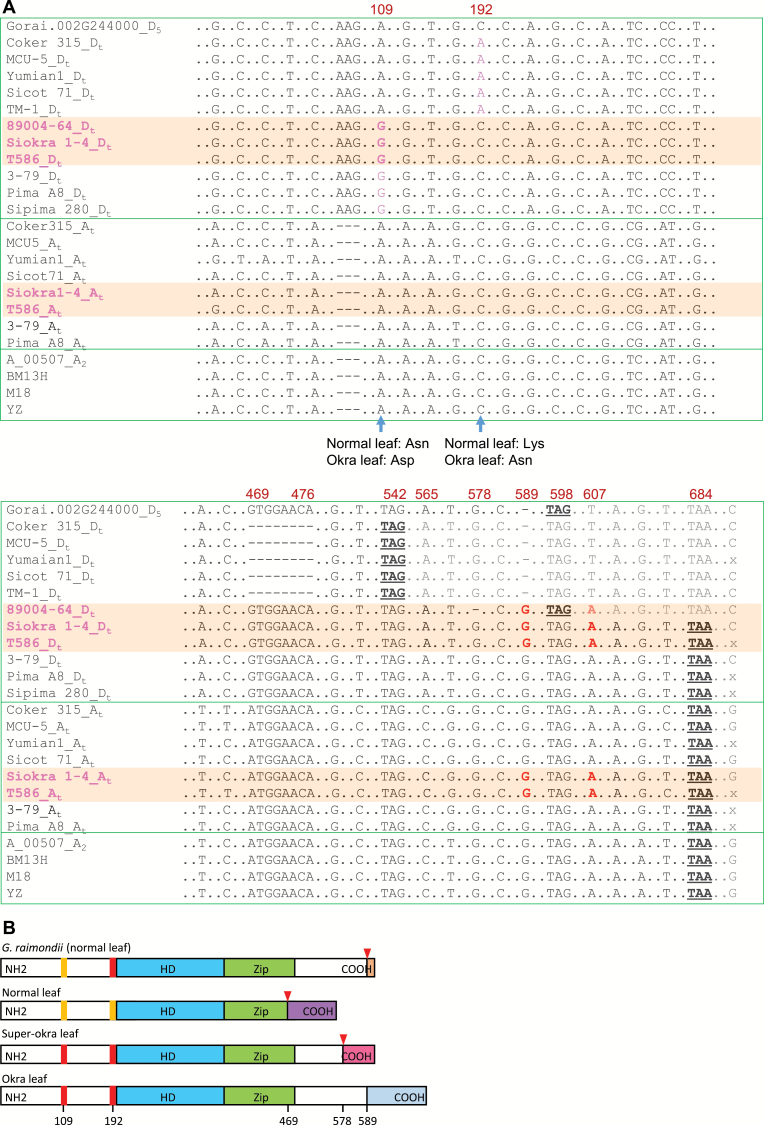
Comparison of the nucleotide and protein sequences of the okra leaf gene. (A) Alignment of the coding sequences of Gorai.002G244000 and its orthologues in other cotton species. Only the positions that are polymorphic between any two sequences are shown. Accession name followed by Dt (e.g. Coker 315_Dt) and At represents the Dt and At subgenome allele, respectively. Coker 315, MCU-5, Yumian1, Sicot 71, and TM-1 are normal leaf G. hirsutum accessions; 89004-64, Siokra 1-4, and T586 (shown in pink and highlighted) are superokra leaf or okra leaf G. hirsutum accessions. Pima A8, 3-79, and Sipima 280 are G. barbadense accessions showing the subokra leaf shape. YZ (okra), M18, and BM13H (subokra) are G. arboreum accessions. A dash represent a deletion. Stop codons are shown in bold and underlined. The Dt subgenome SNPs between the normal and okra leaf accessions and the SNPs suggesting the NRHR event are shown in pink and red, respectively. Positions shown on top of the sequences were based on GhOKRA-D t of Siokra 1-4, i.e. Siokra 1-4_Dt. An ‘x’ at the end of some sequences indicates that data were unavailable. (B) Schematic representation of GhOKRA-Dt from G. raimondii and normal, okra, and superokra leaf G. hirsutum accessions. Rectangles represent protein sequences with differences shown in different colours. The numbers at the bottom indicate the nucleotide locations of SNPs or indels. Red triangles indicate the positions of indel(s) that caused a frame shift of the okra leaf allele. HD, homeodomain; Zip, Zip domain.
Fig. 4.
Fig. 4.
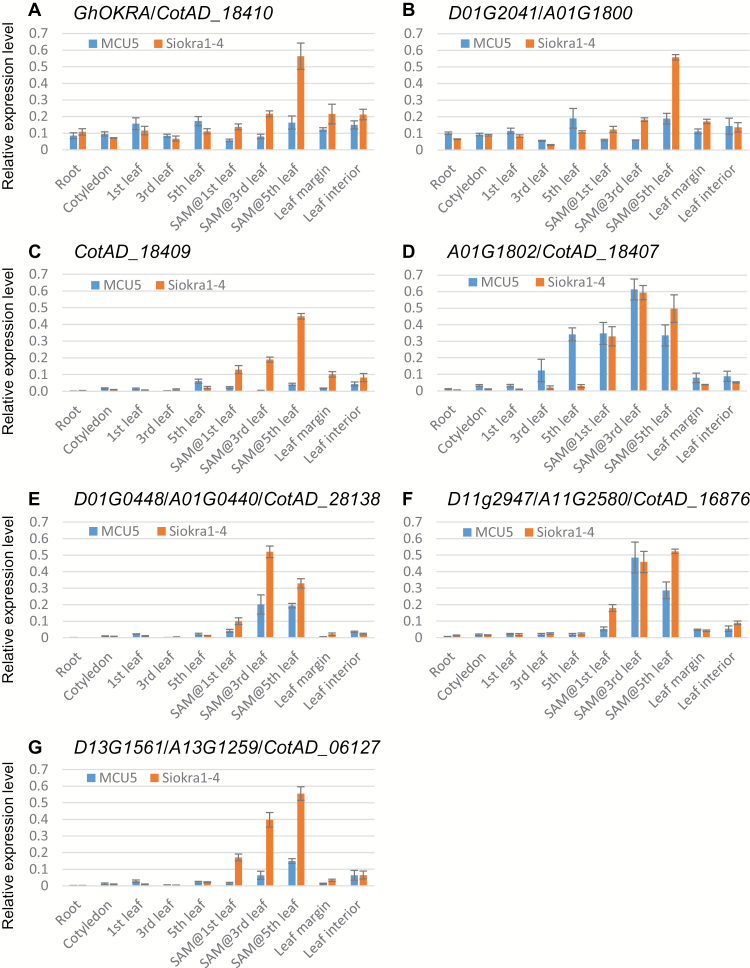
Expression levels of GhOKRA (A) and its neighbour genes (B–D) as well as cotton orthologues (E–G) of Arabidopsis CUC2 in normal (MCU-5) and okra leaf (Siokra 1-4) G. hirsutum accessions. For each gene except GhOKRA, primers were designed based on the D5 and A2 genome sequences to amplify both the Dt and At subgenome alleles. For GhOKRA, Dt- and At-specific primers were used, but expression was only detected in the Dt subgenome. Designation of the gene names was based on the BLAST search results using the corresponding D5 genes as queries to search against the annotated genes of the newly released G. hirsutum genomes (Li et al., 2015; Zhang et al., 2015). Genes shown in (A)–(G) are G. hirsutum orthologues of Gorai.002g244000, Gorai.002g23900, Gorai.002g244100, Gorai.002g244200, Gorai.002g067300, Gorai.007g323900, and Gorai.013g171300, respectively. For Gorai.002g23900, no corresponding gene was annotated in the G. hirsutum genome reported by Li et al. (2015). In the G. hirsutum genome reported by Zhang et al. (2015), the orthologue of Gorai.002g244100 was not annotated, and D01G2042 was found to be a combination of Gorai.002g244000 and Gorai.002g244200. Gorai.002g244200 is a homologue of Gorai.002g244000. Cotton ubiquitin gene (GenBank accession no. EU604080) was used as the reference. Data shown are the average of three biological replicates. Error bars represent standard deviation.

References

    1. Andries JA, Jones JE, Sloane LW, Marshall JG. 1969. Effects of okra leaf shape on boll rot, yield, and other important characters of Upland cotton, Gossypium hirsutum L. Crop Science 9, 705–710.
    1. Andres RJ, Bowman DT, Kaur B, Kuraparthy V. 2014. Mapping and genomic targeting of the major leaf shape gene (L) in Upland cotton (Gossypium hirsutum L.). Theoretical and Applied Genetics 127, 167–177. - PubMed
    1. Berger Y, Harpaz-Saad S, Brand A, Melnik H, Sirding N, Alvarez JP, Zinder M, Samach A, Eshed Y, Ori N. 2009. The NAC-domain transcription factor GOBLET specifies leaflet boundaries in compound tomato leaves. Development 136, 823–832. - PubMed
    1. Bilsborough GD, Runions A, Barkoulas M, Jenkins HW, Hasson A, Galinha C, Laufs P, Hay A, Prusinkiewicz P, Tsiantis M. 2011. Model for the regulation of Arabidopsis thaliana leaf margin development. Proceedings of the National Academy of Sciences, USA 108, 3424–3429. - PMC - PubMed
    1. Brachi B, Morris GP, Borevitz JO. 2011. Genome-wide association studies in plants: the missing heritability is in the field. Genome Biology 12, 232. - PMC - PubMed

Publication types