


Interventions for trachoma trichiasis
- PMID: 26568232
- PMCID: PMC4661324
- DOI: 10.1002/14651858.CD004008.pub3
Interventions for trachoma trichiasis
Abstract
Background: Trachoma is the leading infectious cause of blindness. The World Health Organization (WHO) recommends eliminating trachomatous blindness through the SAFE strategy: Surgery for trichiasis, Antibiotic treatment, Facial cleanliness and Environmental hygiene. This is an update of a Cochrane review first published in 2003, and previously updated in 2006.
Objectives: To assess the effects of interventions for trachomatous trichiasis for people living in endemic settings.
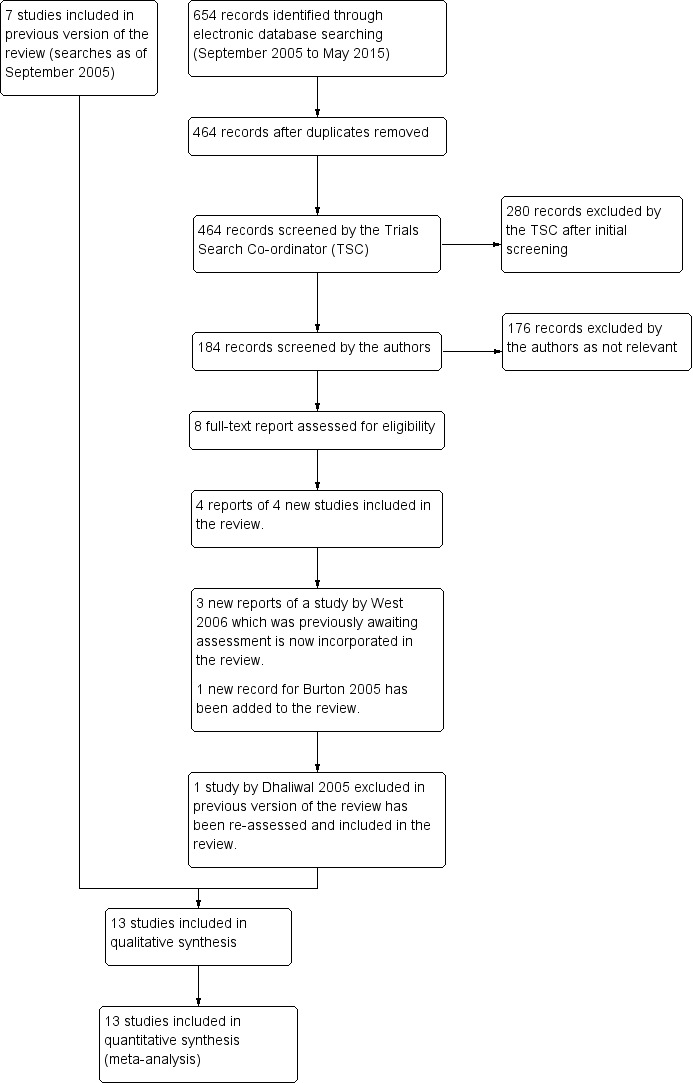
Search methods: We searched CENTRAL (which contains the Cochrane Eyes and Vision Group Trials Register) (2015, Issue 4), Ovid MEDLINE, Ovid MEDLINE In-Process and Other Non-Indexed Citations, Ovid MEDLINE Daily, Ovid OLDMEDLINE (January 1946 to May 2015), EMBASE (January 1980 to May 2015), the ISRCTN registry (www.isrctn.com/editAdvancedSearch), ClinicalTrials.gov (www.clinicaltrials.gov) and the WHO International Clinical Trials Registry Platform (ICTRP) (www.who.int/ictrp/search/en). We did not use any date or language restrictions in the electronic searches for trials. We last searched the electronic databases on 7 May 2015. We searched the reference lists of included studies to identify further potentially relevant studies. We also contacted authors for details of other relevant studies.
Selection criteria: We included randomised trials of any intervention intended to treat trachomatous trichiasis.
Data collection and analysis: Three review authors independently selected and assessed the trials, including the risk of bias. We contacted trial authors for missing data when necessary. Our primary outcome was post-operative trichiasis which was defined as any lash touching the globe at three months, one year or two years after surgery.
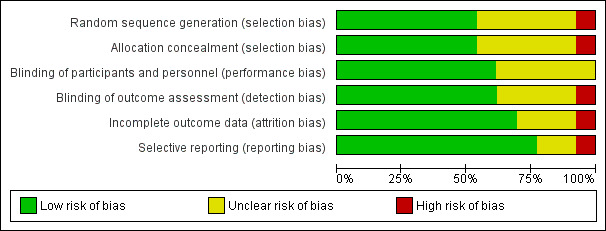
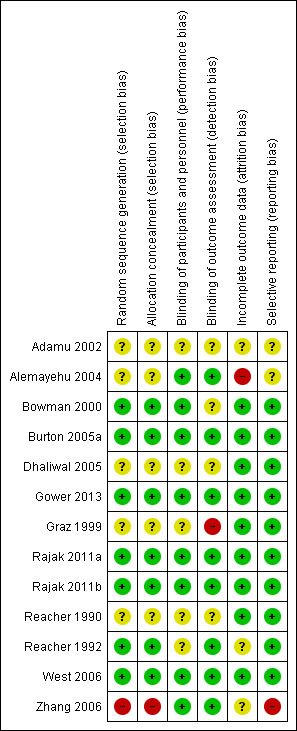
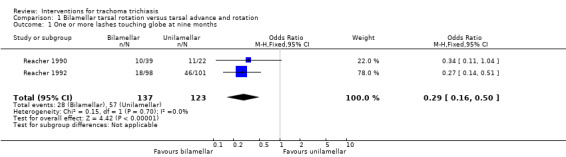
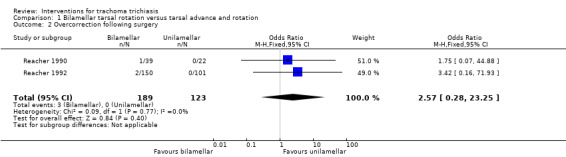
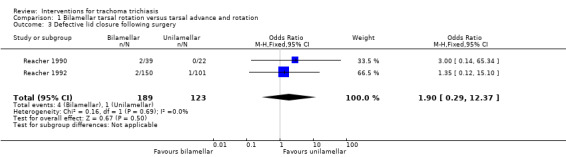
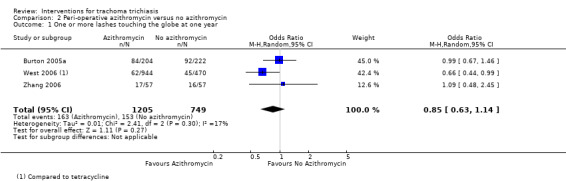
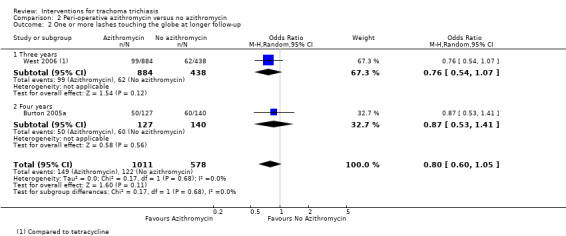
Main results: Thirteen studies met the inclusion criteria with 8586 participants. Most of the studies were conducted in sub-Saharan Africa. The majority of the studies were of a low or unclear risk of bias.Five studies compared different surgical interventions. Most surgical interventions were performed by non-physician technicians. These trials suggest the most effective surgery is full-thickness incision of the tarsal plate and rotation of the terminal tarsal strip. Pooled data from two studies suggested that the bilamellar rotation was more effective than unilamellar rotation (OR 0.29, 95% CI 0.16 to 0.50). Use of a lid clamp reduced lid contour abnormalities (OR 0.65, 95% CI 0.44 to 0.98) and granuloma formation (OR 0.67, 95% CI 0.46 to 0.97). Absorbable sutures gave comparable outcomes to silk sutures (OR 0.90, 95% CI 0.68 to 1.20) and were associated with less frequent granuloma formation (OR 0.63, 95% CI 0.40 to 0.99). Epilation was less effective at preventing eyelashes from touching the globe than surgery for mild trichiasis, but had comparable results for vision and corneal change. Peri-operative azithromycin reduced post-operative trichiasis; however, the estimate of effect was imprecise and compatible with no effect or increased trichiasis (OR 0.85, 95% CI 0.63 to 1.14; 1954 eyes; 3 studies). Community-based surgery when compared to health centres increased uptake with comparable outcomes. Surgery performed by ophthalmologists and integrated eye care workers was comparable. Adverse events were typically infrequent or mild and included rare postoperative infections, eyelid contour abnormalities and conjunctival granulomas.
Authors' conclusions: No trials were designed to evaluate whether the interventions for trichiasis prevent blindness as an outcome; however, several found modest improvement in vision following intervention. Certain interventions have been shown to be more effective at eliminating trichiasis. Full-thickness incision of the tarsal plate and rotation of the lash-bearing lid margin was found to be the best technique and is preferably delivered in the community. Surgery may be carried out by an ophthalmologist or a trained ophthalmic assistant. Surgery performed with silk or absorbable sutures gave comparable results. Post-operative azithromycin was found to improve outcomes where overall recurrence was low.
Conflict of interest statement
MJB was an investigator on three of the trials: Burton 2005a; Rajak 2011a; Rajak 2011b
EH was an investigator on two of the trials: Rajak 2011a; Rajak 2011b
EWG was an investigator on two of the trials: West 2006; Gower 2013
Figures
Update of
-
Interventions for trachoma trichiasis.Cochrane Database Syst Rev. 2006 Jul 19;(3):CD004008. doi: 10.1002/14651858.CD004008.pub2. Cochrane Database Syst Rev. 2006. Update in: Cochrane Database Syst Rev. 2015 Nov 13;(11):CD004008. doi: 10.1002/14651858.CD004008.pub3. PMID: 16856026 Updated.
References
References to studies included in this review
Adamu 2002 {published data only}
-
- Adamu Y, Alemayehu W. A randomized clinical trial of the success rates of bilamellar tarsal rotation and tarsotomy for upper eyelid trachomatous trichiasis. Ethiopian Medical Journal 2002;40(2):107‐14. - PubMed
Alemayehu 2004 {published data only}
-
- Alemayehu W, Melase M, Bejiga A, Worku A, Kebede W, Fantaye D. Surgery for trichiasis by ophthalmologists versus integrated eye workers: a randomized trial. Ophthalmology 2004;111(3):578‐84. - PubMed
Bowman 2000 {published data only}
-
- Bowman RJ, Soma OS, Alexander N, Milligan P, Rowley J, Faal H, et al. Should trichiasis surgery be offered in the village? A community randomised trial of village vs. health centre‐based surgery. Tropical Medicine and International Health 2000;5(8):528‐33. - PubMed
Burton 2005a {published data only}
Dhaliwal 2005 {published data only}
-
- Dhaliwal U, Monga PK, Gupta VP. Comparison of three surgical procedures of differing complexity in the correction of trachomatous upper lid entropion: a prospective study. Orbit 2005;23(4):227‐36. - PubMed
Gower 2013 {published data only}
-
- Gower EW, West SK, Harding JC, Cassard SD, Munoz BE, Othman MS, et al. Trachomatous trichiasis clamp vs standard bilamellar tarsal rotation instrumentation for trichiasis surgery. Archives of Ophthalmology 2013;131(3):294‐301. - PubMed
Graz 1999 {published data only}
-
- Graz B, Xu JM, Yao ZS, Han SR, Kok A. Trachoma: can trichiasis be treated with a sticking‐plaster? A randomized clinical trial in China. Tropical Medicine and International Health 1999;4(3):222‐8. - PubMed
Rajak 2011a {published data only}
Rajak 2011b {published data only}
Reacher 1990 {published data only}
Reacher 1992 {published data only}
-
- Reacher MH, Munoz B, Alghassany A, Daar AS, Elbualy M, Taylor HR. A controlled trial of surgery for trachomatous trichiasis of the upper lid. Archives of Ophthalmology 1992;110(5):667‐74. - PubMed
West 2006 {published data only}
-
- West SK, West ES, Alemayehu W, Melese M, Munoz B, Imeru A, et al. Single‐dose azithromycin prevents trichiasis recurrence following surgery: randomized trial in Ethiopia. Archives of Ophthalmology 2006;124(3):309‐14. - PubMed
Additional references
Bog 1993
Bowman 2002
-
- Bowman RJ, Faal H, Jatta B, Myatt M, Foster A. Longitudinal study of trachomatous trichiasis in The Gambia: barriers to acceptance of surgery. Investigative Ophthalmology and Visual Science 2002;43(4):936‐40. - PubMed
Burton 2005b
Burton 2010
Burton 2012
Courtright 1994
-
- Courtright P. Acceptance of surgery for trichiasis among rural Malawian women. East African Medical Journal 1994;71(12):803‐4. - PubMed
Ejere 2015
Emerson 2000
-
- Emerson PM, Cairncross S, Bailey RL, Mabey DC. Review of the evidence base for the 'F' and 'E' components of the SAFE strategy for trachoma control. Tropical Medicine and International Health 2000;5(8):515‐27. - PubMed
Evans 2011
Glanville 2006
Habtamu 2011
Higgins 2011
-
- Higgins JPT, Altman DG, Sterne JAC (editors). Chapter 8: Assessing risk of bias in included studies. In: Higgins JPT, Green S (editors). Cochrane Handbook for Systematic Reviews of Interventions Version 5.1.0 (updated March 2011). The Cochrane Collaboration, 2011. Available from www.cochrane‐handbook.org.
Hu 2013
Khandekar 2001
-
- Khandekar R, Mohammed AJ, Courtright P. Recurrence of trichiasis: a long‐term follow‐up study in the Sultanate of Oman. Ophthalmic Epidemiology 2001;8(2‐3):155‐61. - PubMed
Mariotti 2009
-
- Mariotti SP, Pascolini D, Rose‐Nussbaumer J. Trachoma: global magnitude of a preventable cause of blindness. British Journal of Ophthalmology 2009;93(5):563‐8. - PubMed
Merbs 2005
-
- Merbs SL, West SK, West ES. Pattern of recurrence of trachomatous trichiasis after surgery surgical technique as an explanation. Ophthalmology 2005;112(4):705‐9. - PubMed
Rabiu 2012
Rajak 2011
Rajak 2012
Rajak 2013
Ward 2005
-
- Ward ES, Mkocha H, Munoz B, Mabey D, Foster A, Bailey R, et al. Risk factors for post‐surgical trichiasis recurrence in a trachoma endemic area. Investigative Ophthalmology and Visual Science 2005;46(2):447‐53. - PubMed
West 1991
-
- West SK, Munoz B, Turner VM, Mmbaga BB, Taylor HR. The epidemiology of trachoma in central Tanzania. International Journal of Epidemiology 1991;20(4):1088‐92. - PubMed
West 1994
-
- West S, Lynch M, Munoz B, Katala S, Tobin S, Mmbaga BB. Predicting surgical compliance in a cohort of women with trichiasis. International Ophthalmology 1994;18(2):105‐9. - PubMed
West 2005
-
- West ES, Mkocha H, Munoz B, Mabey D, Foster A, Bailey R, et al. Risk factors for postsurgical trichiasis recurrence in a trachoma‐endemic area. Investigative Ophthalmology and Visual Science 2005;46(2):447‐453. - PubMed
WHO 2013
-
- World Health Organization. Trichiasis surgery for trachoma. apps.who.int/iris/bitstream/10665/101430/1/9789241548670_eng.pdf (accessed 23 September 2015).
Wolle 2011
Zhang 2004
-
- Zhang H, Kandel RP, Sharma B, Dean D. Risk factors for recurrence of post‐operative trichiasis: implications for trachoma blindness prevention. Archives of Ophthalmology 2004;122(4):511‐6. - PubMed
References to other published versions of this review
Yorston 2003
Publication types
MeSH terms
Substances
Grants and funding
LinkOut - more resources
Full Text Sources
Medical
Research Materials
Miscellaneous
