. 2015 Sep 20;8(Supple 2):1-13.
doi: 10.4137/BCI.S31353. eCollection 2015.

Arabinosylation Plays a Crucial Role in Extensin Cross-linking In Vitro

Affiliations

Arabinosylation Plays a Crucial Role in Extensin Cross-linking In Vitro

Yuning Chen et al. Biochem Insights. .

Abstract

Extensins (EXTs) are hydroxyproline-rich glycoproteins (HRGPs) that are structural components of the plant primary cell wall. They are basic proteins and are highly glycosylated with carbohydrate accounting for >50% of their dry weight. Carbohydrate occurs as monogalactosyl serine and arabinosyl hydroxyproline, with arabinosides ranging in size from ~1 to 4 or 5 residues. Proposed functions of EXT arabinosylation include stabilizing the polyproline II helix structure and facilitating EXT cross-linking. Here, the involvement of arabinosylation in EXT cross-linking was investigated by assaying the initial cross-linking rate and degree of cross-linking of partially or fully de-arabinosylated EXTs using an in vitro cross-linking assay followed by gel permeation chromatography. Our results indicate that EXT arabinosylation is required for EXT cross-linking in vitro and the fourth arabinosyl residue in the tetraarabinoside chain, which is uniquely α-linked, may determine the initial cross-linking rate. Our results also confirm the conserved structure of the oligoarabinosides across species, indicating an evolutionary significance for EXT arabinosylation.

Keywords: HRGP; RSH; arabinosylation; extensin; in vitro cross-linking; peroxidase; tomato P1.


Figures
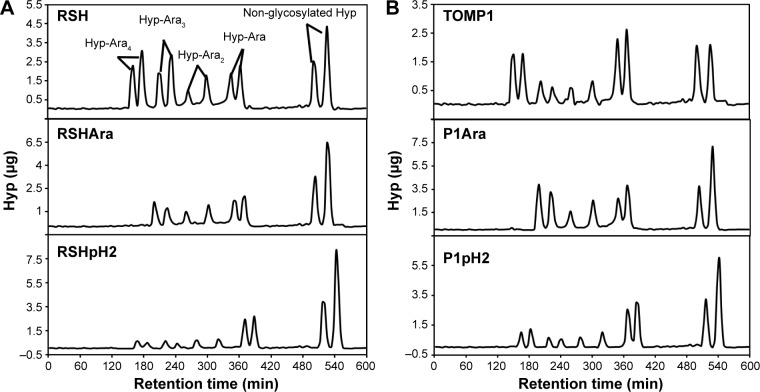
Figure 1
Figure 1
Hyp-Ara profiling of partially deglycosylated EXTs. (A) Top to bottom: RSH, RSHAra, and RSHpH2; (B) top to bottom: TOMP1, P1Ara, and P1pH2. Each Hyp-arabinosides were present in two peaks due to two configurations of Hyp (cis or trans) generated during base hydrolysis. The Hyp-Ara4 peaks disappeared after α-arabinofuranosidase treatment, while some Hyp-Ara4 glycans were still present after pH 2.0 HCl deglycosylation. See Table 2 for Hyp-oligoarabinan content quantification in each sample.
Figure 2
Figure 2
Superose 6 size exclusion chromatography profiles of the cross-linking of deglycosylated RSH. Left to right: native RSH (control), RSH treated with arabinofuranosidase (RSHAra) and pH 2.0 HCl (RSHpH2), respectively. A conversion of monomers to oligomers with the increase of cross-linking time is observed. The two peaks after 100 minutes were contributed by buffer and 2-mercaptoethanol.
Figure 3
Figure 3
Superose 6 size exclusion chromatography profiles of the cross-linking of deglycosylated TOMP1. Left to right: native TOMP1 (control), TOMP1 treated with arabinofuranosidase (P1Ara) and pH 2.0 HCl (P1pH2), respectively. A conversion of monomers to oligomers with the increase of cross-linking time is observed. The two peaks after 100 minutes were contributed by buffer and 2-mercaptoethanol.
Figure 4
Figure 4
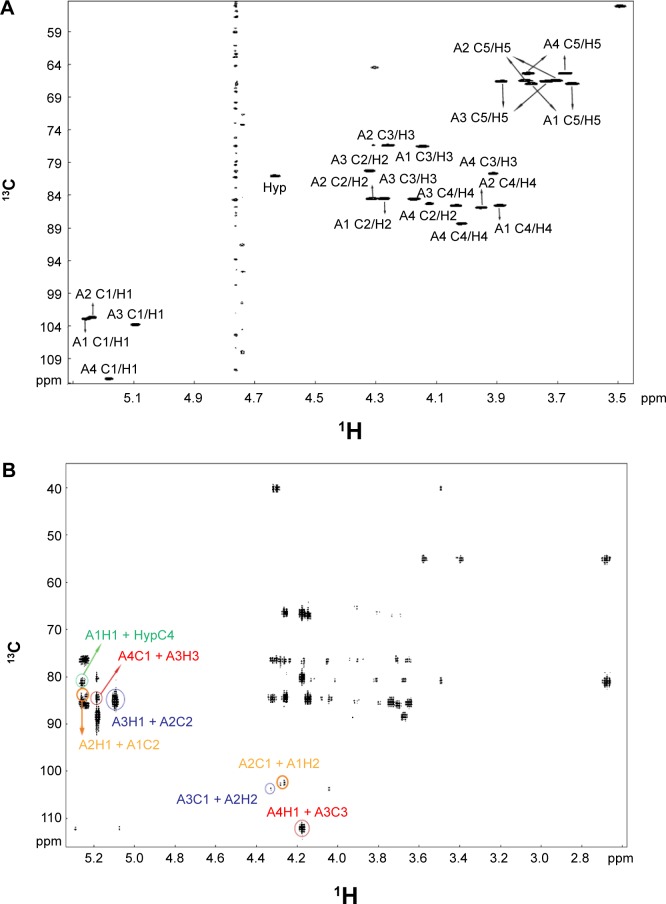
Structure elucidation of RSH Hyp-Ara4. (A) HSQC spectrum: cross-peaks identified the chemical shifts of each carbon atom and its corresponding hydrogen atom(s) in each arabinose ring system. A4 is the fourth Ara at the non-reducing end of the Hyp-Ara4 chain, while A1 occupies the reducing end and is attached to Hyp (first Ara in the chain). A2 and A3 are the second and third Ara of the chain. The A1 C1/H1 label indicates the cross-peak arising from the chemical shifts of the anomeric carbon (C1) and its corresponding hydrogen (H1) on the A1 residue. The cross-peaks for the other carbon atoms and their corresponding hydrogens of A1 and the cross-peaks for A2 to A4 are similarly labeled. Two cross-peaks are observed for the fifth carbon atoms on each ring system due to their possession of two corresponding hydrogen atoms. (B) HMBC spectrum: the cross-peaks arising from A4H1(5.2 ppm) + A3C3(84.6 ppm) and A4C1(112.1 ppm) + A3H3(4.2 ppm), highlighted by red circles, established the α-Araf-(1→3)-β-Araf linkage between A4 and A3; cross-peaks arising from A3H1(5.1 ppm) + A2C2(84.5 ppm) and A3C1(103.8 ppm) + A2H2(4.3 ppm), highlighted by blue circles, established the β-Araf-(1→2)-β-Araf linkage between A3 and A2; cross-peaks arising from A2H1(5.2 ppm) + A1C2(84.5 ppm) and A2C1(102.7 ppm) + A1H2(4.3 ppm), highlighted by orange circles, established the β-Araf-(1→2)-β-Araf linkage between A2 and A1, and cross-peak arising from A1H1(5.3 ppm) + HypC4 (81.1 ppm), highlighted by the green circle, established the β-Araf-(1→4)-Hyp linkage between A1 and Hyp. The chemical shifts of the cross-peaks are summarized in Table 5.
Figure 5
Figure 5
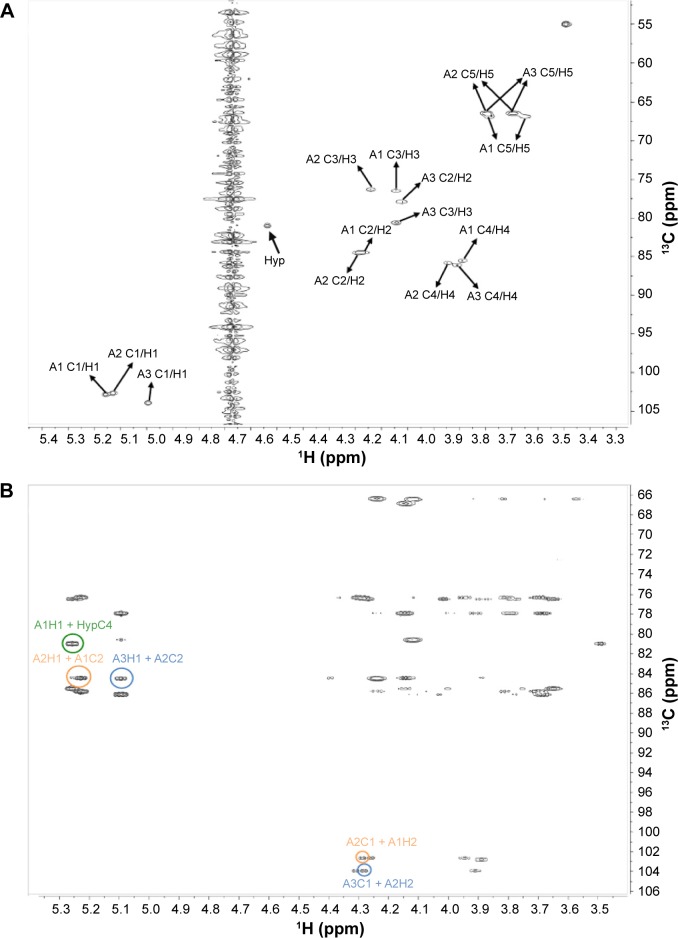
Structure elucidation of RSH Hyp-Ara3. (A) HSQC spectrum: cross-peaks identified the chemical shifts of each carbon atom and its corresponding hydrogen atom(s) in each arabinose ring system. A3 is the third Ara at the nonreducing end of the Hyp-Ara3 chain, while A1 occupies the reducing end and is attached to Hyp (first Ara in the chain). A2 is the second Ara of the chain. The A1 C1/H1 label indicates the cross-peak arising from the chemical shifts of the anomeric carbon (C1) and its corresponding hydrogen (H1) on the A1 residue. The cross-peaks for the other carbon atoms and their corresponding hydrogens of A1 and the cross-peaks for A2 to A3 are similarly labeled. Two cross-peaks are observed for the fifth carbon atoms on each ring system due to their possession of two corresponding hydrogen atoms. There are overlapping signals between the cross-peaks from A1 C2/H2 and A2 C2/H2 and those from A2 C5/H5 and A3 C5/H5 due to their identical chemical shifts (Table 5). (B) HMBC spectrum: cross-peaks arising from A3H1(5.1 ppm) + A2C2(84.5 ppm) and A3C1(103.9 ppm) + A2H2(4.3 ppm), highlighted by blue circles, established the β-Araf-(1→2)-β-Araf linkage between A3 and A2; cross-peaks arising from A2H1(5.2 ppm) + A1C2(84.5 ppm) and A2C1(102.7 ppm) + A1H2(4.3 ppm), highlighted by orange circles, established the β-Araf-(1→2)-β-Araf linkage between A2 and A1, and cross-peak arising from A1H1(5.3 ppm) + HypC4(81.0 ppm), highlighted by the green circle, established the β-Araf-(1→4)-Hyp linkage between A1 and Hyp. The chemical shifts are summarized in Table 5.
Figure 6
Figure 6
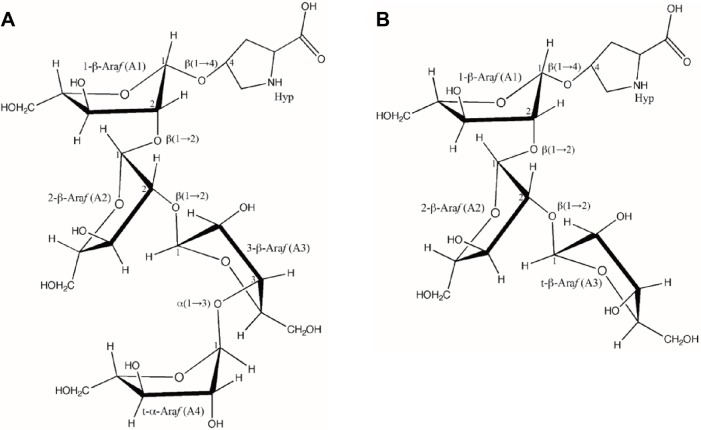
Characterized primary structure of RSH Hyp-Ara4 and Hyp-Ara3. Each arabinose residue is labeled corresponding to those in Table 5 with their anomeric configurations. The glycosidic linkages between arabinose residues and with Hyp are labeled according to the HMBC data (Figs. 4 and 5) with carbon numbers indicating the C atoms involved in the linkages.

References

    1. Lamport DTA, Kieliszewski MJ, Chen Y, Cannon MC. Role of the extensin superfamily in primary cell wall architecture. Plant Physiol. 2011;156:11–19. - PMC - PubMed
    1. Lamport DTA, Northcote DH. Hydroxyproline in primary cell walls of higher plants. Nature. 1960;188:665–666.
    1. Goodenough UW, Heuser JE. The Chlamydomonas cell wall and its constituent glycoprotein analyzed by the quick-freeze, deep-etch technique. J Cell Biol. 1985;101:1550–1568. - PMC - PubMed
    1. Goodenough UW, Gebhart B, Mecham RP, Heuser JE. Crystals of the Chlamydomonas reinhardtii cell wall: polymerization, depolymerization and purification of glycoprotein monomers. J Cell Biol. 1986;103:405–417. - PMC - PubMed
    1. Sadava D, Chrispeels MJ. Hydroxyproline-rich cell wall protein (extensin): role in the cessation of elongation in excised pea epicotyls. Dev Biol. 1973;30:49–55. - PubMed

LinkOut - more resources