


Advances and Concepts in Cervical Cancer Trials: A Road Map for the Future
- PMID: 26569057
- PMCID: PMC4831060
- DOI: 10.1097/IGC.0000000000000587
Advances and Concepts in Cervical Cancer Trials: A Road Map for the Future
Abstract
Objective: Cervical cancer is responsible for more than a quarter of a million deaths globally each year, mostly in developing countries, making therapeutic advances in all health care settings a top priority. The Gynecologic Cancer InterGroup (GCIG) is a worldwide collaboration of leading national research groups that develops and promotes multinational trials in gynecologic cancer. In recognition of the pressing need for action, the GCIG convened an international meeting with expert representation from the GCIG groups and selected large sites in low- and middle-income countries.
Methods: The focus was to develop a consensus on several concepts for future clinical trials, which would be developed and promoted by the GCIG and launched with major international participation. The first half of the meeting was devoted to a resume of the current state of the knowledge and identifying the gaps in need of new evidence, validating control arms for present and future clinical trials and identifying national and international barriers for studies of cervix cancers. The second half of the meeting was concerned with achieving consensus on a path forward.
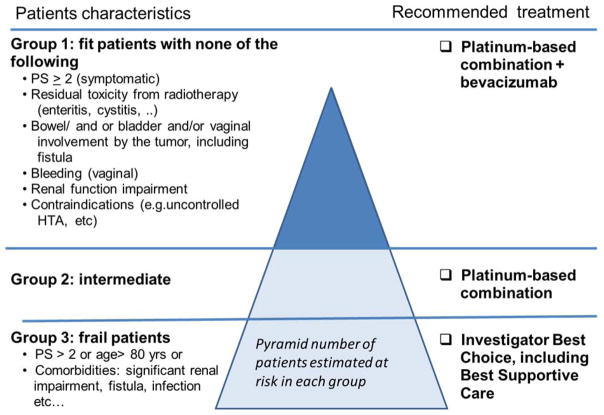
Results and conclusions: There were 5 principal outcomes as follows: first, a proposal to expand fertility-preserving options with neoadjuvant chemotherapy; second, validation of the assessment of sentinel lymph nodes using minimally invasive surgery with an emphasis on identification and management of low-volume metastasis, such as isolated tumor cells and micrometastasis; third, evaluation of hypofractionation for palliative and curative radiation under the umbrella of the GCIG Cervix Cancer Research Network; fourth, adding to the advances in antiangiogenesis therapy in the setting of metastatic disease; and fifth, developing a maintenance study among women at high risk of relapse. The latter 2 systemic interventions could study PI3K (phosphatidylinositol-3-kinase) inhibitors, immunotherapy, anti-human papillomavirus approaches, or novel antiangiogenic agents/combinations.
Conflict of interest statement
The authors declare no conflicts of interest.
To be completed once all journal COIs are returned.
Figures
References
-
- Temple R. A regulatory authority’s opinion about surrogate endpoints. In: Nimmo W, Tucker G, editors. Clinical measurement in drug evaluation. West Sussex, England: Wiley; 1995. pp. 3–21.
-
- Vercellino GF, Piek JM, Schneider A, et al. Laparoscopic lymph node dissection should be performed before fertility preserving treatment of patients with cervical cancer. Gynecol Oncol. 2012;126:325–329. - PubMed
-
- Plante M. Bulky Early-Stage Cervical Cancer (2–4 cm Lesions): Upfront Radical Trachelectomy or Neoadjuvant Chemotherapy Followed by Fertility-Preserving Surgery: Which Is the Best Option? Int J Gynecol Cancer. 2015;25:722–728. - PubMed
-
- Lecuru F, Mathevet P, Querleu D, et al. Bilateral Negative Sentinel Nodes Accurately Predict Absence of Lymph Node Metastasis in Early Cervical Cancer: Results of The SENTICOL Study. J Clin Oncol. 2011;29:1686–1691. - PubMed
Publication types
MeSH terms
Grants and funding
LinkOut - more resources
Full Text Sources
Other Literature Sources
Medical
