


Identification of Differentially Expressed IGFBP5-Related Genes in Breast Cancer Tumor Tissues Using cDNA Microarray Experiments
- PMID: 26569312
- PMCID: PMC4690035
- DOI: 10.3390/genes6041201
Identification of Differentially Expressed IGFBP5-Related Genes in Breast Cancer Tumor Tissues Using cDNA Microarray Experiments
Abstract
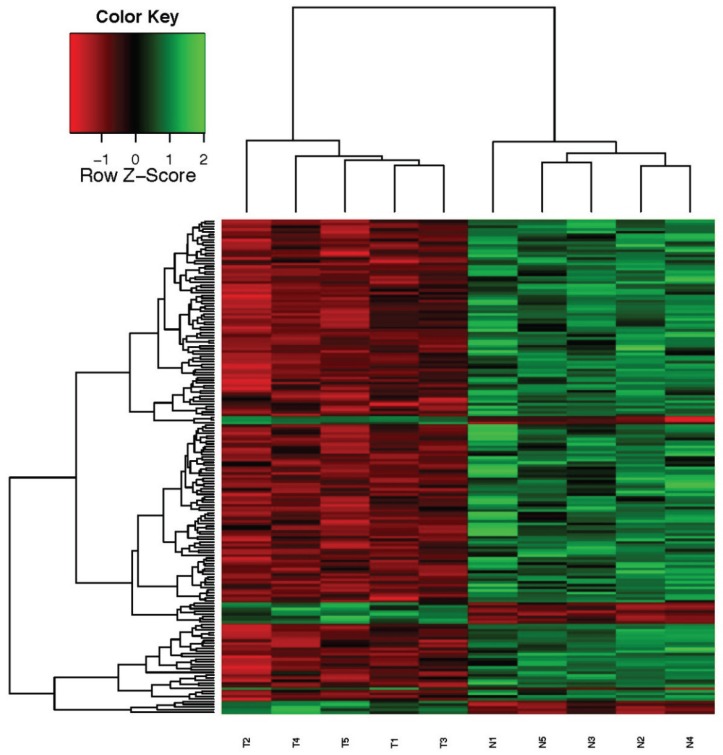
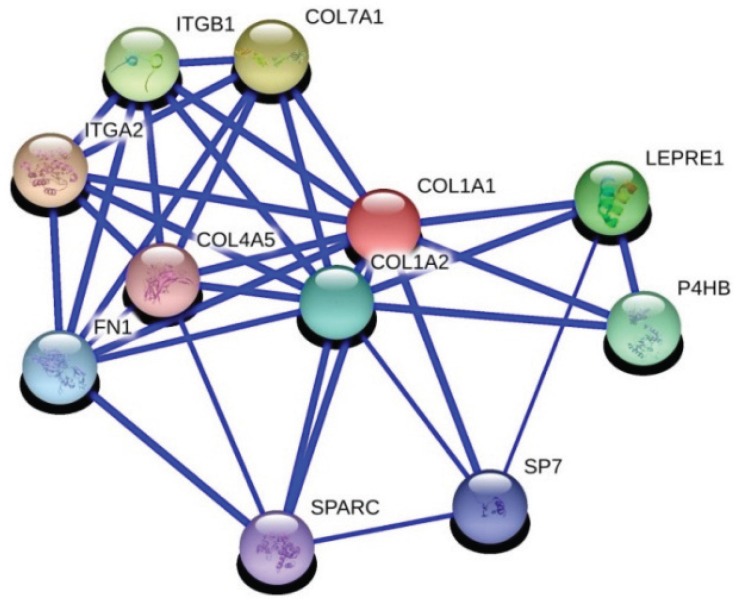
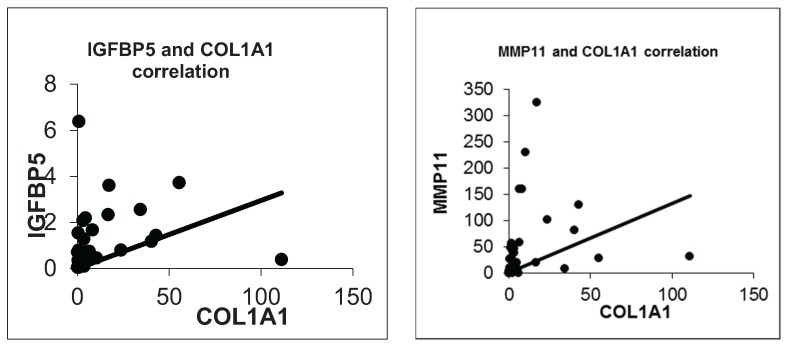
IGFBP5 is an important regulatory protein in breast cancer progression. We tried to identify differentially expressed genes (DEGs) between breast tumor tissues with IGFBP5 overexpression and their adjacent normal tissues. In this study, thirty-eight breast cancer and adjacent normal breast tissue samples were used to determine IGFBP5 expression by qPCR. cDNA microarrays were applied to the highest IGFBP5 overexpressed tumor samples compared to their adjacent normal breast tissue. Microarray analysis revealed that a total of 186 genes were differentially expressed in breast cancer compared with normal breast tissues. Of the 186 genes, 169 genes were downregulated and 17 genes were upregulated in the tumor samples. KEGG pathway analyses showed that protein digestion and absorption, focal adhesion, salivary secretion, drug metabolism-cytochrome P450, and phenylalanine metabolism pathways are involved. Among these DEGs, the prominent top two genes (MMP11 and COL1A1) which potentially correlated with IGFBP5 were selected for validation using real time RT-qPCR. Only COL1A1 expression showed a consistent upregulation with IGFBP5 expression and COL1A1 and MMP11 were significantly positively correlated. We concluded that the discovery of coordinately expressed genes related with IGFBP5 might contribute to understanding of the molecular mechanism of the function of IGFBP5 in breast cancer. Further functional studies on DEGs and association with IGFBP5 may identify novel biomarkers for clinical applications in breast cancer.
Keywords: IGFBP5; breast cancer; gene expression profiling; microarray; pathway analysis.
Figures
References
-
- Mita K., Zhang Z., Ando Y., Toyama T., Hamaguchi M., Kobayashi S., Hayashi S.I., Fujii Y., Iwase H., Yamashita H. Prognostic significance of insulin like growth factor binding protein (IGFBP)-4 and IGFBP-5 expression in breast cancer. J. Clin. Oncol. 2007;37:575–582. - PubMed
-
- Pekonen F., Nyman T., Ilvesmaki V., Partanen S. Insulin-like growth factor binding proteins in human breast cancer tissue. Cancer Res. 1992;52:5204–5207. - PubMed
-
- Perks C.M., Bowen S., Gill Z.P., Newcomb P.V., Holly J.M. Differential IGF-independent effects of insulin-like growth factor binding proteins (1–6) on apoptosis of breast epithelial cells. J. Cell Biochem. 1999;75:652–664. doi: 10.1002/(SICI)1097-4644(19991215)75:4<652::AID-JCB11>3.0.CO;2-0. - DOI - PubMed
LinkOut - more resources
Full Text Sources
Other Literature Sources
Miscellaneous
