. 2015 Nov 16;10(11):e0142867.
doi: 10.1371/journal.pone.0142867. eCollection 2015.

Nitrogen Limited Red and Green Leaf Lettuce Accumulate Flavonoid Glycosides, Caffeic Acid Derivatives, and Sucrose while Losing Chlorophylls, Β-Carotene and Xanthophylls

Affiliations

Nitrogen Limited Red and Green Leaf Lettuce Accumulate Flavonoid Glycosides, Caffeic Acid Derivatives, and Sucrose while Losing Chlorophylls, Β-Carotene and Xanthophylls

Christine Becker et al. PLoS One. .

Abstract

Reduction of nitrogen application in crop production is desirable for ecological and health-related reasons. Interestingly, nitrogen deficiency can lead to enhanced concentrations of polyphenols in plants. The reason for this is still under discussion. The plants' response to low nitrogen concentration can interact with other factors, for example radiation intensity. We cultivated red and green leaf lettuce hydroponically in a Mediterranean greenhouse, supplying three different levels of nitrogen (12 mM, 3 mM, 0.75 mM), either in full or reduced (-50%) radiation intensity. In both red and green lettuce, we found clear effects of the nitrogen treatments on growth characteristics, phenolic and photosynthetic compounds, nitrogen, nitrate and carbon concentration of the plants. Interestingly, the concentrations of all main flavonoid glycosides, caffeic acid derivatives, and sucrose increased with decreasing nitrogen concentration, whereas those of chlorophylls, β-carotene, neoxanthin, lactucaxanthin, all trans- and cis-violaxanthin decreased. The constitutive concentrations of polyphenols were lower in the green cultivar, but their relative increase was more pronounced than in the red cultivar. The constitutive concentrations of chlorophylls, β-carotene, neoxanthin, all trans- and cis-violaxanthin were similar in red and green lettuce and with decreasing nitrogen concentration they declined to a similar extent in both cultivars. We only detected little influence of the radiation treatments, e.g. on anthocyanin concentration, and hardly any interaction between radiation and nitrogen concentration. Our results imply a greater physiological plasticity of green compared to the red lettuce regarding its phenolic compounds. They support the photoprotection theory regarding anthocyanins as well as the theory that the deamination activity of phenylalanine ammonia-lyase drives phenylpropanoid synthesis.


Conflict of interest statement

Competing Interests: The authors have declared that no competing interests exist.

Figures

Fig 1
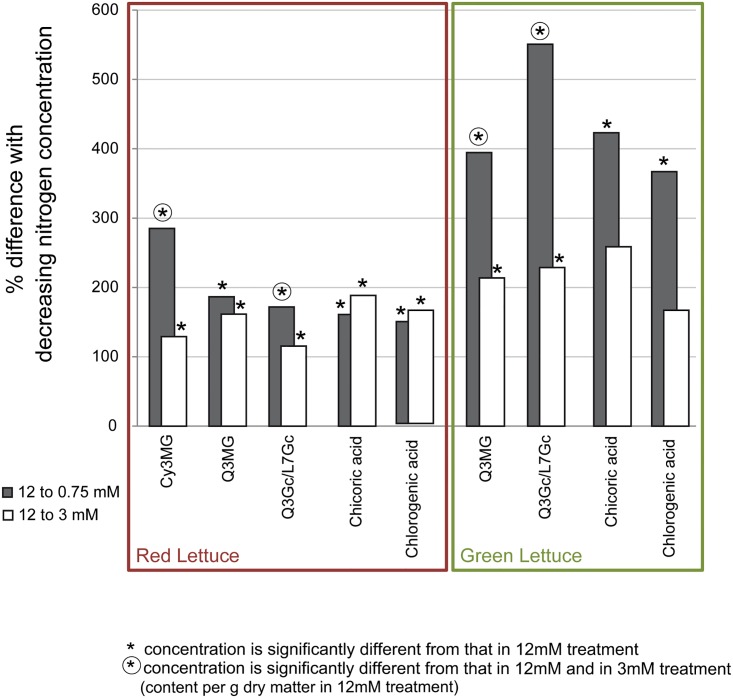
Fig 1. Phenolic compounds’ response to decreased nitrogen concentration.
Flavonoid glycosides and caffeic acid derivatives were present in different concentrations in red and green lettuce, cultivated at 12, 3 or 0.75 mM nitrogen in the nutrient solution. The percentage of difference between the 3 and 12 mM treatments is represented by the white bars, difference between the 0.75 and 12 mM treatments is represented by the grey bars. Asterisks indicate that the value is significantly different from that in 12 mM treatment, asterisks in circles indicate 0.75 mM treatment values which were significantly different from those in the 12 and the 3 mM treatments (two-way ANOVA, Tukey HSD test, α = 0.05, n = 3; as calculated based on the concentrations and listed in Table 2). Cy3MG = cyanidin-3-O-(6΄΄-O-malonyl)-glucoside, Q3MG = quercetin-3-O-(6΄΄-O-malonyl)-glucoside, Q3Gc/L7Gc = quercetin-3-O-glucuronide and luteolin-7-O-glucuronide (sum).
Fig 2
Fig 2. Chlorophylls’ and carotenoids’ response to decreased nitrogen concentration.
Chlorophylls and carotenoids were present in different concentrations in red and green lettuce, cultivated at 12, 3 or 0.75 mM nitrogen in the nutrient solution. The percentage of difference between the 3 and 12 mM treatments is represented by the white bars, difference between the 0.75 and 12 mM treatments is represented by the grey bars. Asterisks indicate that the value is significantly different from that in 12 mM treatment, asterisks in circles indicate 0.75 mM treatment values which were significantly different from those in the 12 and the 3 mM treatments (two-way ANOVA, Tukey HSD test, α = 0.05, n = 3; as calculated based on the concentrations and listed in Table 3).
Fig 3
Fig 3. Calculations on the contribution of PAL activity to total nitrogen in the leaves and to nitrogen invested in chlorophyll, respectively.
(A) Percentage of total nitrogen attributable to PAL activity and (B) the ratio between the amount of N attributable to PAL activity and the amount of N invested in chlorophyll a+b, each depicted together with the the total N concentration given in milligram per gram dry matter in red and green lettuce, cultivated with three different nitrogen concentrations in the nutrient solution, given in millimol. Identical letters at the graphs indicate that the means, evaluated per cultivar, do not differ significantly (two-way ANOVA, Tukey HSD test, α = 0.05, n = 3). N = nitrogen, PAL = phenylalanine ammonia-lyase.

References

    1. Liu W, Zhu D-W, Liu D-H, Geng M-J, Zhou W-B, Mi WJ, et al. (2010) Influence of nitrogen on the primary and secondary metabolism and synthesis of flavonoids in Chrysanthemum morifolium Ramat. Journal of Plant Nutrition 33: 240–254.
    1. Galloway JN, Townsend AR, Erisman JW, Bekunda M, Cai Z, Freney JR, et al. (2008) Transformation of the nitrogen cycle: recent trends, questions, and potential solutions. Science 320: 889–892. 10.1126/science.1136674 - DOI - PubMed
    1. Treutter D (2010) Managing Phenol Contents in Crop Plants by Phytochemical Farming and Breeding-Visions and Constraints. International Journal of Molecular Sciences 11: 807–857. 10.3390/ijms11030807 - DOI - PMC - PubMed
    1. Becker C, Klaering H-P, Kroh LW, Krumbein A (2013) Temporary reduction of radiation does not permanently reduce flavonoid glycosides and phenolic acids in red lettuce. Plant Physiology and Biochemistry 72: 154–160. 10.1016/j.plaphy.2013.05.006 - DOI - PubMed
    1. Gould KS, Lister C (2006) Flavonoid functions in plants In: Andersen Ø, Markham K, editors. Flavonoids: Chemistry, biochemistry and applications. pp. 397–441.

Publication types

MeSH terms

LinkOut - more resources