


Combination of Insecticide Treated Nets and Indoor Residual Spraying in Northern Tanzania Provides Additional Reduction in Vector Population Density and Malaria Transmission Rates Compared to Insecticide Treated Nets Alone: A Randomised Control Trial
- PMID: 26569492
- PMCID: PMC4646432
- DOI: 10.1371/journal.pone.0142671
Combination of Insecticide Treated Nets and Indoor Residual Spraying in Northern Tanzania Provides Additional Reduction in Vector Population Density and Malaria Transmission Rates Compared to Insecticide Treated Nets Alone: A Randomised Control Trial
Erratum in
-
Correction: Combination of Insecticide Treated Nets and Indoor Residual Spraying in Northern Tanzania Provides Additional Reduction in Vector Population Density and Malaria Transmission Rates Compared to Insecticide Treated Nets Alone: A Randomised Control Trial.PLoS One. 2016 Jan 5;11(1):e0146629. doi: 10.1371/journal.pone.0146629. eCollection 2016. PLoS One. 2016. PMID: 26730815 Free PMC article. No abstract available.
Abstract
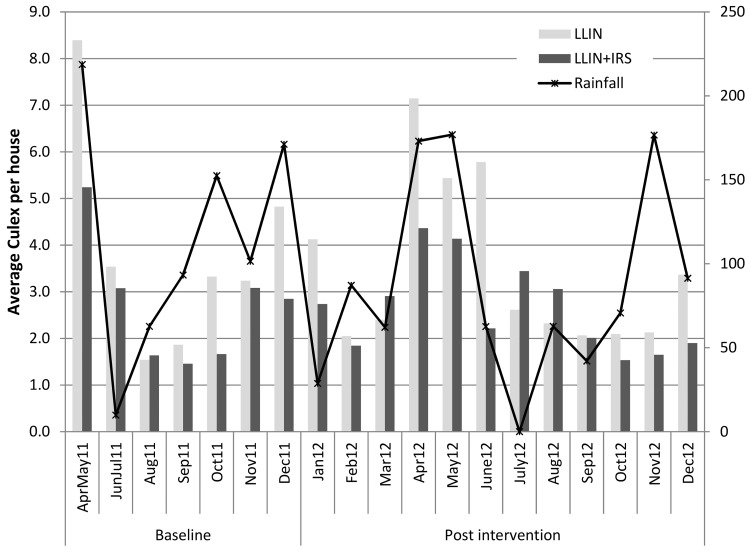
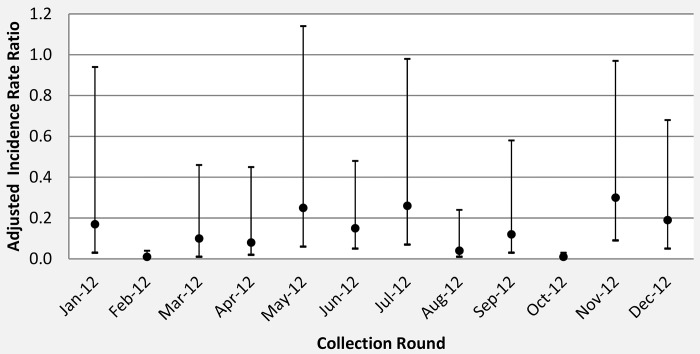
Indoor residual spraying (IRS) combined with insecticide treated nets (ITN) has been implemented together in several sub-Saharan countries with inconclusive evidence that the combined intervention provides added benefit. The impact on malaria transmission was evaluated in a cluster randomised trial comparing two rounds of IRS with bendiocarb plus universal coverage ITNs, with ITNs alone in northern Tanzania. From April 2011 to December 2012, eight houses in 20 clusters per study arm were sampled monthly for one night with CDC light trap collections. Anopheles gambiae s.l. were identified to species using real time PCR Taq Man and tested for the presence of Plasmodium falciparum circumsporozoite protein. ITN and IRS coverage was estimated from household surveys. IRS coverage was more than 85% in two rounds of spraying in January and April 2012. Household coverage with at least one ITN per house was 94.7% after the universal coverage net campaign in the baseline year and the proportion of household with all sleeping places covered by LLIN was 50.1% decreasing to 39.1% by the end of the intervention year. An.gambiae s.s. comprised 80% and An.arabiensis 18.3% of the anopheline collection in the baseline year. Mean An.gambiae s.l. density in the ITN+IRS arm was reduced by 84% (95%CI: 56%-94%, p = 0.001) relative to the ITN arm. In the stratum of clusters categorised as high anopheline density at baseline EIR was lower in the ITN+IRS arm compared to the ITN arm (0.5 versus 5.4 per house per month, Incidence Rate Ratio: 0.10, 95%CI: 0.01-0.66, p-value for interaction <0.001). This trial provides conclusive evidence that combining carbamate IRS and ITNs produces major reduction in Anopheles density and entomological inoculation rate compared to ITN alone in an area of moderate coverage of LLIN and high pyrethroid resistance in An.gambiae s.s.
Conflict of interest statement
Figures
References
-
- World Health Organization. WHO Malaria Report 2014. Geneva, Switzerland: World Health Organization; 2014.
-
- Bradley J, Matias A, Schwabe C, Vargas D, Monti F, Nseng G, et al. Increased risks of malaria due to limited residual life of insecticide and outdoor biting versus protection by combined use of nets and indoor residual spraying on Bioko Island, Equatorial Guinea. Malar J 2012;11:242 10.1186/1475-2875-11-242 - DOI - PMC - PubMed
-
- Worl Health Organization. Global plan for insecticide resistance management in malaria vectors (GPIRM) Geneva, Switzerland: World Health Organization; 2012.
-
- Lines J, Kleinschmidt I. Is malaria control better with both treated nets and spraying? Lancet 2014. December 8. - PubMed
Publication types
MeSH terms
Substances
Grants and funding
LinkOut - more resources
Full Text Sources
Other Literature Sources
Miscellaneous
