


Antibiotic Use in Cold and Flu Season and Prescribing Quality: A Retrospective Cohort Study
- PMID: 26569644
- PMCID: PMC4829738
- DOI: 10.1097/MLR.0000000000000440
Antibiotic Use in Cold and Flu Season and Prescribing Quality: A Retrospective Cohort Study
Abstract
Background: Excessive antibiotic use in cold and flu season is costly and contributes to antibiotic resistance. The study objective was to develop an index of excessive antibiotic use in cold and flu season and determine its correlation with other indicators of prescribing quality.
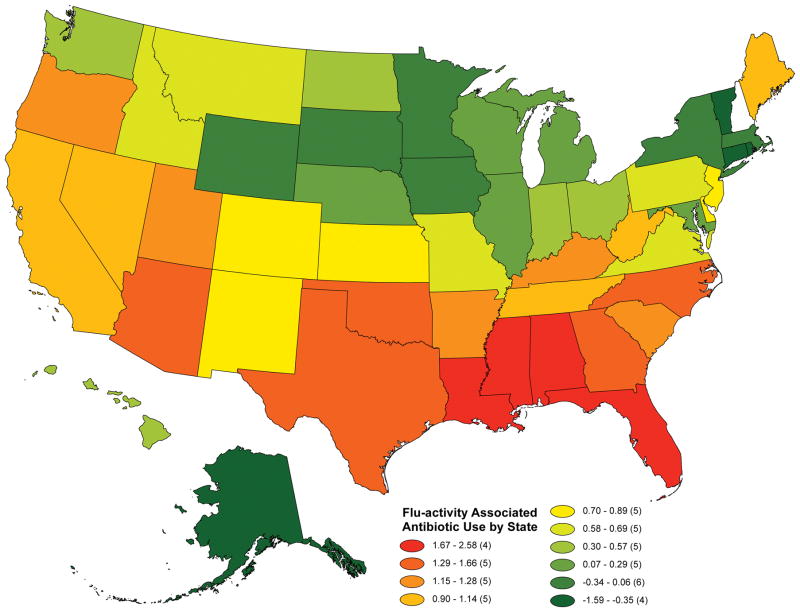
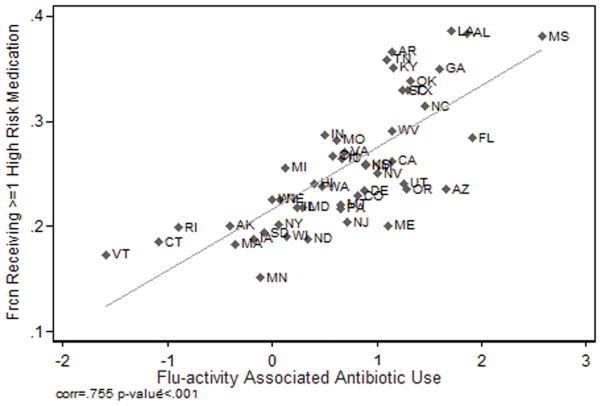
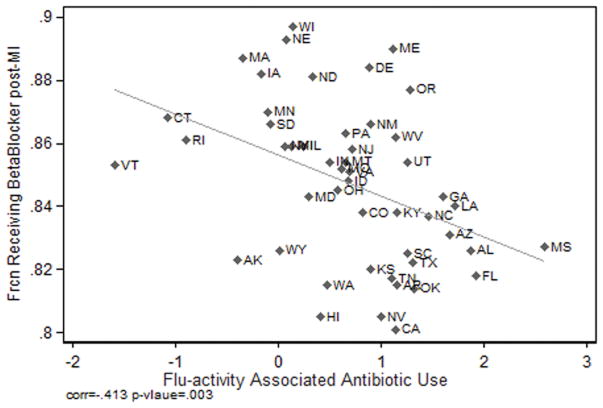
Methods and findings: We included Medicare beneficiaries in the 40% random sample denominator file continuously enrolled in fee-for-service benefits for 2010 or 2011 (7,961,201 person-years) and extracted data on prescription fills for oral antibiotics that treat respiratory pathogens. We collapsed the data to the state level so they could be merged with monthly flu activity data from the Centers for Disease Control and Prevention. Linear regression, adjusted for state-specific mean antibiotic use and demographic characteristics, was used to estimate how antibiotic prescribing responded to state-specific flu activity. Flu-activity associated antibiotic use varied substantially across states-lowest in Vermont and Connecticut, highest in Mississippi and Florida. There was a robust positive correlation between flu-activity associated prescribing and use of medications that often cause adverse events in the elderly (0.755; P<0.001), whereas there was a strong negative correlation with beta-blocker use after a myocardial infarction (-0.413; P=0.003).
Conclusions: Adjusted flu-activity associated antibiotic use was positively correlated with prescribing high-risk medications to the elderly and negatively correlated with beta-blocker use after myocardial infarction. These findings suggest that excessive antibiotic use reflects low-quality prescribing. They imply that practice and policy solutions should go beyond narrow, antibiotic specific, approaches to encourage evidence-based prescribing for the elderly Medicare population.
Conflict of interest statement
Conflict of Interest Disclosures: Skinner is an investor in Dorsata, Inc., a startup clinical pathway software company. No other authors have conflicts of interest with regard to this study.
Figures
References
-
- Centers for Disease Control and Prevention. Adult Appropriate Antibiotic Use Summary: Physician Information Sheet (Adults) 2012 Retrieved from http://www.cdc.gov/getsmart/campaign-materials/info-sheets/adult-approp-....
-
- Centers for Disease Control and Prevention. World Health Day Media Fact Sheet: Antimicrobial Resistance No Action Today No Cure Tomorrow. 2011 Retrieved from http://www.cdc.gov/media/releases/2011/f0407_antimicrobialresistance.html.
-
- Centers for Disease Control and Prevention. Cold and Flu Season: No Reason for Antibiotics. 2009 Retrieved from http://www.cdc.gov/getsmart/campaign-materials/press_kit/Cold-Flu_Season....
Publication types
MeSH terms
Substances
Grants and funding
LinkOut - more resources
Full Text Sources
Medical
