. 2015 Dec;44(12):1431-40.
doi: 10.1016/j.ijom.2015.06.006.

Algorithm for planning a double-jaw orthognathic surgery using a computer-aided surgical simulation (CASS) protocol. Part 1: planning sequence

Affiliations

Algorithm for planning a double-jaw orthognathic surgery using a computer-aided surgical simulation (CASS) protocol. Part 1: planning sequence

J J Xia et al. Int J Oral Maxillofac Surg. 2015 Dec.

Abstract

The success of craniomaxillofacial (CMF) surgery depends not only on the surgical techniques, but also on an accurate surgical plan. The adoption of computer-aided surgical simulation (CASS) has created a paradigm shift in surgical planning. However, planning an orthognathic operation using CASS differs fundamentally from planning using traditional methods. With this in mind, the Surgical Planning Laboratory of Houston Methodist Research Institute has developed a CASS protocol designed specifically for orthognathic surgery. The purpose of this article is to present an algorithm using virtual tools for planning a double-jaw orthognathic operation. This paper will serve as an operation manual for surgeons wanting to incorporate CASS into their clinical practice.

Keywords: CASS; computer-aided surgical simulation; dentofacial deformity; double-jaw orthognathic surgery; planning algorithm.


Figures

Fig. 1
Fig. 1
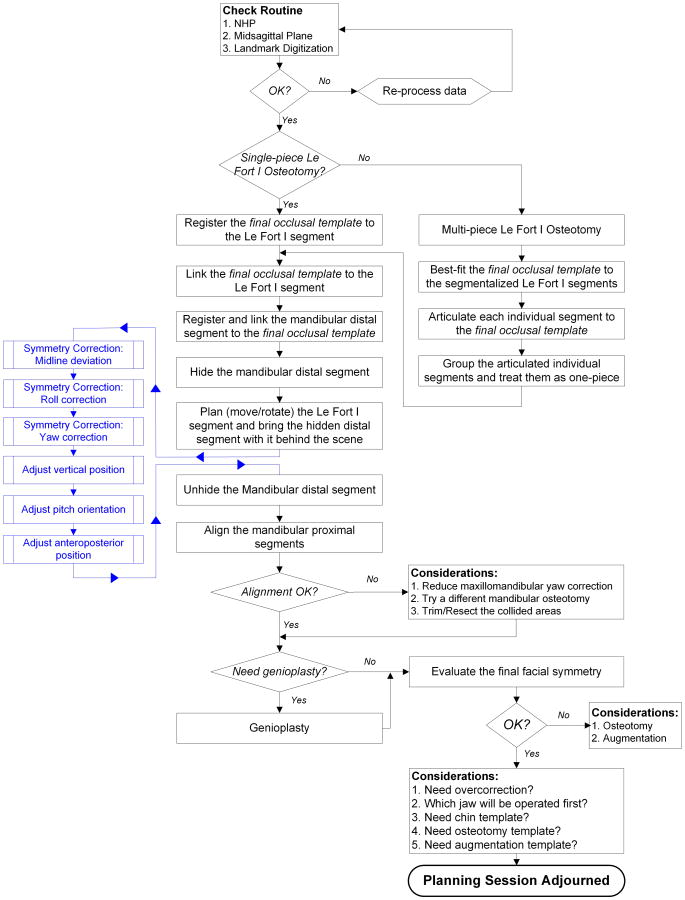
Algorithm for planning a double-jaw orthognathic surgery using the CASS protocol.
Fig. 2
Fig. 2
Creation of the composite model. (A) A face-bow with fiducial markers is attached to the bite-jig. (B) The patient bites on the bite-jig and face-bow during the CT scan. (C) Four separate but correlated computer models are reconstructed: a midface model, a mandibular model, a fiducial marker model, and a soft tissue model (not shown). (D) The bite-jig and face-bow is placed between the upper and lower plaster dental models during the scanning process. (E) Three separate but correlated digital dental models are also reconstructed: a maxillary dental model, a mandibular dental model, and a fiducial marker model. (F) By aligning the fiducial markers, the digital dental models are incorporated into the 3D-CT skull model. The computerized composite skull model is thus created. It simultaneously displays an accurate rendition of both the bony structures and the teeth.
Fig. 3
Fig. 3
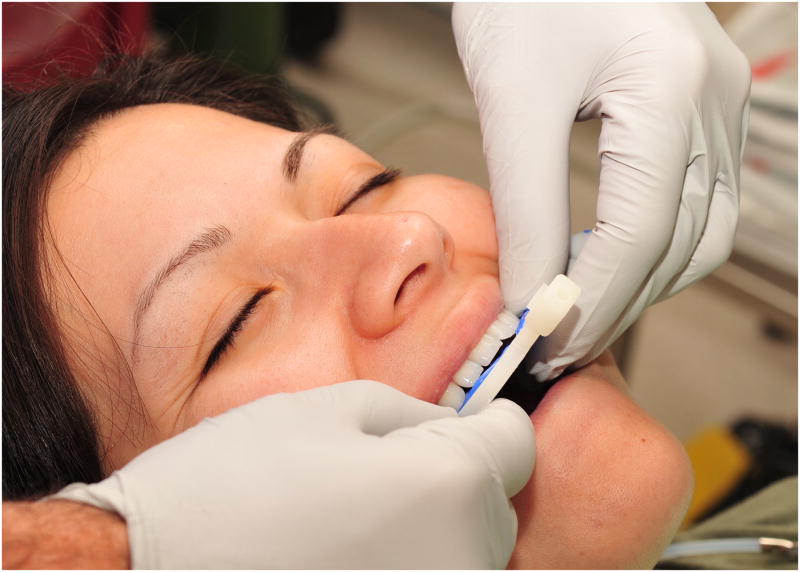
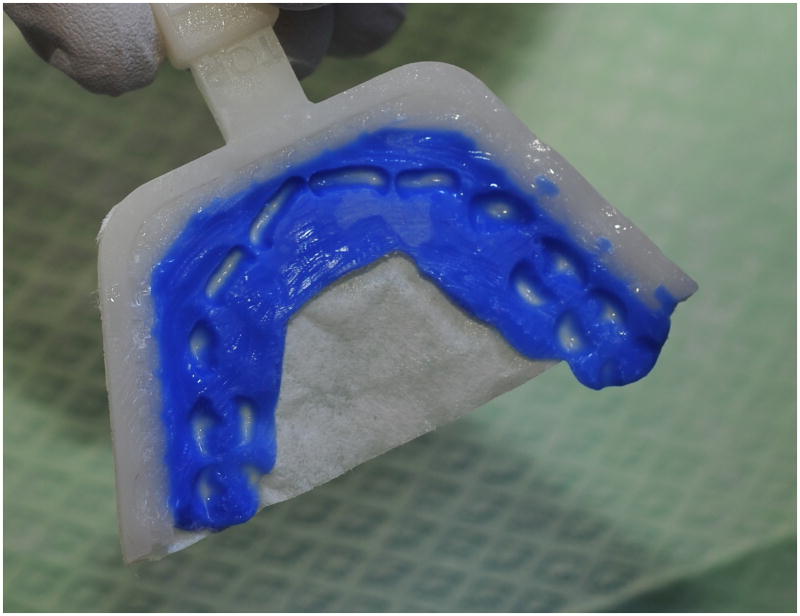
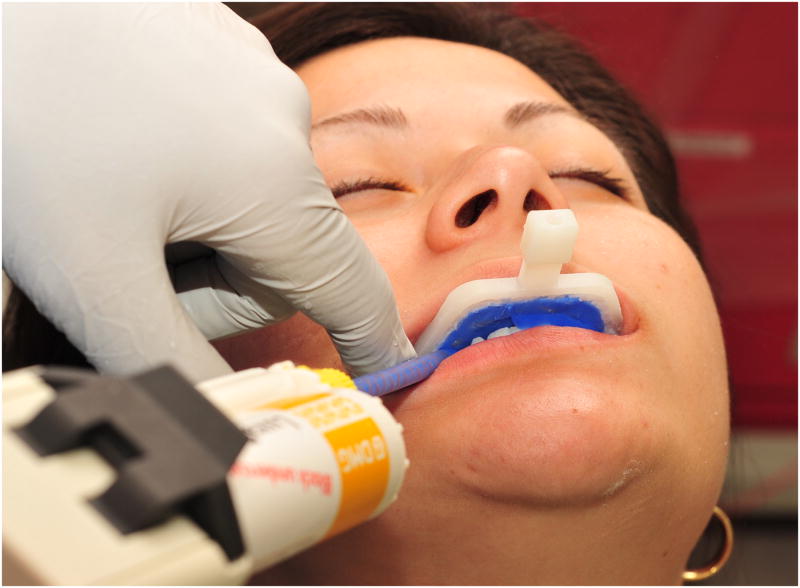
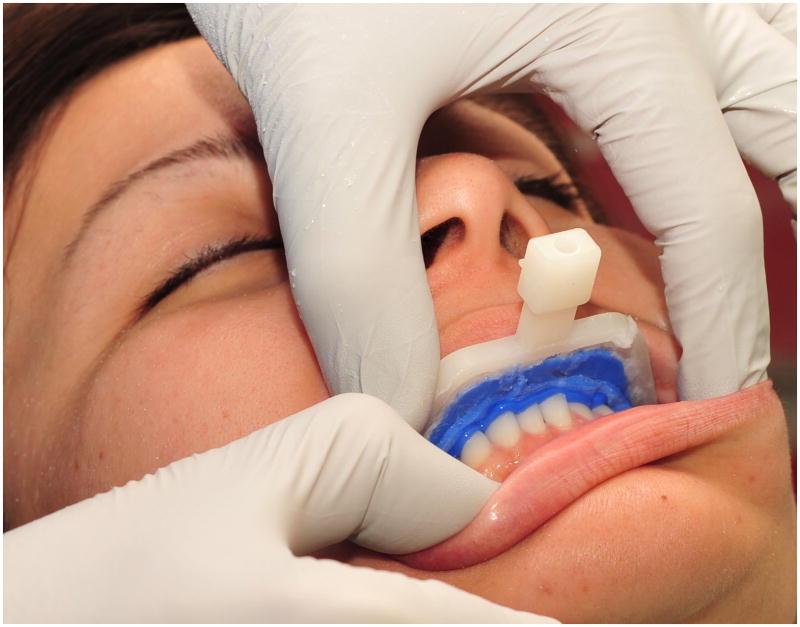
Fabrication of the patient-specific bite-jig using a three-layer approach to prevent undercuts on the bite-jig and correctly record centric relation. The first layer of the registration material is only placed on the maxillary side of the bite-jig frame to capture the geometry of the maxillary dental occlusal surfaces (A). Before the material completely sets (e.g., about 2–3 min), the bite-jig should be gently and repeatedly taken off (B) and placed back (C) on the teeth a few times in order to get rid of any possible undercuts. Once the material is completely set (e.g., about 5 min), the first layer should be ground to thin it but remain thick enough to ‘lock’ onto the maxillary occlusal surface (D). The bite-jig is then replaced on the maxillary dental arch. The surgeon should make every attempt to position the patient's mandible to centric relation. While in the centric relation, the second layer is added at the buccal and labial side of the bite-jig (E). Once the material is completely set, a third layer is added to capture the geometry of the mandibular dental occlusal surfaces (F). Guided by the second layer, the mandible should be positioned in centric relation for the third layer impression using the same method as indicated for the first layer.
Fig. 3
Fig. 3
Fabrication of the patient-specific bite-jig using a three-layer approach to prevent undercuts on the bite-jig and correctly record centric relation. The first layer of the registration material is only placed on the maxillary side of the bite-jig frame to capture the geometry of the maxillary dental occlusal surfaces (A). Before the material completely sets (e.g., about 2–3 min), the bite-jig should be gently and repeatedly taken off (B) and placed back (C) on the teeth a few times in order to get rid of any possible undercuts. Once the material is completely set (e.g., about 5 min), the first layer should be ground to thin it but remain thick enough to ‘lock’ onto the maxillary occlusal surface (D). The bite-jig is then replaced on the maxillary dental arch. The surgeon should make every attempt to position the patient's mandible to centric relation. While in the centric relation, the second layer is added at the buccal and labial side of the bite-jig (E). Once the material is completely set, a third layer is added to capture the geometry of the mandibular dental occlusal surfaces (F). Guided by the second layer, the mandible should be positioned in centric relation for the third layer impression using the same method as indicated for the first layer.
Fig. 3
Fig. 3
Fabrication of the patient-specific bite-jig using a three-layer approach to prevent undercuts on the bite-jig and correctly record centric relation. The first layer of the registration material is only placed on the maxillary side of the bite-jig frame to capture the geometry of the maxillary dental occlusal surfaces (A). Before the material completely sets (e.g., about 2–3 min), the bite-jig should be gently and repeatedly taken off (B) and placed back (C) on the teeth a few times in order to get rid of any possible undercuts. Once the material is completely set (e.g., about 5 min), the first layer should be ground to thin it but remain thick enough to ‘lock’ onto the maxillary occlusal surface (D). The bite-jig is then replaced on the maxillary dental arch. The surgeon should make every attempt to position the patient's mandible to centric relation. While in the centric relation, the second layer is added at the buccal and labial side of the bite-jig (E). Once the material is completely set, a third layer is added to capture the geometry of the mandibular dental occlusal surfaces (F). Guided by the second layer, the mandible should be positioned in centric relation for the third layer impression using the same method as indicated for the first layer.
Fig. 3
Fig. 3
Fabrication of the patient-specific bite-jig using a three-layer approach to prevent undercuts on the bite-jig and correctly record centric relation. The first layer of the registration material is only placed on the maxillary side of the bite-jig frame to capture the geometry of the maxillary dental occlusal surfaces (A). Before the material completely sets (e.g., about 2–3 min), the bite-jig should be gently and repeatedly taken off (B) and placed back (C) on the teeth a few times in order to get rid of any possible undercuts. Once the material is completely set (e.g., about 5 min), the first layer should be ground to thin it but remain thick enough to ‘lock’ onto the maxillary occlusal surface (D). The bite-jig is then replaced on the maxillary dental arch. The surgeon should make every attempt to position the patient's mandible to centric relation. While in the centric relation, the second layer is added at the buccal and labial side of the bite-jig (E). Once the material is completely set, a third layer is added to capture the geometry of the mandibular dental occlusal surfaces (F). Guided by the second layer, the mandible should be positioned in centric relation for the third layer impression using the same method as indicated for the first layer.
Fig. 3
Fig. 3
Fabrication of the patient-specific bite-jig using a three-layer approach to prevent undercuts on the bite-jig and correctly record centric relation. The first layer of the registration material is only placed on the maxillary side of the bite-jig frame to capture the geometry of the maxillary dental occlusal surfaces (A). Before the material completely sets (e.g., about 2–3 min), the bite-jig should be gently and repeatedly taken off (B) and placed back (C) on the teeth a few times in order to get rid of any possible undercuts. Once the material is completely set (e.g., about 5 min), the first layer should be ground to thin it but remain thick enough to ‘lock’ onto the maxillary occlusal surface (D). The bite-jig is then replaced on the maxillary dental arch. The surgeon should make every attempt to position the patient's mandible to centric relation. While in the centric relation, the second layer is added at the buccal and labial side of the bite-jig (E). Once the material is completely set, a third layer is added to capture the geometry of the mandibular dental occlusal surfaces (F). Guided by the second layer, the mandible should be positioned in centric relation for the third layer impression using the same method as indicated for the first layer.
Fig. 3
Fig. 3
Fabrication of the patient-specific bite-jig using a three-layer approach to prevent undercuts on the bite-jig and correctly record centric relation. The first layer of the registration material is only placed on the maxillary side of the bite-jig frame to capture the geometry of the maxillary dental occlusal surfaces (A). Before the material completely sets (e.g., about 2–3 min), the bite-jig should be gently and repeatedly taken off (B) and placed back (C) on the teeth a few times in order to get rid of any possible undercuts. Once the material is completely set (e.g., about 5 min), the first layer should be ground to thin it but remain thick enough to ‘lock’ onto the maxillary occlusal surface (D). The bite-jig is then replaced on the maxillary dental arch. The surgeon should make every attempt to position the patient's mandible to centric relation. While in the centric relation, the second layer is added at the buccal and labial side of the bite-jig (E). Once the material is completely set, a third layer is added to capture the geometry of the mandibular dental occlusal surfaces (F). Guided by the second layer, the mandible should be positioned in centric relation for the third layer impression using the same method as indicated for the first layer.
Fig. 4
Fig. 4
Orientation of the composite skull model to the neutral head posture (NHP) using the digital orientation sensor method. (A) A digital orientation sensor is attached to the bite-jig and face-bow. (B) The pitch, roll, and yaw of the sensor are recorded. (C) In the computer, a digital replica (CAD model) of the orientation sensor is registered to the composite skull model via the fiducial markers, and the two objects are attached to each other. (D) The recorded pitch, roll, and yaw are applied to the face-bow frame, reorienting the composite skull model to the NHP. (E) After the composite skull is orientated to the NHP, the CAD model of the orientation sensor is marked hidden.
Fig. 5
Fig. 5
Incorporating the final-occlusal-template and placement of the mandibular distal segment into final occlusion in a single-piece Le Fort I osteotomy. (A) In this example, virtual osteotomies, including a single-piece Le Fort I osteotomy and bilateral sagittal split osteotomy, are completed. Each bony segment is located in its original location. (B) The digital final-occlusal-template is generated by scanning the hand-articulated stone models using a high-resolution scanner. (C) The upper part (maxillary teeth) of the final-occlusal-template is first registered to the maxillary teeth in the composite model. (D) The mandible is set into the final occlusion by registering the distal mandibular teeth to the lower part (mandibular teeth) of the template.
Fig. 6
Fig. 6
Incorporating the final-occlusal-template in a multiple-piece Le Fort I osteotomy. (A) In this example, a three-piece Le Fort I osteotomy is completed. All bony segments (yellow) are located in their original locations. (B) The upper part (maxillary teeth) of the digital final-occlusal-template. The template is also generated by scanning the hand-articulated stone models, in which the upper stone model is first cut into three pieces, then hand-articulated to the final occlusion without using an articulator. Note that the posterior Le Fort I segments in the composite model are medial. (C) The upper part of the final-occlusal-template is registered to the maxillary teeth at the central dental midline, best fitting the posterior parts of the teeth. (D) All Le Fort I segments are then perfectly registered to the corresponding segment in the final-occlusal-template, resulting in a new intra-arch relationship among the Le Fort I segments.
Fig. 7
Fig. 7
Mirror image routine. (A) The planned outcome after all bony segments are moved to their desired positions. (B) One side of the face is first copied. (C) The copy is flipped horizontally. (D) The flipped copy is superimposed on the contralateral side; finally, side-to-side differences are calculateed.

References

    1. Xia JJ, Gateno J, Teichgraeber JF. New clinical protocol to evaluate craniomaxillofacial deformity and plan surgical correction. J Oral Maxillofac Surg. 2009;67:2093–2106. - PMC - PubMed
    1. Gateno J, Xia J, Teichgraeber JF, Rosen A. A new technique for the creation of a computerized composite skull model. J Oral Maxillofac Surg. 2003;61:222–227. - PubMed
    1. Xia JJ, Gateno J, Teichgraeber JF. Three-dimensional computer-aided surgical simulation for maxillofacial surgery. Atlas Oral Maxillofac Surg Clin North Am. 2005;13:25–39. - PubMed
    1. Swennen GR, Mommaerts MY, Abeloos J, De Clercq C, Lamoral P, Neyt N, Casselman J, Schutyser F. The use of a wax bite wafer and a double computed tomography scan procedure to obtain a three-dimensional augmented virtual skull model. J Craniofac Surg. 2007;18:533–539. - PubMed
    1. Swennen GR, Mollemans W, Schutyser F. Three-dimensional treatment planning of orthognathic surgery in the era of virtual imaging. J Oral Maxillofac Surg. 2009;67:2080–2092. - PubMed

Publication types