Frailty and Cognitive Function in Incident Hemodialysis Patients
- PMID: 26573615
- PMCID: PMC4670760
- DOI: 10.2215/CJN.01960215
Frailty and Cognitive Function in Incident Hemodialysis Patients
Abstract
Background and objectives: Patients of all ages undergoing hemodialysis (HD) have a high prevalence of cognitive impairment and worse cognitive function than healthy controls, and those with dementia are at high risk of death. Frailty has been associated with poor cognitive function in older adults without kidney disease. We hypothesized that frailty might also be associated with poor cognitive function in adults of all ages undergoing HD.
Design, setting, participants, & measurements: At HD initiation, 324 adults enrolled (November 2008 to July 2012) in a longitudinal cohort study (Predictors of Arrhythmic and Cardiovascular Risk in ESRD) were classified into three groups (frail, intermediately frail, and nonfrail) based on the Fried frailty phenotype. Global cognitive function (3MS) and speed/attention (Trail Making Tests A and B [TMTA and TMTB, respectively]) were assessed at cohort entry and 1-year follow-up. Associations between frailty and cognitive function (at cohort entry and 1-year follow-up) were evaluated in adjusted (for sex, age, race, body mass index, education, depression and comorbidity at baseline) linear (3MS, TMTA) and Tobit (TMTB) regression models.
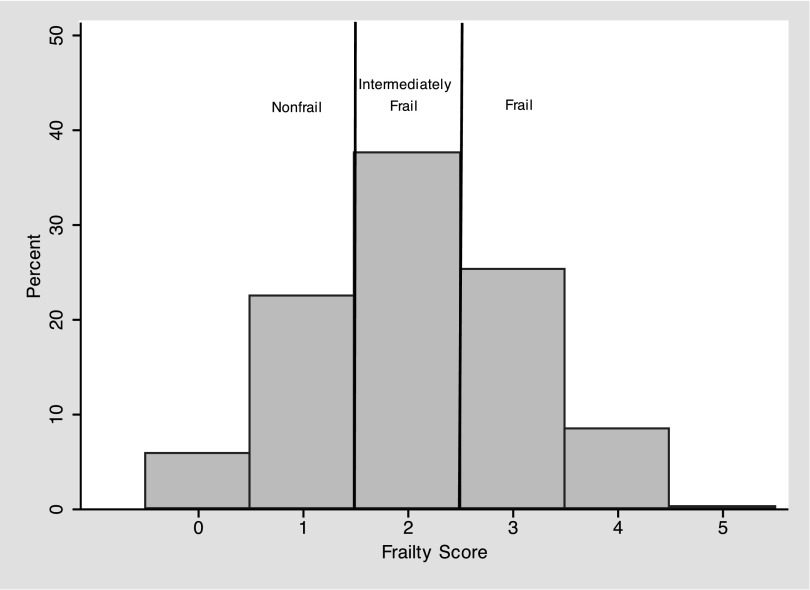
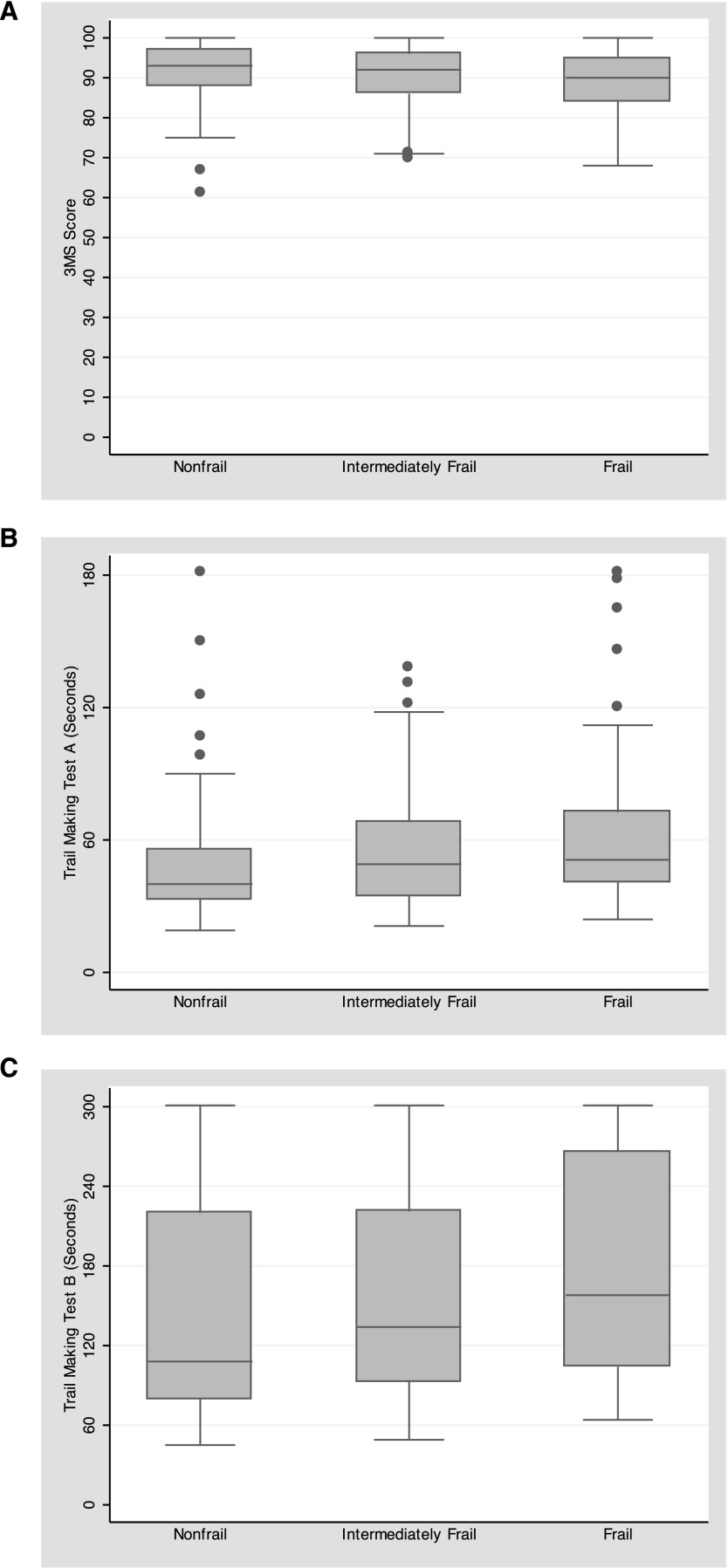
Results: At cohort entry, the mean age was 54.8 years (SD 13.3), 56.5% were men, and 72.8% were black. The prevalence of frailty and intermediate frailty were 34.0% and 37.7%, respectively. The mean 3MS was 89.8 (SD 7.6), TMTA was 55.4 (SD 29), and TMTB was 161 (SD 83). Frailty was independently associated with lower cognitive function at cohort entry for all three measures (3MS: -2.4 points; 95% confidence interval [95% CI], -4.2 to -0.5; P=0.01; TMTA: 12.1 seconds; 95% CI, 4.7 to 19.4; P<0.001; and TMTB: 33.2 seconds; 95% CI, 9.9 to 56.4; P=0.01; all tests for trend, P<0.001) and with worse 3MS at 1-year follow-up (-2.8 points; 95% CI, -5.4 to -0.2; P=0.03).
Conclusions: In adult incident HD patients, frailty is associated with worse cognitive function, particularly global cognitive function (3MS).
Keywords: ESRD; african american; black; cognition; dementia; depression; epidemiology and outcomes; frailty; hemodialysis; kidney failure, chronic; renal dialysis.
Copyright © 2015 by the American Society of Nephrology.
Figures
Comment in
-
Frailty and Cognitive Impairment in ESRD: Brain-Body Connections.Clin J Am Soc Nephrol. 2015 Dec 7;10(12):2104-6. doi: 10.2215/CJN.11321015. Epub 2015 Nov 16. Clin J Am Soc Nephrol. 2015. PMID: 26573614 Free PMC article. No abstract available.
References
-
- Sehgal AR, Grey SF, DeOreo PB, Whitehouse PJ: Prevalence, recognition, and implications of mental impairment among hemodialysis patients. Am J Kidney Dis 30: 41–49, 1997 - PubMed
-
- Kurella M, Mapes DL, Port FK, Chertow GM: Correlates and outcomes of dementia among dialysis patients: The Dialysis Outcomes and Practice Patterns Study. Nephrol Dial Transplant 21: 2543–2548, 2006 - PubMed
-
- Fried LP, Tangen CM, Walston J, Newman AB, Hirsch C, Gottdiener J, Seeman T, Tracy R, Kop WJ, Burke G, McBurnie MA, Cardiovascular Health Study Collaborative Research Group : Frailty in older adults: Evidence for a phenotype. J Gerontol A Biol Sci Med Sci 56: M146–M156, 2001 - PubMed
-
- Robertson DA, Savva GM, Kenny RA: Frailty and cognitive impairment--a review of the evidence and causal mechanisms. Ageing Res Rev 12: 840–851, 2013 - PubMed
Publication types
MeSH terms
Grants and funding
- R01DK072367/DK/NIDDK NIH HHS/United States
- P30-AG021334/AG/NIA NIH HHS/United States
- T32 HL007024/HL/NHLBI NIH HHS/United States
- P30 AG021334/AG/NIA NIH HHS/United States
- K01 AG043501/AG/NIA NIH HHS/United States
- KL2 RR025006/RR/NCRR NIH HHS/United States
- K24DK101828/DK/NIDDK NIH HHS/United States
- R01 DK072367/DK/NIDDK NIH HHS/United States
- R01 AG042504/AG/NIA NIH HHS/United States
- T32HL007024/HL/NHLBI NIH HHS/United States
- R01AG042504/AG/NIA NIH HHS/United States
- K24 DK101828/DK/NIDDK NIH HHS/United States
- KL2RR025006/RR/NCRR NIH HHS/United States
- K01AG043501/AG/NIA NIH HHS/United States
LinkOut - more resources
Full Text Sources
Medical