


History and origin of the HIV-1 subtype C epidemic in South Africa and the greater southern African region
- PMID: 26574165
- PMCID: PMC4648088
- DOI: 10.1038/srep16897
History and origin of the HIV-1 subtype C epidemic in South Africa and the greater southern African region
Abstract
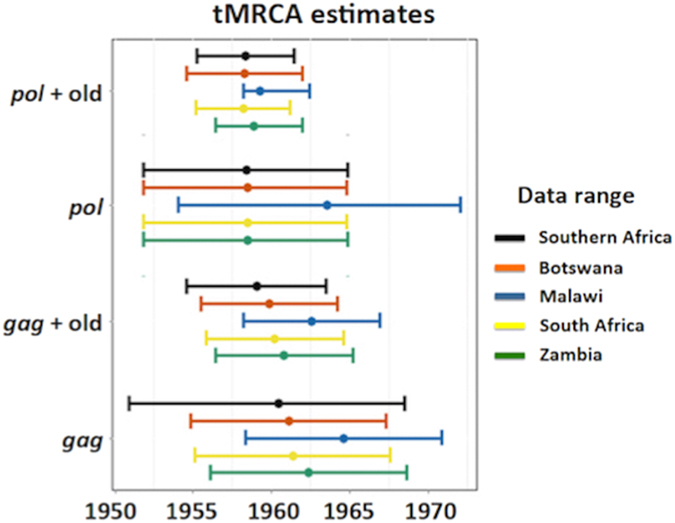
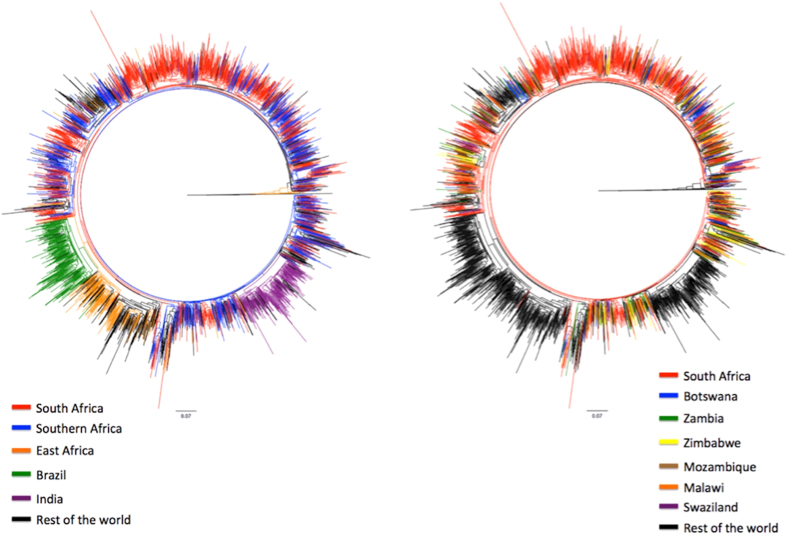
HIV has spread at an alarming rate in South Africa, making it the country with the highest number of HIV infections. Several studies have investigated the histories of HIV-1 subtype C epidemics but none have done so in the context of social and political transformation in southern Africa. There is a need to understand how these processes affects epidemics, as socio-political transformation is a common and on-going process in Africa. Here, we genotyped strains from the start of the epidemic and applied phylodynamic techniques to determine the history of the southern Africa and South African epidemic from longitudinal sampled data. The southern African epidemic's estimated dates of origin was placed around 1960 (95% HPD 1956-64), while dynamic reconstruction revealed strong growth during the 1970s and 80s. The South African epidemic has a similar origin, caused by multiple introductions from neighbouring countries, and grew exponentially during the 1980s and 90s, coinciding with socio-political changes in South Africa. These findings provide an indication as to when the epidemic started and how it has grown, while the inclusion of sequence data from the start of the epidemic provided better estimates. The epidemic have stabilized in recent years with the expansion of antiretroviral therapy.
Figures

References
-
- UNAIDS. Global report, UNAIDS report on the global AIDS epidemic 2013. Available at: http://www.unaids.org/sites/default/files/<underline>en/media/unaids/con... (Accessed: 19th February 2015).
-
- Bello G. et al. Origin and evolutionary history of HIV-1 subtype C in Brazil. AIDS. 22(15), 1993–2000 (2008). - PubMed
Publication types
MeSH terms
Substances
Grants and funding
LinkOut - more resources
Full Text Sources
Other Literature Sources
Medical
