Review
. 2015 Nov 17;4(11):e264.
doi: 10.1038/mtna.2015.37.

Off-target Effects in CRISPR/Cas9-mediated Genome Engineering

Affiliations
Review

Off-target Effects in CRISPR/Cas9-mediated Genome Engineering

Xiao-Hui Zhang et al. Mol Ther Nucleic Acids. .

Abstract

CRISPR/Cas9 is a versatile genome-editing technology that is widely used for studying the functionality of genetic elements, creating genetically modified organisms as well as preclinical research of genetic disorders. However, the high frequency of off-target activity (≥50%)-RGEN (RNA-guided endonuclease)-induced mutations at sites other than the intended on-target site-is one major concern, especially for therapeutic and clinical applications. Here, we review the basic mechanisms underlying off-target cutting in the CRISPR/Cas9 system, methods for detecting off-target mutations, and strategies for minimizing off-target cleavage. The improvement off-target specificity in the CRISPR/Cas9 system will provide solid genotype-phenotype correlations, and thus enable faithful interpretation of genome-editing data, which will certainly facilitate the basic and clinical application of this technology.


Figures
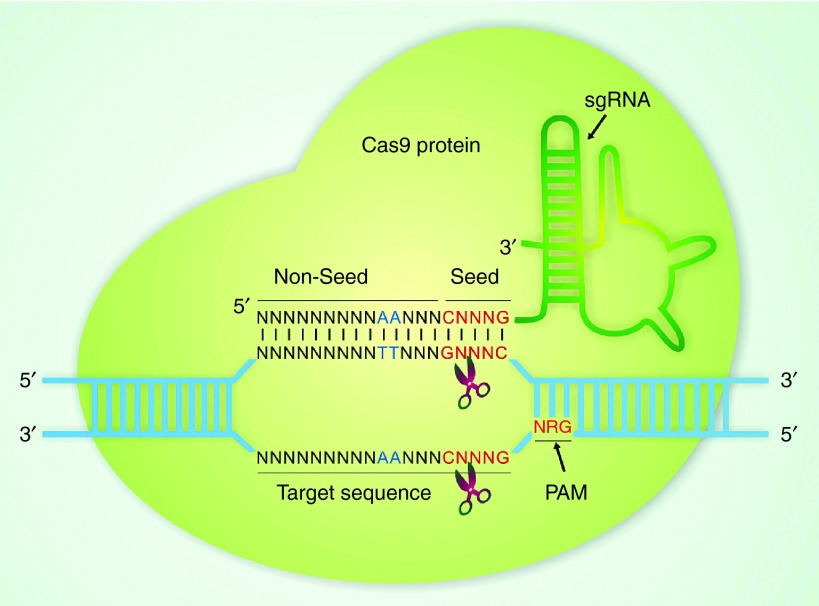
Figure 1
Figure 1
Base preferences for CRISPR/Cas9 system. Cas9 protein is shown in orange. PAM and seed sequences are shown in red. Base preferences are shown in blue. Scissors indicate cleavage sites. The single-letter DNA code is used (N=A, T, C, G; R=G or A).
Figure 2
Figure 2
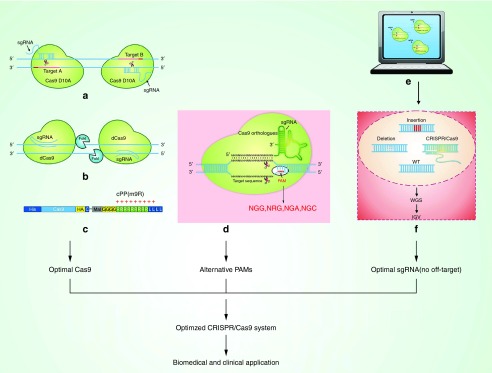
Methods for optimal CRISPR/Cas9 system for biomedical and clinical application. (a) Double nicking by RNA-Guided CRISPR Cas9 for enhanced genome-editing specificity. Cas9 protein is shown in orange. Scissors indicate cleavage sites. (b) Fusion of catalytically inactive Cas9 to Fok I nuclease. (c) Delivery of Cas9 protein. cPP, cell-penetrating peptide. The single-letter codes for amino acids are used. C, cysteine; G, glycine; R, arginine; L, leucine. His, Histidine tag; HA, hemagglutinin tag; Mal, maleimide. (d) Alternative PAMs for CIRSPR/Cas9 system. (e) SgRNA design—CRISPR/Cas9 design tools. (f) Method of off-target detection-Degenome-seq. IGV, Integrative Genomics Viewer; WGS, whole-genome sequencing; WT, wild type.

References

    1. Mali, P, Yang, L, Esvelt, KM, Aach, J, Guell, M, DiCarlo, JE et al. (2013). RNA-guided human genome engineering via Cas9. Science 339: 823–826. - PMC - PubMed
    1. Cong, L, Ran, FA, Cox, D, Lin, S, Barretto, R, Habib, N et al. (2013). Multiplex genome engineering using CRISPR/Cas systems. Science 339: 819–823. - PMC - PubMed
    1. Hsu, PD, Lander, ES and Zhang, F (2014). Development and applications of CRISPR-Cas9 for genome engineering. Cell 157: 1262–1278. - PMC - PubMed
    1. Doudna, JA and Charpentier, E (2014). Genome editing. The new frontier of genome engineering with CRISPR-Cas9. Science 346: 1258096. - PubMed
    1. Cox, DB, Platt, RJ and Zhang, F (2015). Therapeutic genome editing: prospects and challenges. Nat Med 21: 121–131. - PMC - PubMed