Randomized Controlled Trial
. 2015 Nov 17:16:190.
doi: 10.1186/s12882-015-0185-3.

Strategy and rationale for urine collection protocols employed in the NEPTUNE study

Affiliations
Randomized Controlled Trial

Strategy and rationale for urine collection protocols employed in the NEPTUNE study

Marie C Hogan et al. BMC Nephrol. .

Abstract

Background: Glomerular diseases are potentially fatal, requiring aggressive interventions and close monitoring. Urine is a readily-accessible body fluid enriched in molecular signatures from the kidney and therefore particularly suited for routine clinical analysis as well as development of non-invasive biomarkers for glomerular diseases.

Methods: The Nephrotic Syndrome Study Network (NEPTUNE; ClinicalTrials.gov Identifier NCT01209000) is a North American multicenter collaborative consortium established to develop a translational research infrastructure for nephrotic syndrome. This includes standardized urine collections across all participating centers for the purpose of discovering non-invasive biomarkers for patients with nephrotic syndrome due to minimal change disease, focal segmental glomerulosclerosis, and membranous nephropathy. Here we describe the organization and methods of urine procurement and banking procedures in NEPTUNE.

Results: We discuss the rationale for urine collection and storage conditions, and demonstrate the performance of three experimental analytes (neutrophil gelatinase-associated lipocalin [NGAL], retinol binding globulin, and alpha-1 microglobulin) under these conditions with and without urine preservatives (thymol, toluene, and boric acid). We also demonstrate the quality of RNA and protein collected from the urine cellular pellet and exosomes.

Conclusions: The urine collection protocol in NEPTUNE allows robust detection of a wide range of proteins and RNAs from urine supernatant and pellets collected longitudinally from each patient over 5 years. Combined with the detailed clinical and histopathologic data, this provides a unique resource for exploration and validation of new or accepted markers of glomerular diseases.

Trial registration: ClinicalTrials.gov Identifier NCT01209000.


Figures
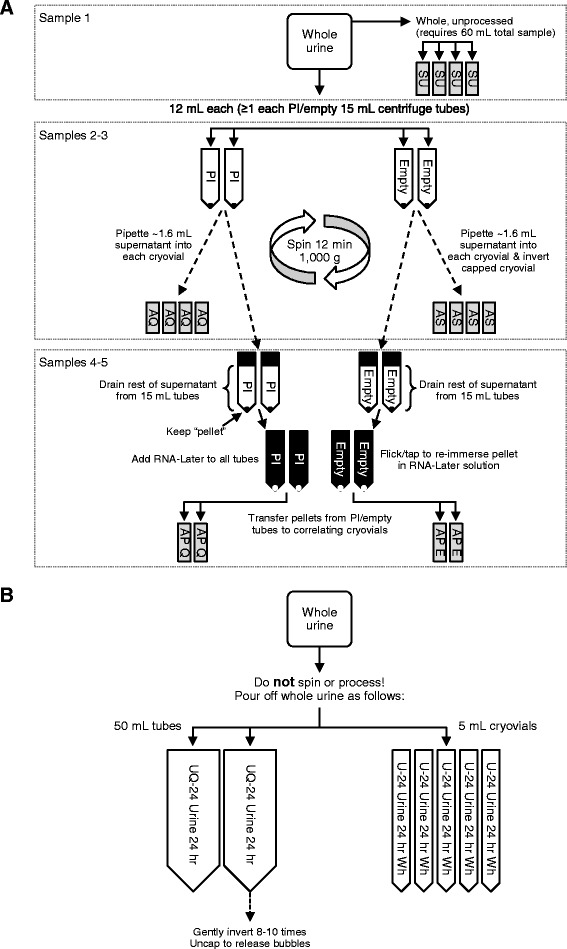
Fig. 1
Fig. 1
a NEPTUNE spot urine sample processing: Sample 1: 4 × 2 mL cryovials whole unprocessed “raw” urine (SU). Sample 2: 4 × 2 mL samples with sodium azide additive (AS). Supernatant after low speed centrifugation is saved in cryovials with 20 μL 100 mM sodium azide (12 mL × 4). Sodium azide has anti-bacterial properties. Sample 3: 4 cryovials with proteinase inhibitor (PI). Sample 4: 2 sets of pellet from this are stored in RNAlater obtained by centrifugation at 1000 g × 12 min in a tabletop centrifuge (AP-E). Sample 5: 4 × 2 mL from the PI sample. 2 sets of pellet from this are stored in in RNAlater obtained by centrifugation at 1000 g x 12 min in a tabletop centrifuge (AQ-Q). All samples are stored on ice in transport and during collection. All samples are frozen as soon possible at −80 °C. Cryovial final volume stored is 1.6 mL urine. b NEPTUNE 24-h urine sample processing. One subaliquot 40 mL whole urine (inverted x 3) frozen at −80 °C immediately (U1). 1 subaliquot (40 mL) of whole urine with protease inhibitor (6 μL; Sigma P1860) (UQ1); 5 × 5 mL cryovials whole urine (U-24)
Fig. 2
Fig. 2
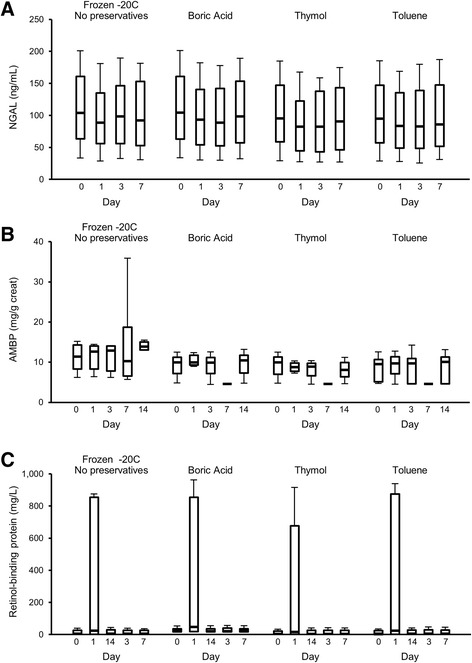
Immunoassay of soluble proteins. a Neutrophil gelatinase-associated lipocalin (NGAL) (b). Alpha-1 microglobulin (AMBP). c Retinol-binding globulin. All 3 were stable at room temperature, 4 °C, and −20 °C in urine (shown in this figure) without preservatives and also with toluene, thymol, and boric acid. None were stable with acetic acid, 6 N HCl, or 6 N HNO3 (Additional file 2: Table S3). Median and interquartile ranges are shown
Fig. 3
Fig. 3
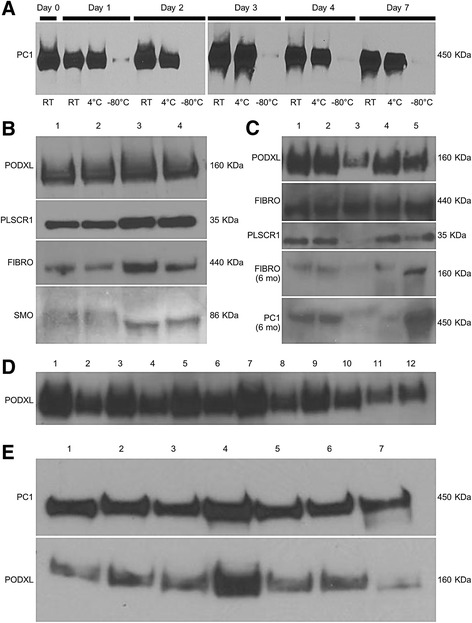
Western blot of exosome pellets. Exosomal proteins of interest including podocalyxin (PODXL), fibrocystin (FIBRO) and polycystin 1 (PC1) were examined by Western blot after storage and compared with freshly-isolated exosomes. These proteins were best preserved by the Sigma protease cocktail. a Polycystin 1 detection by Western blot was stable for 1 week at room temperature after exosomes were isolated and stored in 0.01 % sodium azide (n = 7). However, polycystin 1 was not detected well from exosomes isolated after urine was frozen.at -80C probably because of precipitation issues and unlikely due to loss of protease activity. Effects of preservatives on Western blot of exosome pellet proteins PODXL, scramblase (PLSCR1), FIBRO, and smoothened (SMO). b Lane 1, Fresh, no preservatives; Lane 2, Fresh, no preservatives; Lane 3, −80 °C Frozen/Thawed; Lane 4, −80 °C Frozen/Thawed. c Comparison of varied amounts of protease inhibitors on exosome protein detection by Western blot. Initial assessment and following 6 months storage at −80 °C. Lane 1, 4.8 μL. Sigma protease inhibitor; Lane 2, 4.0 μL Sigma protease inhibitor; Lane 3, 1:100 Roche Complete tablet; Lane 4, −80 °C Frozen/Thawed; Lane 5, Fresh, no preservatives. d Exosomal Podocalyxin fared well at RT and at 4 °C. Sodium azide did not affect their survival. e Analysis of exosomes extracted from frozen (−80 °C) raw urine stored for 12 months

References

    1. Meyers CM, Geanacopoulos M, Holzman LB, Salant DJ. Glomerular disease workshop. J Am Soc Nephrol. 2005;16:3472–6. doi: 10.1681/ASN.2005090899. - DOI - PubMed
    1. Standard Protocol for Urine Collection and Storage [http://www.hkupp.org/Urine%20collectiion%20Documents.htm]. Access date 11/15/2015.
    1. Elliott P, Peakman TC. The UK Biobank sample handling and storage protocol for the collection, processing and archiving of human blood and urine. Int J Epidemiol. 2008;37:234–44. doi: 10.1093/ije/dym276. - DOI - PubMed
    1. Thongboonkerd V. Practical points in urinary proteomics. J Proteome Res. 2007;6:3881–90. doi: 10.1021/pr070328s. - DOI - PubMed
    1. Thongboonkerd V, Chutipongtanate S, Kanlaya R. Systematic evaluation of sample preparation methods for gel-based human urinary proteomics: quantity, quality, and variability. J Proteome Res. 2006;5:183–91. doi: 10.1021/pr0502525. - DOI - PubMed

Publication types

Associated data