


A comparative dosimetric study of left sided breast cancer after breast-conserving surgery treated with VMAT and IMRT
- PMID: 26577189
- PMCID: PMC4650319
- DOI: 10.1186/s13014-015-0531-4
A comparative dosimetric study of left sided breast cancer after breast-conserving surgery treated with VMAT and IMRT
Abstract
Background and purposes: This study compared VMAT and IMRT plans for intact breast radiotherapy for left sided breast cancer and evaluated the irradiated dose of planning target volume and OARs, especially focusing on heart and coronary artery.
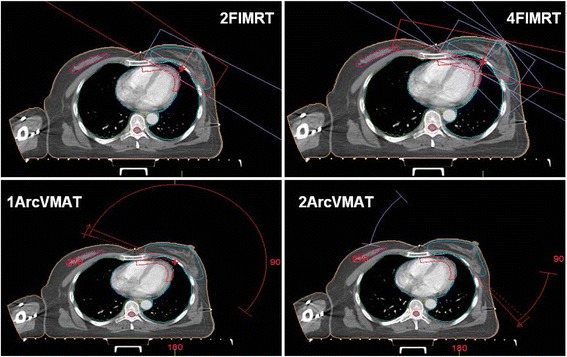
Materials and methods: Eleven patients with left sided breast cancer whose breast was relatively smaller (the mean volumes is 296 cc) treated with breast-conserving surgery were prescribed radiotherapy of 50 Gy in 25 fractions using two or four-field step and shoot IMRT (2 or 4-F IMRT), and one or two-arc VMAT (1 or 2-arc VMAT). The 10 Gy electron boost to the tumor bed after delivery of 50 Gy was not included in the analysis. Multiple planning parameters for the PTV and the PRV-OARs were measured and analyzed.
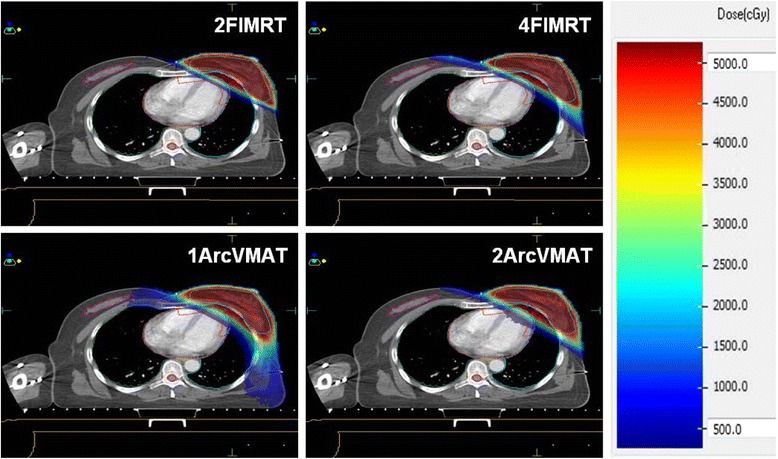
Results: Treatment plans generated using VMAT had better PTV homogeneity than the IMRT plans. For the PRV-OARs, the 1-arc VMAT had significantly higher Dmean and V5 for left lung and heart, and showed worse Dmean for liver, esophagus, spinal cord, contralateral lung and breast. In contrast, the 2-arc VMAT and the 2-F or 4-F IMRT plans showed better results for the PRV-OARs than the 1-arc VMAT. However, for the heart and coronary artery, the 1-arc VMAT showed better V20 and V40 compared with the other plans. Moreover, the 2 F-IMRT had specially advantage on V5 and V20 for heart and V5 for coronary arteries, the 2-F IMRT also showed a greater MU and treatment times. Using the table of quality score to evaluate the plans, we found that 2-F IMRT had the highest scores of 13, followed by the 2-arc VMAT plan (10 points) and 1-arc VMAT plan (8 points), and finally the 4-F IMRT plan (6 points). Moreover, when a dose comparison for heart minus coronary artery was calculated, the V20 and V40 for the rest of heart in all plans were very small and closed, indicating the dose to the coronary artery contributed dramatically to the high dose volumes for the entire heart.
Conclusions: Compared to other plans, the 2-F IMRT plan with fewer monitor units and shorter delivery time is an appropriate technique for left sided breast cancer, which achieved good PTV coverage and sparing of organs at risk besides for the heart and coronary artery.
Figures
References
-
- Sardaro A, Petruzzelli MF, D’Errico MP, Grimaldi L, Pili G, Portaluri M. Radiation-induced cardiac damage in early left breast cancer patients: risk factors, biological mechanisms, radiobiology, and dosimetric constraints. Radiother Oncol. 2012;103(2):133–42. doi: 10.1016/j.radonc.2012.02.008. - DOI - PubMed
-
- McLaughlin SA, Ochoa-Frongia LM, Patil SM, Cody HS, 3rd, Sclafani LM. Influence of frozen-section analysis of sentinel lymph node and lumpectomy margin status on reoperation rates in patients undergoing breast-conservation therapy. J Am Coll Surg. 2008;206(1):76–82. doi: 10.1016/j.jamcollsurg.2007.07.021. - DOI - PubMed
-
- Darby S, McGale P, Correa C, Taylor C, Arriagada R, Clarke M, et al. Effect of radiotherapy after breast-conserving surgery on 10-year recurrence and 15-year breast cancer death: meta-analysis of individual patient data for 10,801 women in 17 randomised trials. Lancet. 2011;378(9804):1707–16. doi: 10.1016/S0140-6736(11)61629-2. - DOI - PMC - PubMed
Publication types
MeSH terms
LinkOut - more resources
Full Text Sources
Other Literature Sources
Research Materials
