. 2015 Nov 17:15:256.
doi: 10.1186/s12862-015-0541-8.

A new fireworm (Amphinomidae) from the Cretaceous of Lebanon identified from three-dimensionally preserved myoanatomy

Affiliations

A new fireworm (Amphinomidae) from the Cretaceous of Lebanon identified from three-dimensionally preserved myoanatomy

Luke A Parry et al. BMC Evol Biol. .

Abstract

Background: Rollinschaeta myoplena gen. et sp. nov is described from the Late Cretaceous (Cenomanian) Konservat-Lagerstätten of Hakel and Hjoula, Lebanon. The myoanatomy of the fossils is preserved in exceptional detail in three dimensions as calcium phosphate, allowing the musculature of the body wall, gut and parapodia to be reconstructed in detail.

Results: The major muscle groups of polychaetes can be identified in Rollinschaeta, including longitudinal muscle bands, circular muscles, oblique muscles, the parapodial muscle complex and the gut musculature, with a resolution sufficient to preserve individual fibres. To allow meaningful comparison with the phosphatized fossil specimens, extant polychaetes were stained with iodine and visualised using microCT. Rollinschaeta myoplena possesses two pairs of dorsal longitudinal muscles, dorsal and ventral circular muscles and a single pair of ventral longitudinal muscles. While six longitudinal muscle bands are known from other polychaete groups, their presence in combination with circular muscles is unique to Amphinomidae, allowing these fossils to be diagnosed to family level based solely on their myoanatomy. The elongate, rectilinear body and equally sized, laterally projecting parapodia of Rollinschaeta are found only within Amphinominae, demonstrating that the Cretaceous species is derived amongst Amphinomida.

Conclusion: The uniquely preserved myoanatomy of Rollinschaeta has allowed diagnosis of a fossil annelid to subfamily level using microCT as a comparative tool for exploring myoanatomy in fossil and extant polychaetes. Our results demonstrate that fossilized muscles can provide systematically informative anatomical detail and that they should be studied when preserved.


Figures
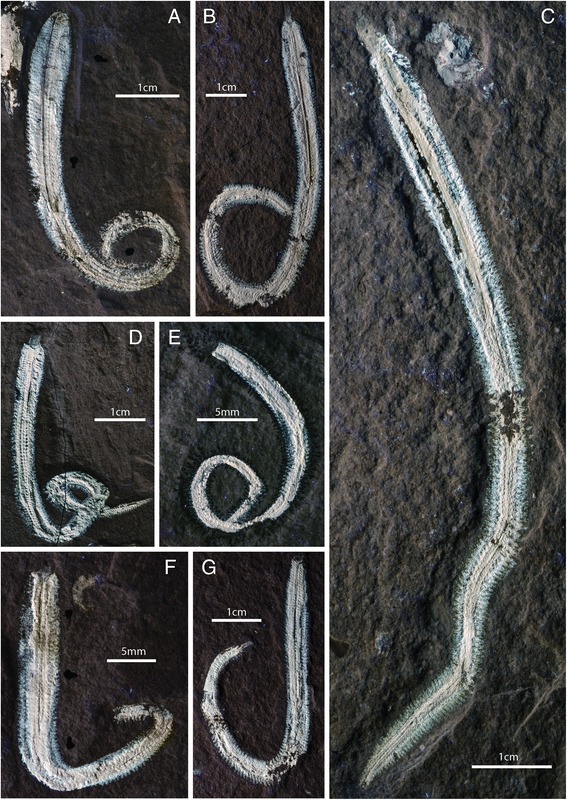
Fig. 1
Fig. 1
Specimens of Rollinschaeta myoplena. a) NHMUK PI AN 15074 (holotype); b) AN 15072; c) AN 15077; d) AN 15078; e) AN 15066; f) AN 15075; g) AN 15070. All photographs taken under UV light
Fig. 2
Fig. 2
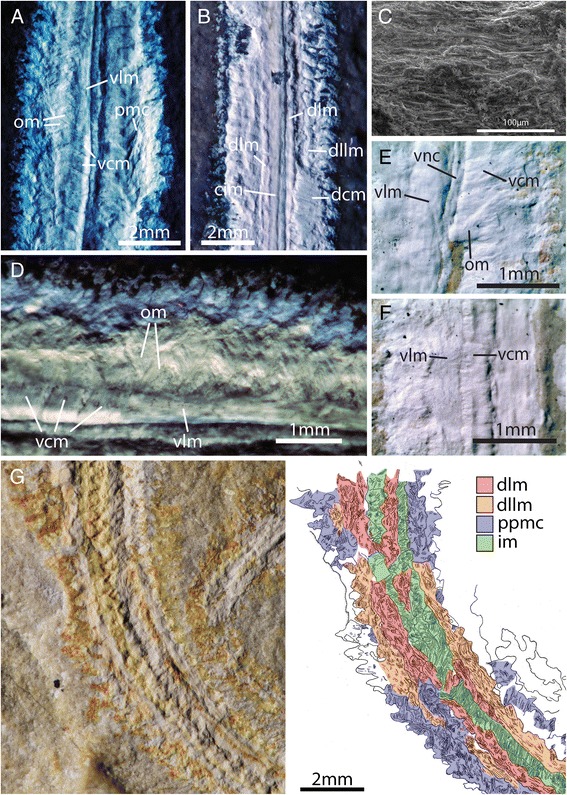
Myoanatomical features of Rollinschaeta myoplena. a) NHMUK PI AN15070 UV light; b) AN15077 UV light; c) SEM backscatter; d) AN15070 UV light; e) AN15068 light microscopic photomicrograph; f) AN15068 light microscopic photomicrograph; g) AN15074 (holotype), photo under low angle plain light at left, camera lucida drawing at right. Abbreviations: dlm – dorsal longitudinal muscle, dllm – dorsolateral longitudinal muscle, vlm – ventral longitudinal muscle, vcm – ventral circular muscle, dcm – dorsal circular muscle, om – oblique muscle, vnc – ventral nerve cord, cim – circular intestinal muscle
Fig. 3
Fig. 3
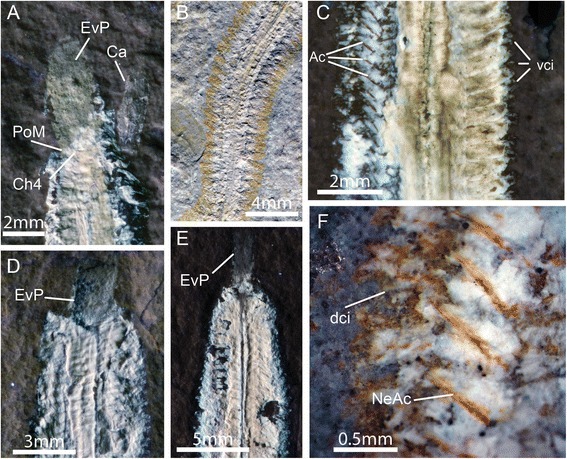
Additional morphological characters of Rollinschaeta myoplena. a) NHMUK PI AN AN15077 UV light; b) AN15077 plain light; c) AN15075 UV light; d) AN15078 UV light; e) AN15072 UV light; f) AN15075 light microscopic photomicrograph. Abbreviations: dci – dorsal cirrus, vci – ventral cirrus, PoM – posterior margin of mouth, EvP – everted proboscis, Ch4 – chaetiger 4, Ca – caruncle, Ac – aciculae, NeAc – neuroaciculae
Fig. 4
Fig. 4
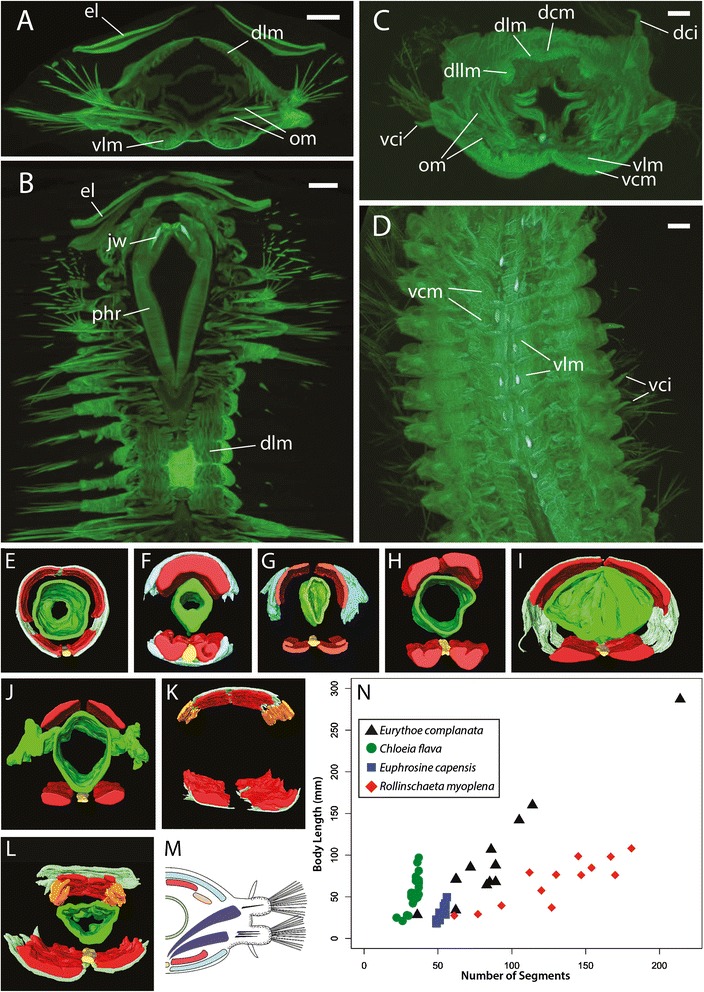
a-b Virtual histological sections of Harmothoe imbricata, scale bars 1 mm. a – transverse section, b – sagittal section. cd virtual histological sections of Eurythoe complanata, scale bars 1 mm. c – transverse section, d – sagittal section. el 3-d models of manually segmented body wall muscles, gut and ventral nerve cord (VNC). Dorsal longitudinal muscles shown in red, dorsolateral longitudinal muscles in orange, circular muscles in blue, VNC in yellow and intestine in green. eGlycera alba, fGoniada maculata, gHediste diversicolor, hNephtys hombergii, iNothria conchylega, jHarmothoe imbricata, k – Amphinomidae sp. (intestine and VNC not shown), lEurythoe complanata. m – schematic reconstruction of Rollinschaeta myoplena, colour scheme as per E-L, with oblique muscles shown in dark blue. n – plot of segment number and body length for three extant amphinomid taxa and Rollinschaeta. Abbreviations: el – elytrae, dlm – dorsal longitudinal muscle, dllm – dorsolateral longitudinal muscle, vlm – ventral longitudinal muscle, vcm – ventral circular muscle, dcm – dorsal circular muscle, om – oblique muscle, phr – pharynx, jw – jaw, dci – dorsal cirrus, vci – ventral cirrus

References

    1. Vinther J, Eibye-Jacobsen D, Harper DA. An Early Cambrian stem polychaete with pygidial cirri. Biol Lett. 2011;7(6):929–932. doi: 10.1098/rsbl.2011.0592. - DOI - PMC - PubMed
    1. Parry L, Tanner A, Vinther J. The origin of annelids. Palaeontology. 2014;57(6):1091–1103. doi: 10.1111/pala.12129. - DOI
    1. Parry L, Vinther J, Edgecombe GD. Cambrian stem-group annelids and a metameric origin of the annelid head. Biol Lett. 2015;11:20150763. doi: 10.1098/rsbl.2015.0763. - DOI - PMC - PubMed
    1. Vinther J, Van Roy P, Briggs DEG. Machaeridians are Palaeozoic armoured annelids. Nature. 2008;451:185–188. doi: 10.1038/nature06474. - DOI - PubMed
    1. Thompson I. Errant polychaetes (Annelida) from the Pennsylvanian Essex fauna of northern Illinois. Palaeontographica Abt A. 1979;163(4–6):169–199.

LinkOut - more resources