


Patterns of Substance Use Across the First Year of College and Associated Risk Factors
- PMID: 26578984
- PMCID: PMC4621385
- DOI: 10.3389/fpsyt.2015.00152
Patterns of Substance Use Across the First Year of College and Associated Risk Factors
Abstract
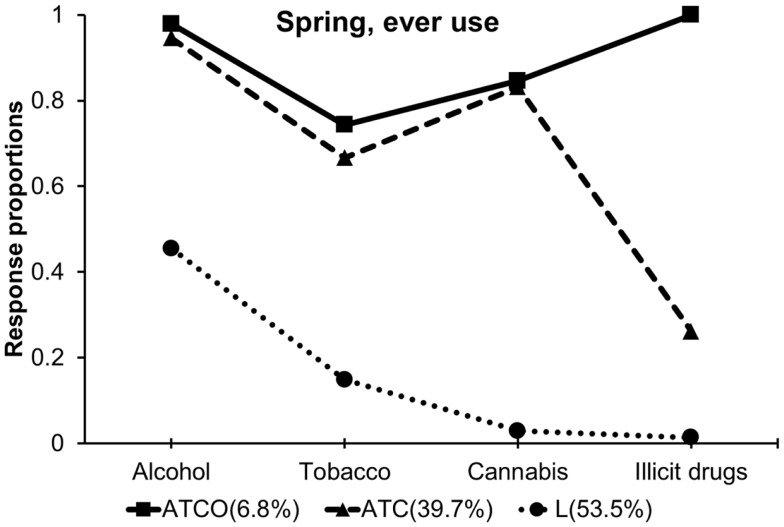
Starting college is a major life transition. This study aims to characterize patterns of substance use across a variety of substances across the first year of college and identify associated factors. We used data from the first cohort (N = 2056, 1240 females) of the "Spit for Science" sample, a study of incoming freshmen at a large urban university. Latent transition analysis was applied to alcohol, tobacco, cannabis, and other illicit drug uses measured at the beginning of the fall semester and midway through the spring semester. Covariates across multiple domains - including personality, drinking motivations and expectancy, high school delinquency, peer deviance, stressful events, and symptoms of depression and anxiety - were included to predict the patterns of substance use and transitions between patterns across the first year. At both the fall and spring semesters, we identified three subgroups of participants with patterns of substance use characterized as: (1) use of all four substances; (2) alcohol, tobacco, and cannabis use; and (3) overall low substance use. Patterns of substance use were highly stable across the first year of college: most students maintained their class membership from fall to spring, with just 7% of participants in the initial low substance users transitioning to spring alcohol, tobacco, and cannabis users. Most of the included covariates were predictive of the initial pattern of use, but covariates related to experiences across the first year of college were more predictive of the transition from the low to alcohol, tobacco, and cannabis user groups. Our results suggest that while there is an overall increase in alcohol use across all students, college students largely maintain their patterns of substance use across the first year. Risk factors experienced during the first year may be effective targets for preventing increases in substance use.
Keywords: college students; early adulthood; latent transition analysis; risk/protective factors; spit for science; substance use.
Figures

References
-
- White HR, McMorris BJ, Catalano RF, Fleming CB, Haggerty KP, Abbott RD. Increases in alcohol and marijuana use during the transition out of high school into emerging adulthood: the effects of leaving home, going to college, and high school protective factors. J Stud Alcohol Drugs (2005) 67:810–22.10.15288/jsa.2006.67.810 - DOI - PMC - PubMed
-
- White HR, Labouvie EW, Papadaratsakis V. Changes in substance use during the transition to adulthood: a comparison of college students and their noncollege age peers. J Drug Issues (2005) 35:281–306.10.1177/002204260503500204 - DOI
-
- SAMHSA. Substance Abuse and Mental Health Services Administration, Results from the 2010 National Survey on Drug Use and Health: Summary of National Findings, NSDUH Series H-41, HHS Publication No. (SMA) 11-4658. Rockville, MD: Substance Abuse and Mental Health Services Administration; (2011).
Grants and funding
LinkOut - more resources
Full Text Sources
Other Literature Sources
