. 2015 Nov 16;7(11):9475-91.
doi: 10.3390/nu7115480.

Fat Quality Influences the Obesogenic Effect of High Fat Diets

Affiliations

Fat Quality Influences the Obesogenic Effect of High Fat Diets

Raffaella Crescenzo et al. Nutrients. .

Abstract

High fat and/or carbohydrate intake are associated with an elevated risk for obesity and chronic diseases such as diabetes and cardiovascular diseases. The harmful effects of a high fat diet could be different, depending on dietary fat quality. In fact, high fat diets rich in unsaturated fatty acids are considered less deleterious for human health than those rich in saturated fat. In our previous studies, we have shown that rats fed a high fat diet developed obesity and exhibited a decrease in oxidative capacity and an increase in oxidative stress in liver mitochondria. To investigate whether polyunsaturated fats could attenuate the above deleterious effects of high fat diets, energy balance and body composition were assessed after two weeks in rats fed isocaloric amounts of a high-fat diet (58.2% by energy) rich either in lard or safflower/linseed oil. Hepatic functionality, plasma parameters, and oxidative status were also measured. The results show that feeding on safflower/linseed oil diet attenuates the obesogenic effect of high fat diets and ameliorates the blood lipid profile. Conversely, hepatic steatosis and mitochondrial oxidative stress appear to be negatively affected by a diet rich in unsaturated fatty acids.

Keywords: hepatic steatosis; high fat diet; lipid peroxidation; unsaturated fatty acids.


Figures
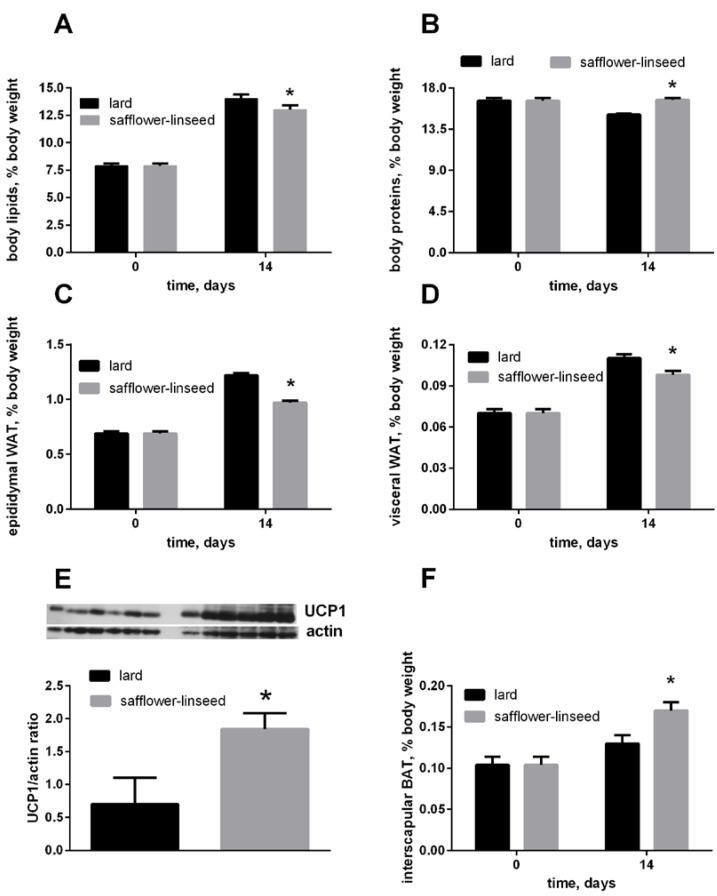
Figure 1
Figure 1
Body lipids (A) body proteins; (B) body epididymal WAT; (C) body visceral WAT (D) and body interscapular BAT (F) at day 0 and 14 of the experiment and UCP1 content in interscapular BAT (E) at day 14 of experiment in rats fed lard or safflower-linseed high fat diet. Values are reported as means with their standard errors. n = 8 different rats, except that for UCP1 western blots (n = 6). * p < 0.05 compared to lard. WAT = white adipose tissue, BAT = brown adipose tissue, UCP1 = uncoupling protein 1.
Figure 2
Figure 2
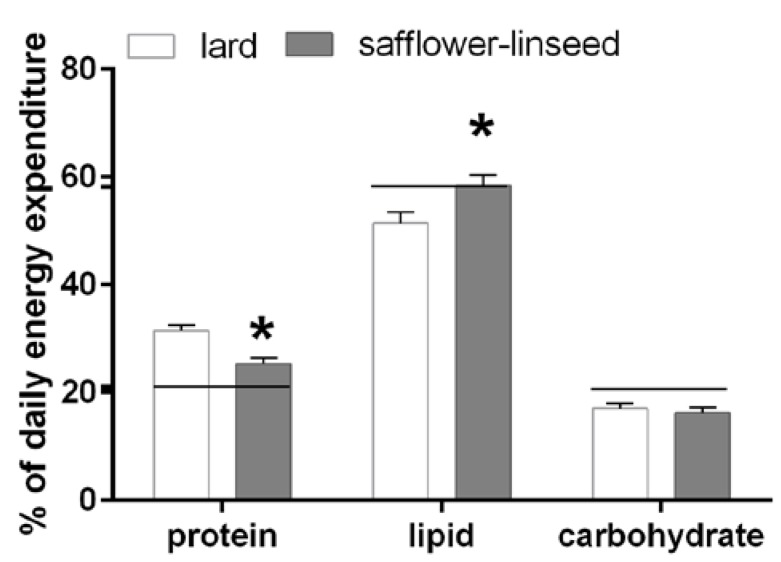
Percent contribution of lipids, proteins and carbohydrates to total daily energy expenditure (lard = 380 ± 15, safflower-linseed = 410 ± 25 kJ/day × kg0.75) in rats fed lard or safflower-linseed high fat diet. Values are reported as means with their standard errors. n = 8 different rats. * p < 0.05 compared to lard. Horizontal lines indicate the percent of each macronutrient in the diet (carbohydrate = 20.7%, protein = 21.1%, lipid = 58.2%).
Figure 3
Figure 3
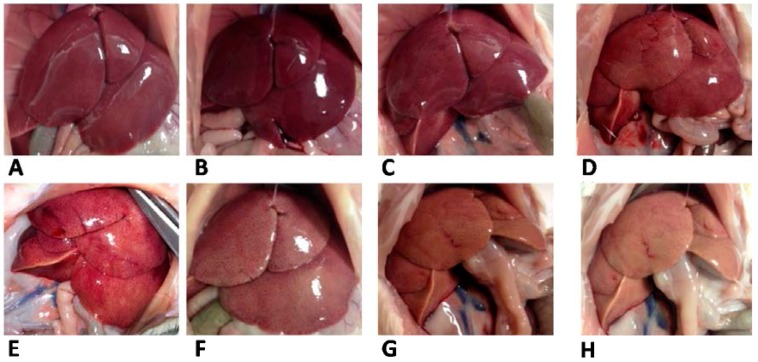
Liver appearance in rats fed lard (AD) or safflower-linseed (EH) high fat diet.
Figure 4
Figure 4
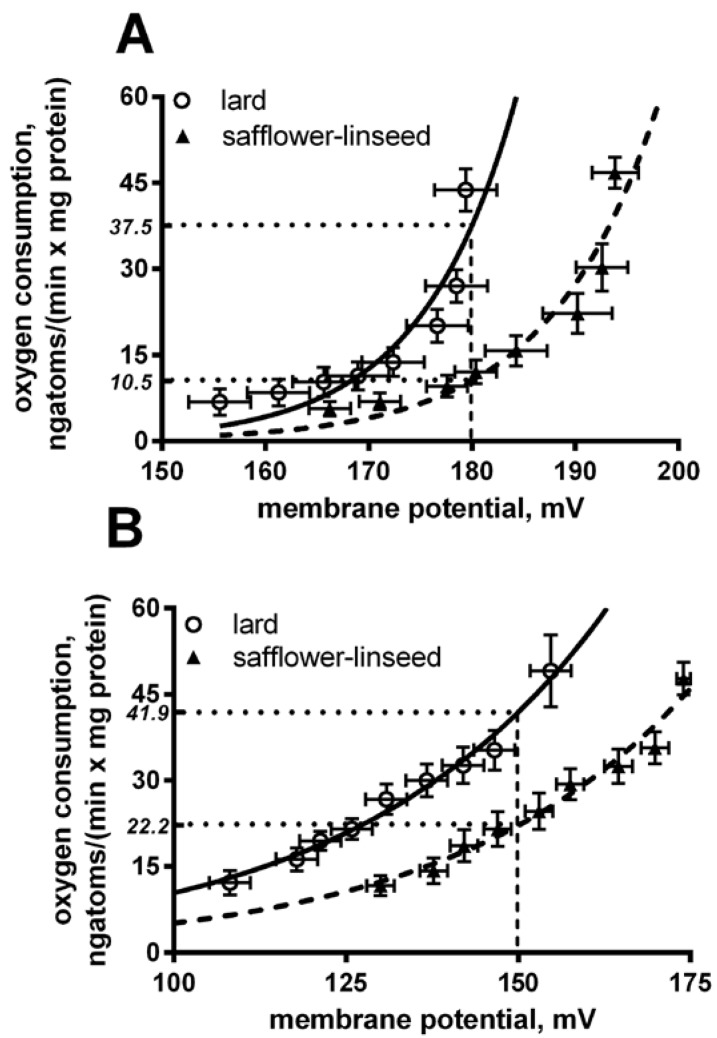
Basal (A) and fatty acid-induced (B) proton leak in rats fed lard or safflower-linseed high fat diet. Values are reported as means with their standard errors. n = 8 different rats. Non-linear regression analysis show that curves for rats fed lard were significantly different than those of rats fed safflower-linseed (p < 0.05). In addition, at the same membrane potential (180 mV for basal leak) the oxygen used to balance proton leak is significantly (p < 0.05) higher in lard compared to safflower-linseed (lard = 37.5 ± 2.1; safflower-linseed = 10.5 ± 0.9 ngatoms oxygen/min × mg protein). Similarly, at the same membrane potential of 150 mV for fatty acid-induced proton leak, the oxygen used to balance proton leak is significantly (p < 0.05) higher in lard compared to safflower-linseed (lard = 41.9 ± 2.2; safflower-linseed = 22.2 ± 1.1 ngatoms oxygen/min × mg protein).
Figure 5
Figure 5
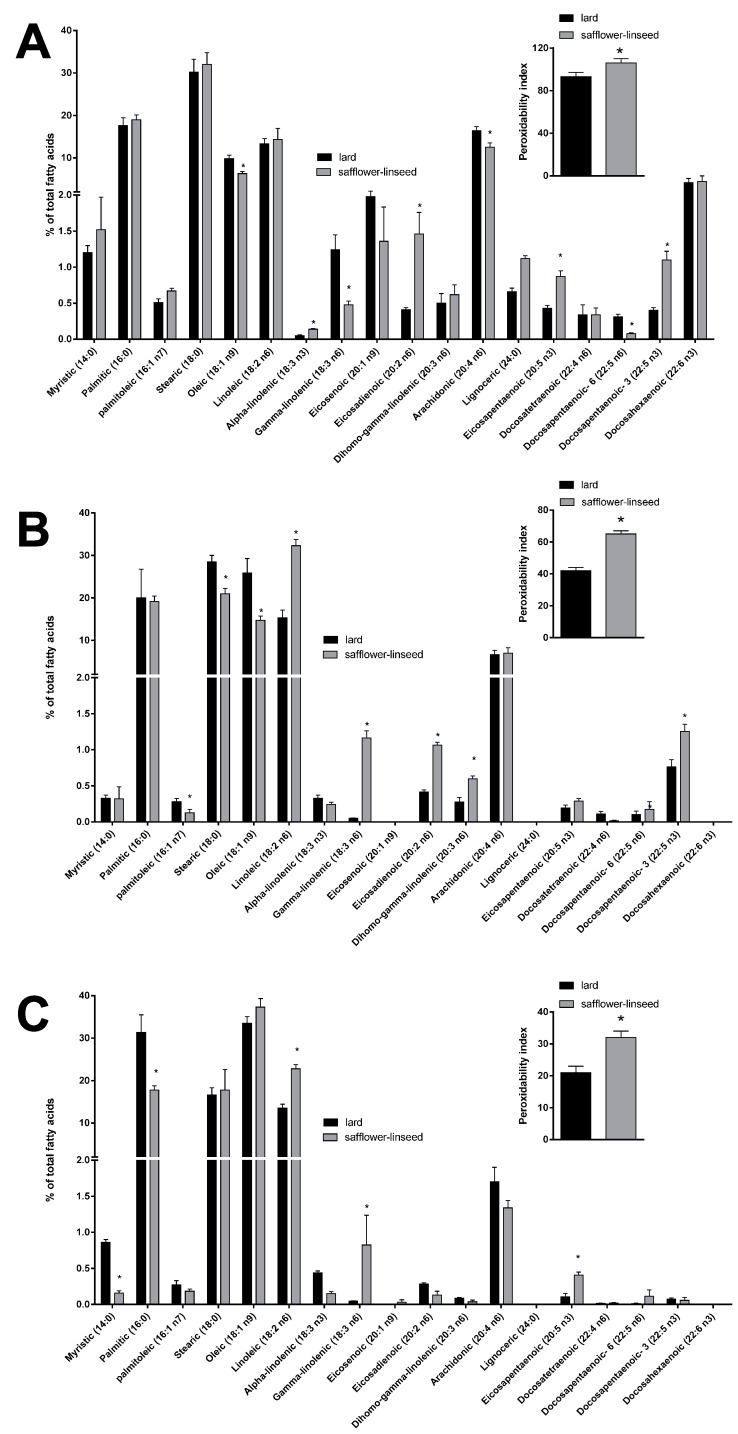
Percentage molar distribution of fatty acids and peroxidative index (inset) in hepatic mitochondria (A), hepatic tissue (B), and plasma (C) of rats fed lard or safflower-linseed high fat diet. Values are reported as means with their standard errors. n = 8 different rats. * p < 0.05 compared to lard.

References

    1. Hofbauer K.G., Nicholson J.R., Boss O. The obesity epidemic: Current and future pharmacological treatments. Annu. Rev. Pharmacol. Toxicol. 2007;47:565–592. doi: 10.1146/annurev.pharmtox.47.120505.105256. - DOI - PubMed
    1. Golay A., Ybarra J. Link between obesity and type 2 diabetes. Best Pract. Res. Clin. Endocrinol. Metab. 2005;19:649–663. doi: 10.1016/j.beem.2005.07.010. - DOI - PubMed
    1. Yatsuya H., Li Y., Hilawe E.H., Ota A., Wang C., Chiang C., Zhang Y., Uemura M., Osako A., Ozaki Y., et al. Global trend in overweight and obesity and its association with cardiovascular disease incidence. Circ. J. 2014;78:2807–2818. doi: 10.1253/circj.CJ-14-0850. - DOI - PubMed
    1. O’Neill S., O’Driscoll L. Metabolic syndrome: A closer look at the growing epidemic and its associated pathologies. Obes. Rev. 2015;16:1–12. doi: 10.1111/obr.12229. - DOI - PubMed
    1. Aydin S., Aksoy A., Aydin S., Kalayci M., Yilmaz M., Kuloglu T., Citil C., Catak Z. Today’s and yesterday’s of pathophysiology: Biochemistry of metabolic syndrome and animal models. Nutrition. 2014;30:1–9. doi: 10.1016/j.nut.2013.05.013. - DOI - PubMed

Publication types

MeSH terms

LinkOut - more resources