Review
. 2016 Jan;79(1):18-26.
doi: 10.1002/ana.24558. Epub 2015 Dec 15.

Tranexamic acid-associated seizures: Causes and treatment

Affiliations
Review

Tranexamic acid-associated seizures: Causes and treatment

Irene Lecker et al. Ann Neurol. 2016 Jan.

Abstract

Antifibrinolytic drugs are routinely used worldwide to reduce the bleeding that results from a wide range of hemorrhagic conditions. The most commonly used antifibrinolytic drug, tranexamic acid, is associated with an increased incidence of postoperative seizures. The reported increase in the frequency of seizures is alarming, as these events are associated with adverse neurological outcomes, longer hospital stays, and increased in-hospital mortality. However, many clinicians are unaware that tranexamic acid causes seizures. The goal of this review is to summarize the incidence, risk factors, and clinical features of these seizures. This review also highlights several clinical and preclinical studies that offer mechanistic insights into the potential causes of and treatments for tranexamic acid-associated seizures. This review will aid the medical community by increasing awareness about tranexamic acid-associated seizures and by translating scientific findings into therapeutic interventions for patients.


Figures

Figure 1
Figure 1
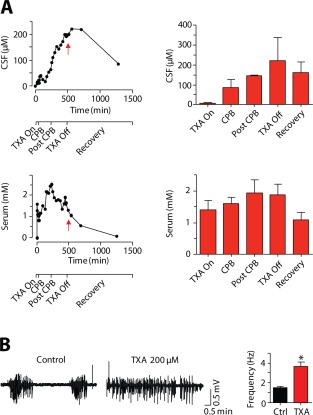
Tranexamic acid (TXA) concentrations measured in the cerebral spinal fluid (CSF) and serum of patients cause hyperexcitability in vitro. (A) The time course of TXA levels in the CSF and serum of 1 patient who experienced a seizure is shown on the left. The decline of TXA levels in the brain lags behind that in the blood. The timeline at the bottom of each figure indicates key surgical events during cardiopulmonary bypass (CPB). The red arrow highlights the concentrations when TXA administration was terminated. On the right are the summarized data of TXA concentrations in the CSF and serum during key surgical events (n = 4). TXA levels in the serum (2mM) are 10‐fold higher than those in the CSF (200 µM). (B) Clinically relevant concentration of TXA (200 µM) causes hyperexcitability by increasing the frequency of seizure‐like events in neocortical slices. *P < 0.05.
Figure 2
Figure 2
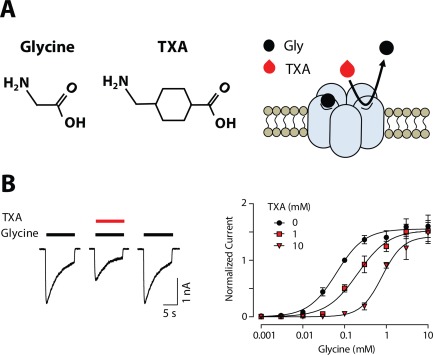
Tranexamic acid (TXA) is a competitive antagonist of glycine (Gly) receptors. (A) Glycine and TXA are structural analogues, suggesting that TXA competes with glycine at the agonist binding site of glycine receptors. (B) TXA (1mM) inhibits glycine (100 µM)‐activated currents in cortical neurons. The concentration–response plots for glycine current recorded in the absence and presence of TXA are shown. The results indicate that TXA is a competitive antagonist of glycine receptors.
Figure 3
Figure 3
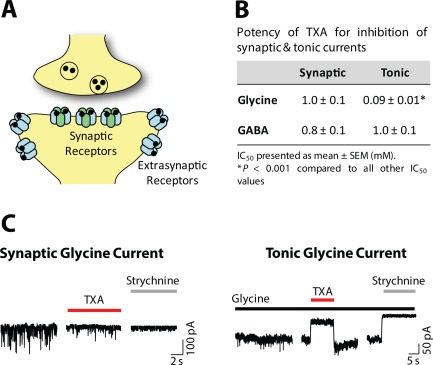
Tonic glycine current is highly sensitive to tranexamic acid (TXA) inhibition. (A) Inhibitory receptors are expressed in synaptic and extrasynaptic regions of the neuron. These receptors are composed of different subunits and have distinct pharmacological properties. Extrasynaptic receptors mediate a tonic inhibitory conductance. (B) Summary table of the half‐maximal inhibitory concentration (IC50) values for TXA inhibition of synaptic and tonic currents mediated by glycine and γ‐aminobutyric acid type A (GABA) receptors. (C) TXA (1mM) inhibits synaptic and tonic glycine currents in a similar manner as the competitive glycine antagonist, strychnine. Synaptic currents were studied by recording miniature inhibitory postsynaptic currents. Tonic currents were evoked by applying a low concentration of glycine (10 µM), similar to the ambient concentration present in the extracellular fluid, to the bath solution. SEM = standard error of the mean.
Figure 4
Figure 4
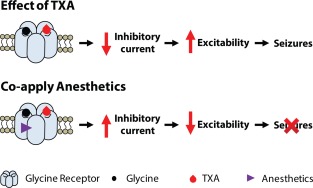
The molecular mechanism underlying tranexamic acid (TXA)‐associated seizures and the reversal of TXA‐mediated inhibition by anesthetics. TXA binds to the glycine receptors, resulting in a decrease in inhibitory current. This reduction in anion conduction increases excitability, which gives rise to seizures. Anesthetics reverse the effect of TXA by increasing glycine receptor function and thereby prevent or reverse TXA‐induced seizures.

References

    1. Henry DA, Carless PA, Moxey AJ, et al. Anti‐fibrinolytic use for minimising perioperative allogeneic blood transfusion. Cochrane Database Syst Rev 2007;(3):CD001886. - PubMed
    1. Dunn CJ, Goa KL. Tranexamic acid: a review of its use in surgery and other indications. Drugs 1999;57:1005–1032. - PubMed
    1. Roberts I, Shakur H, Afolabi A, et al. The importance of early treatment with tranexamic acid in bleeding trauma patients: an exploratory analysis of the CRASH‐2 randomised controlled trial. Lancet 2011;377:1096–1101. - PubMed
    1. Hoylaerts M, Lijnen HR, Collen D. Studies on the mechanism of the antifibrinolytic action of tranexamic acid. Biochim Biophys Acta 1981;673:75–85. - PubMed
    1. Iwamoto M. Plasminogen‐plasmin system IX. Specific binding of tranexamic acid to plasmin. Thromb Diath Haemorrh 1975;33:573–585. - PubMed

Publication types

MeSH terms