


Evolution of the additive genetic variance-covariance matrix under continuous directional selection on a complex behavioural phenotype
- PMID: 26582016
- PMCID: PMC4685799
- DOI: 10.1098/rspb.2015.1119
Evolution of the additive genetic variance-covariance matrix under continuous directional selection on a complex behavioural phenotype
Abstract
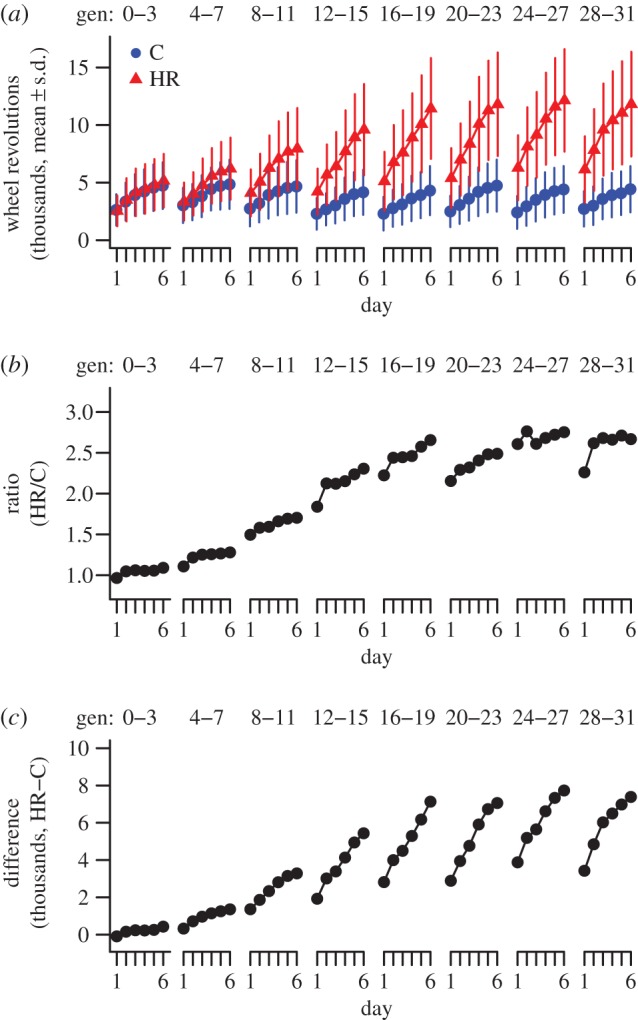
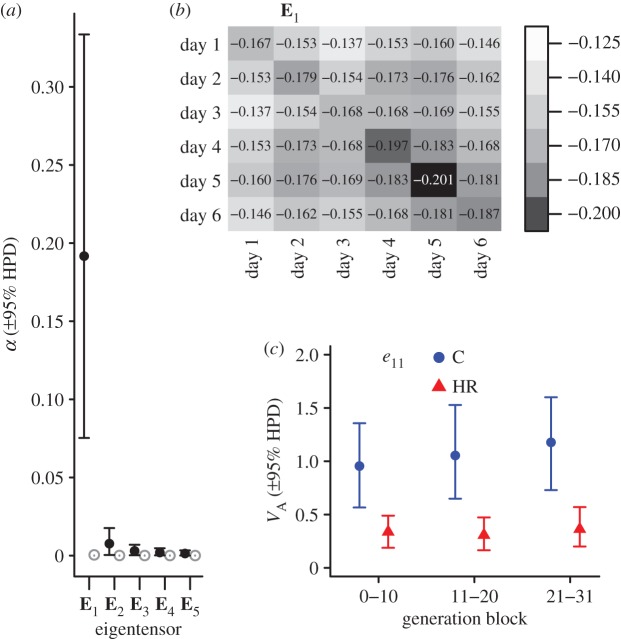
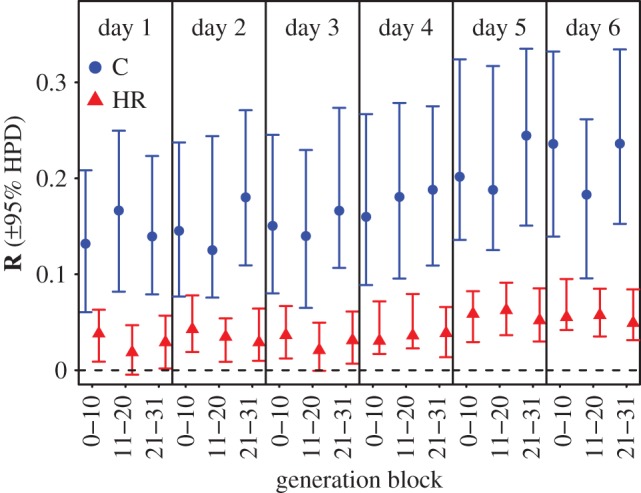
Given the pace at which human-induced environmental changes occur, a pressing challenge is to determine the speed with which selection can drive evolutionary change. A key determinant of adaptive response to multivariate phenotypic selection is the additive genetic variance-covariance matrix ( G: ). Yet knowledge of G: in a population experiencing new or altered selection is not sufficient to predict selection response because G: itself evolves in ways that are poorly understood. We experimentally evaluated changes in G: when closely related behavioural traits experience continuous directional selection. We applied the genetic covariance tensor approach to a large dataset (n = 17 328 individuals) from a replicated, 31-generation artificial selection experiment that bred mice for voluntary wheel running on days 5 and 6 of a 6-day test. Selection on this subset of G: induced proportional changes across the matrix for all 6 days of running behaviour within the first four generations. The changes in G: induced by selection resulted in a fourfold slower-than-predicted rate of response to selection. Thus, selection exacerbated constraints within G: and limited future adaptive response, a phenomenon that could have profound consequences for populations facing rapid environmental change.
Keywords: Bulmer effect; G-matrix; experimental evolution; genetic covariance tensor; selection limit; wheel running.
© 2015 The Author(s).
Figures
References
-
- Walsh B, Blows MW. 2009. Abundant genetic variation + strong selection = multivariate genetic constraints: a geometric view of adaptation. Annu. Rev. Ecol. Syst. 40, 41–59. (10.1146/annurev.ecolsys.110308.120232) - DOI
Publication types
MeSH terms
LinkOut - more resources
Full Text Sources
Other Literature Sources
