. 2015 Nov 22;282(1819):20152200.
doi: 10.1098/rspb.2015.2200.

Macroevolutionary assembly of ant/plant symbioses: Pseudomyrmex ants and their ant-housing plants in the Neotropics

Affiliations

Macroevolutionary assembly of ant/plant symbioses: Pseudomyrmex ants and their ant-housing plants in the Neotropics

Guillaume Chomicki et al. Proc Biol Sci. .

Abstract

Symbioses include some of the clearest cases of coevolution, but their origin, loss or reassembly with different partners can rarely be inferred. Here we use ant/plant symbioses involving three plant clades to investigate the evolution of symbioses. We generated phylogenies for the big-eyed arboreal ants (Pseudomyrmecinae), including 72% of their 286 species, as well as for five of their plant host groups, in each case sampling more than 61% of the species. We show that the ant-housing Vachellia (Mimosoideae) clade and its ants co-diversified for the past 5 Ma, with some species additionally colonized by younger plant-nesting ant species, some parasitic. An apparent co-radiation of ants and Tachigali (Caesalpinioideae) was followed by waves of colonization by the same ant clade, and subsequent occupation by a younger ant group. Wide crown and stem age differences between the ant-housing genus Triplaris (Polygonaceae) and its obligate ant inhabitants, and stochastic trait mapping, indicate that its domatium evolved earlier than the ants now occupying it, suggesting previous symbioses that dissolved. Parasitic ant species evolved from generalists, not from mutualists, and are younger than the mutualistic systems they parasitize. Our study illuminates the macroevolutionary assembly of ant/plant symbioses, which has been highly dynamic, even in very specialized systems.

Keywords: Pseudomyrmex; ant/plant coevolution; co-radiation; molecular clocks; secondary colonization; symbiosis.


Figures

Figure 1.
Figure 1.
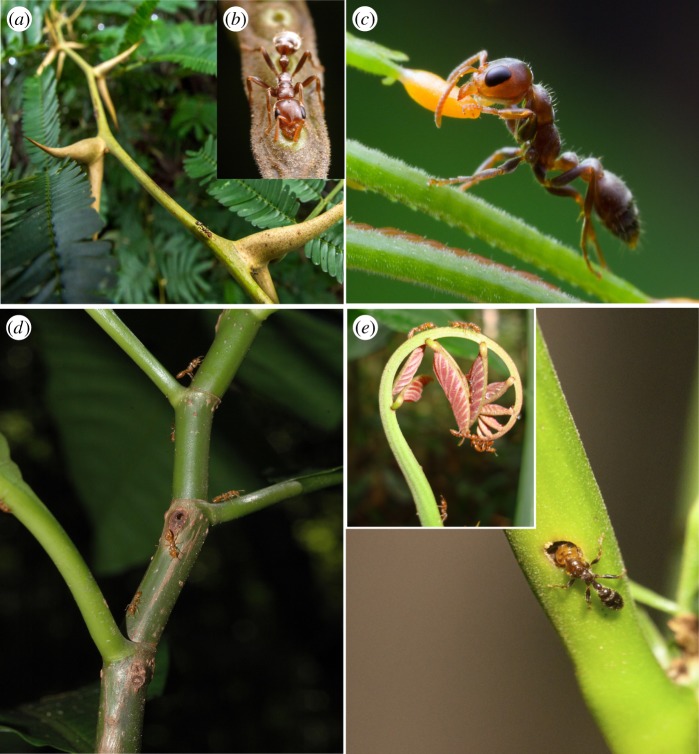
Examples of Pseudomyrmex/plant symbioses. (ac) Vachellia/Pseudomyrmex peperi symbiosis. (a) Vachellia habit with stipular thorn domatia. (b) Pseudomyrmex peperi worker feeding on the large Vachellia extrafloral nectaries. (c) Pseudomyrmex peperi collecting a protein-rich Beltian body from the Vachellia leaflet tips. (d) Triplaris americana domatium inhabited by Pseudomyrmex triplarinus. (e) Tachigali myrmecophila/Pseudomyrmex concolor-group symbiosis. (e, inset) P. concolor entering in a Tachigali myrmecophila leaf domatium. (e) Pseudomyrmex penetrator entering the leaf rachis domatium, where an entrance hole has been chewed. Photo credits: (ac) Alexander Wild, (d) Fabian Michelangeli, (e, inset), Heraldo Vasconcelos, (e) Ricardo Solar. (Online version in colour.)
Figure 2.
Figure 2.
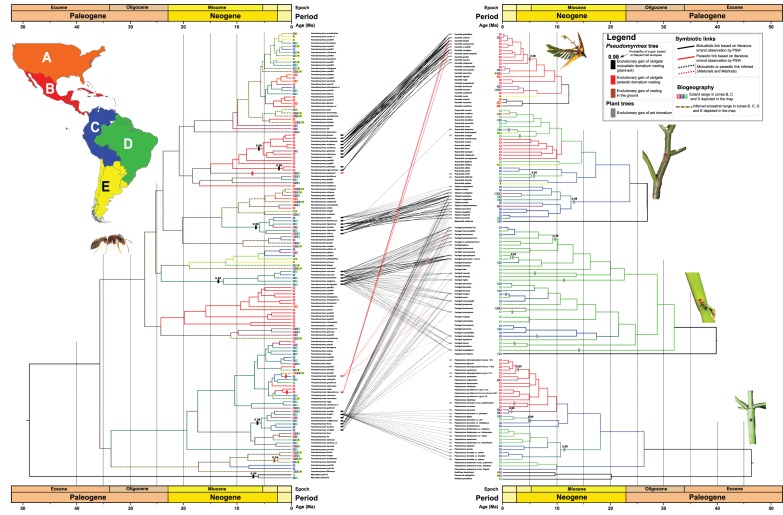
Dated phylogenies of Pseudomyrmex and its five main plant host groups: Vachellia, Triplaris/Ruprechtia, Tachigali and Platymiscium. Colour coding (map) shows the ancestral range resulting from the best-fit model (§2). Links between ant and plant species are solid black for documented mutualistic interactions, red for documented parasitic interactions, and dotted for inferred interactions. Black rectangles mark the evolutionary gain of mutualistic obligate plant nesting; red rectangles mark parasitic obligate plant nesting; and brown rectangles indicate ground nesting. The remaining Pseudomyrmex species are generalist arboreal ants. Grey rectangles mark the evolutionary gain of ant domatia. Numbers above rectangles refer to the probability of an inferred gain based on BayesTraits analyses (this cannot be inferred for single species; see §2). A rectangle positioned next to a crown group means that the trait originated at that node, while the rectangle position for branches leading to single species is arbitrary. Ancestral state reconstructions are shown in the electronic supplementary material, figures S5–S10 and S12. (Online version in colour.)
Figure 3.
Figure 3.
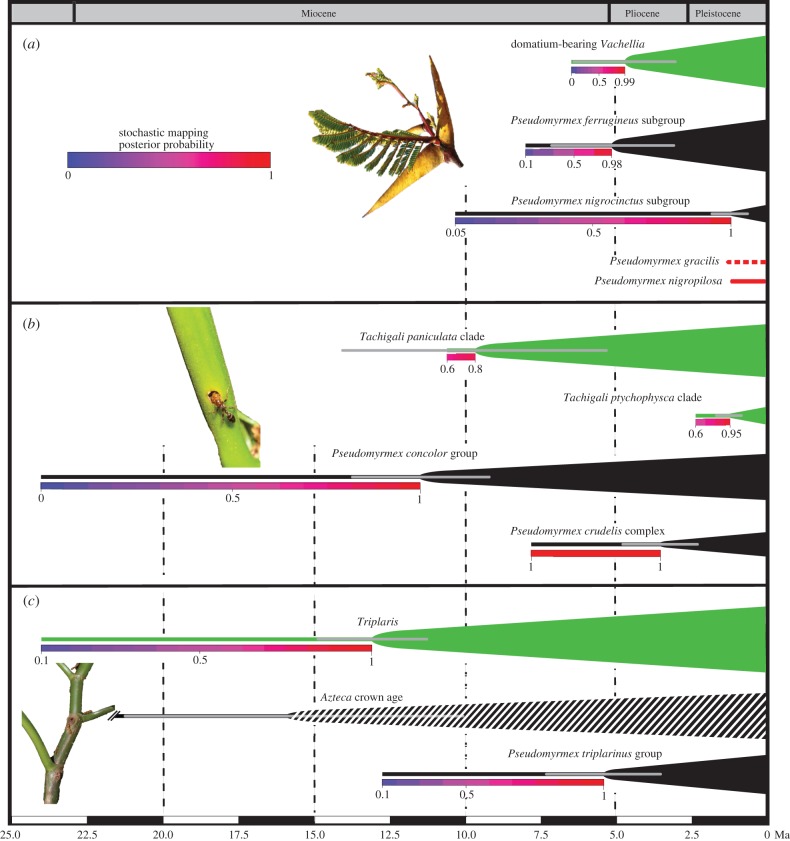
Macroevolutionary patterns of age and trait matching of interacting Pseudomyrmex ants and domatium-bearing plant lineages and hypothetical-associated evolutionary processes. (a) Co-radiation of Vachellia and the P. ferrugineus subgroup, followed by secondary colonization by mutualistic species of the P. nigrocinctus species complex, parasitic P. nigropilosus and the generalist P. gracilis. (b) Potential initial co-radiation of Tachigali and the P. concolor species group, followed by host broadening to other Tachigali lineages and secondary colonization of Tachigali by members of the P. crudelis species complex. (c) In domatium-bearing Triplaris, crown and stem ages and ancestral state reconstruction suggest that the ant mutualists (the P. triplarinus group) that currently nest in Triplaris domatia are younger by approximately 8 Myr than is domatium-presence in Triplaris, suggesting possible symbioses with other (earlier) ant species, such as Azteca whose crown age (banded) matches Triplaris and which sometimes forms symbioses with the latter (see §4). Grey error bars show the 95% CI from BEAST. Black (ants) or green (plant) bars depict stem branches. Colour gradient along the stem branch shows the posterior probability of a density plot summarizing 1000 stochastic simulations of trait evolution. See also the associated electronic supplementary material, figure S12. Below the arbitrary threshold of 0.5, the traits (domatium or domatium-nesting) are unlikely to have been present. (Online version in colour.)

References

    1. Bronstein JL, Alarcón R, Geber M. 2006. The evolution of plant–insect mutualisms. New Phytol. 172, 412–428. (10.1111/j.1469-8137.2006.01864.x) - DOI - PubMed
    1. Frederickson ME. 2013. Rethinking mutualism stability: cheaters and the evolution of sanctions. Q. Rev. Biol. 88, 269–295. (10.1086/673757) - DOI - PubMed
    1. Sachs JL, Simms EL. 2006. Pathways to mutualism breakdown. Trends Ecol. Evol. 21, 585–592. (10.1016/j.tree.2006.06.018) - DOI - PubMed
    1. de Vienne DM, Refrégier G, López-Villavicencio M, Tellier A, Hood ME, Giraud T. 2013. Cospeciation vs host-shift speciation: methods for testing, evidence from natural associations and relation to coevolution. New Phytol. 198, 347–385. (10.1111/nph.12150) - DOI - PubMed
    1. Clark MA, Moran NA, Baumann P, Wernegreen JJ. 2000. Cospeciation between bacterial endosymbionts (Buchnera) and a recent radiation of aphids (Uroleucon) and pitfalls of testing for phylogenetic congruence. Evolution 54, 517–525. (10.1111/j.0014-3820.2000.tb00054.x) - DOI - PubMed

Publication types