


No-dependent signaling pathways in unloaded skeletal muscle
- PMID: 26582991
- PMCID: PMC4628111
- DOI: 10.3389/fphys.2015.00298
No-dependent signaling pathways in unloaded skeletal muscle
Abstract
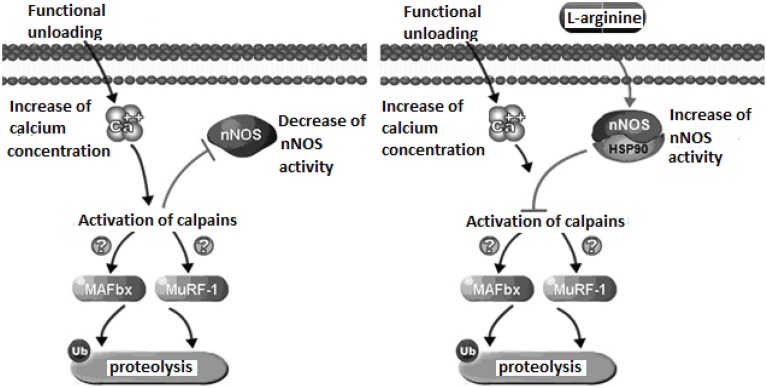
The main focus of the current review is the nitric oxide (NO)-mediated signaling mechanism in unloaded skeletal. Review of the published data describing muscles during physical activity and inactivity demonstrates that NO is an essential trigger of signaling processes, which leads to structural and metabolic changes of the muscle fibers. The experiments with modulation of NO-synthase (NOS) activity during muscle unloading demonstrate the ability of an activated enzyme to stabilize degradation processes and prevent development of muscle atrophy. Various forms of muscle mechanical activity, i.e., plantar afferent stimulation, resistive exercise and passive chronic stretch increase the content of neural NOS (nNOS) and thus may facilitate an increase in NO production. Recent studies demonstrate that NO-synthase participates in the regulation of protein and energy metabolism in skeletal muscle by fine-tuning and stabilizing complex signaling systems which regulate protein synthesis and degradation in the fibers of inactive muscle.
Keywords: NO-synthase; nitric oxide (II); protective function of NO; skeletal muscle; unloading.
Figures
References
Publication types
LinkOut - more resources
Full Text Sources
Other Literature Sources
