


Classifying aging as a disease in the context of ICD-11
- PMID: 26583032
- PMCID: PMC4631811
- DOI: 10.3389/fgene.2015.00326
Classifying aging as a disease in the context of ICD-11
Abstract
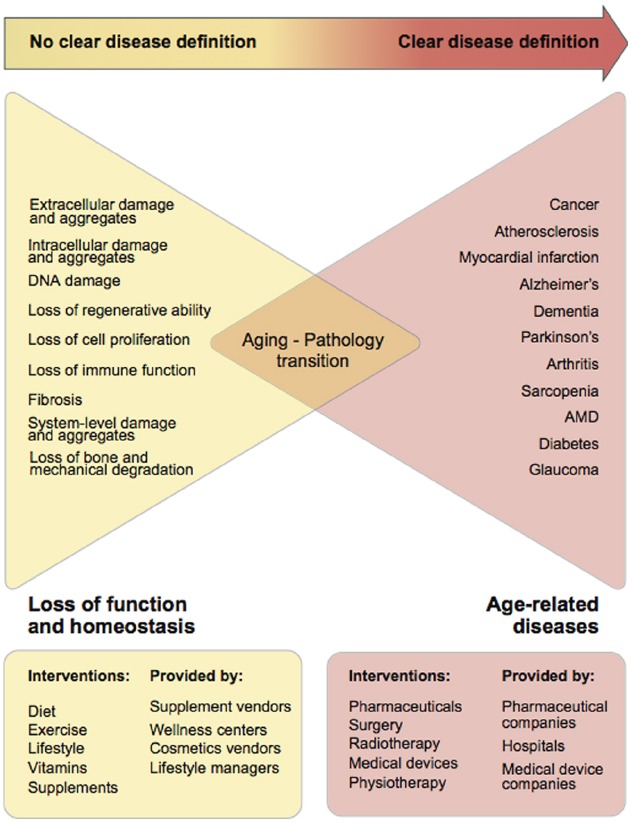
Aging is a complex continuous multifactorial process leading to loss of function and crystalizing into the many age-related diseases. Here, we explore the arguments for classifying aging as a disease in the context of the upcoming World Health Organization's 11th International Statistical Classification of Diseases and Related Health Problems (ICD-11), expected to be finalized in 2018. We hypothesize that classifying aging as a disease with a "non-garbage" set of codes will result in new approaches and business models for addressing aging as a treatable condition, which will lead to both economic and healthcare benefits for all stakeholders. Actionable classification of aging as a disease may lead to more efficient allocation of resources by enabling funding bodies and other stakeholders to use quality-adjusted life years (QALYs) and healthy-years equivalent (HYE) as metrics when evaluating both research and clinical programs. We propose forming a Task Force to interface the WHO in order to develop a multidisciplinary framework for classifying aging as a disease with multiple disease codes facilitating for therapeutic interventions and preventative strategies.
Keywords: ICD-10; ICD-11; QALY; WHO; aging; biogerontology; disease classification; task force.
Figures
References
-
- Aguilar-Olivos N. E., Oria-Hernandez J., Chavez-Tapia N. C., Uribe M., Mendez-Sanchez N. (2015). The role of epigenetics in the progression of non-alcoholic fatty liver disease. Mini Rev. Med. Chem. 15, 1187–1194. - PubMed
-
- American Medical Association. (1961). “Standard nomenclature of diseases and operations,” in National Conference on Medical Nomenclature (U.S.), eds Plunkett R. J., Hayden A. C. (New York: American Medical Association; ).
LinkOut - more resources
Full Text Sources
Other Literature Sources
