. 2016 Feb;79(2):178-89.
doi: 10.1002/ana.24560. Epub 2015 Dec 9.

Genes and Environment in Multiple Sclerosis project: A platform to investigate multiple sclerosis risk

Affiliations

Genes and Environment in Multiple Sclerosis project: A platform to investigate multiple sclerosis risk

Zongqi Xia et al. Ann Neurol. 2016 Feb.

Abstract

The Genes and Environment in Multiple Sclerosis project establishes a platform to investigate the events leading to multiple sclerosis (MS) in at-risk individuals. It has recruited 2,632 first-degree relatives from across the USA. Using an integrated genetic and environmental risk score, we identified subjects with twice the MS risk when compared to the average family member, and we report an initial incidence rate in these subjects that is 30 times greater than that of sporadic MS. We discuss the feasibility of large-scale studies of asymptomatic at-risk subjects that leverage modern tools of subject recruitment to execute collaborative projects.


Conflict of interest statement

Conflict of Interest Disclosures: None

Figures

Figure 1
Figure 1
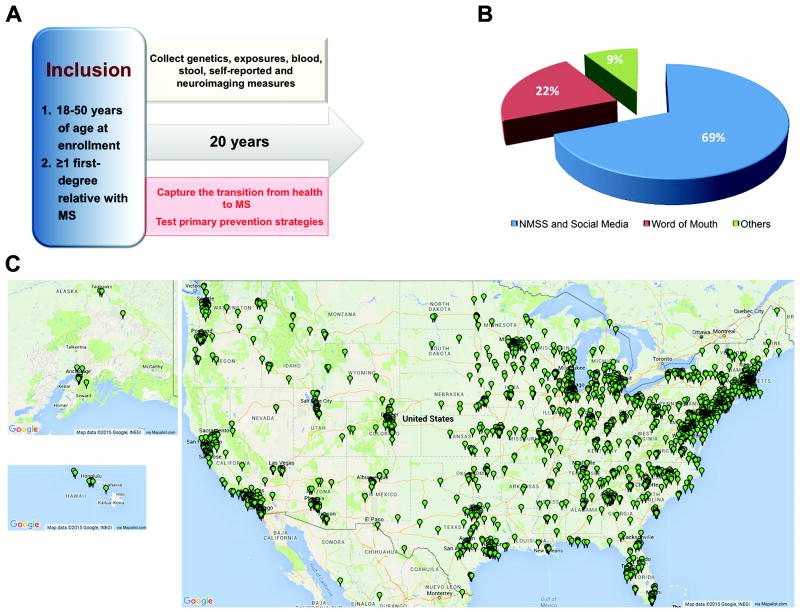
The Genes and Environment in Multiple Sclerosis (GEMS) Study: illustrating the nationwide scope of this new resource of subjects and samples. (A) The diagram summarizes the overall design of the GEMS study. MS, multiple sclerosis. (B) The pie chart displays the relative contribution of different subject recruitment strategies and highlights the importance of electronic communications in subject recruitment. NMSS, National Multiple Sclerosis Society. (C) The maps show the location of enrolled subjects as of August 2015. Maps were generated with permission using Map Data @2015 Google, INEGI, via Mapalist™. Subjects have been recruited from each of the 50 states in the United States.
Figure 2
Figure 2
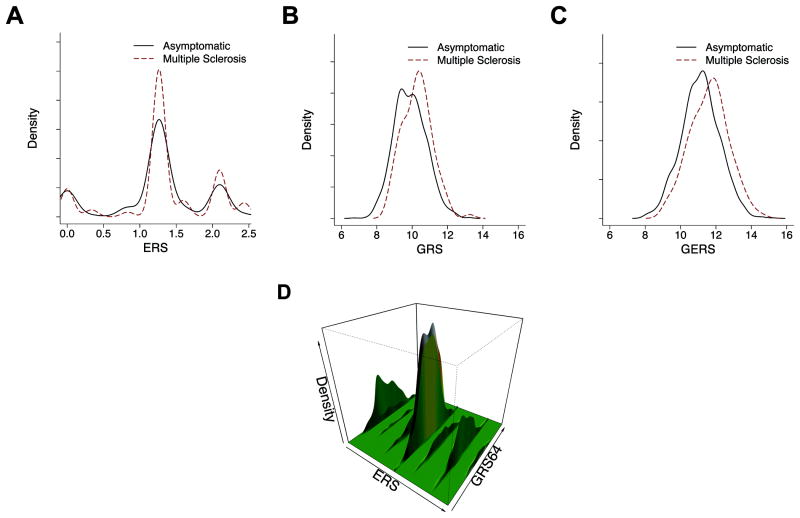
Density distribution of risk scores for the GEMS subjects (first-degree family members with or without multiple sclerosis at the time of study enrollment). (A) Environmental Risk Score (ERS), (B) Genetic Risk Score (GRS), and (C) the combined Genetic and Environmental Risk Score (GERS). The environmental risk score contains three factors. The genetic risk score contains 64 validated genetic variants associated with MS susceptibility. Please refer to the section entitled “Determining the Genetic and Environmental Architecture of MS Risk Among First-Degree Relatives” for details. (D) Two dimensional histogram combining the data from A and B to present the distribution of risk among all GEMS subjects along both the genetic and environmental dimensions simultaneously. Each subject is located somewhere along this surface of risk profile.
Figure 3
Figure 3
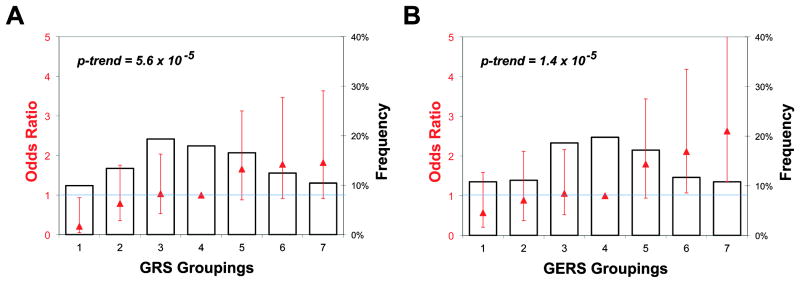
Quantile plot presenting the risk of multiple sclerosis in each of the 7 strata of Genes and Environment in Multiple Sclerosis subjects defined by their risk scores. Groups are stratified using the (A) genetic risk score (GRS) and (B) genetic and environmental risk score (GERS). Please refer to the section Evaluating the Utility of the GERS for Risk Stratification for details. The bars show the frequency of the asymptomatic subjects in each group. Group 1 is the lowest risk category and Group 7 the highest. The odds ratio (red triangles) for MS susceptibility in each risk group is superimposed in red with the 95% confidence interval for that estimate (red line). The p-value is calculated as a linear trend across the groups. Odds ratios are determined as the odds of MS in each group divided by the odds of MS in the reference group (Group 4 is the median group).

References

    1. Compston A, Coles A. Multiple sclerosis. Lancet. 2008;372(9648):1502–1517. - PubMed
    1. Okuda DT, Mowry EM, Beheshtian A, et al. Incidental MRI anomalies suggestive of multiple sclerosis: the radiologically isolated syndrome. Neurology. 2009;72(9):800–805. - PubMed
    1. Engell T. A clinical patho-anatomical study of clinically silent multiple sclerosis. Acta Neurologica Scandinavica. 1989;79(5):428–430. - PubMed
    1. Dalton CM, Chard DT, Davies GR, et al. Early development of multiple sclerosis is associated with progressive grey matter atrophy in patients presenting with clinically isolated syndromes. Brain. 2004;127(Pt 5):1101–1107. - PubMed
    1. Comi G, Martinelli V, Rodegher M, et al. Effect of glatiramer acetate on conversion to clinically definite multiple sclerosis in patients with clinically isolated syndrome (PreCISe study): a randomised, double-blind, placebo-controlled trial. Lancet. 2009;374(9700):1503–1511. - PubMed

Publication types