. 2015 Dec;10(12):2074-80.
doi: 10.1038/nprot.2015.131. Epub 2015 Nov 19.

Extracellular protease digestion to evaluate membrane protein cell surface localization

Affiliations

Extracellular protease digestion to evaluate membrane protein cell surface localization

Richard N Besingi et al. Nat Protoc. 2015 Dec.

Abstract

Membrane proteins have crucial roles in signaling and as anchors for cell surface display. Proper secretion of a membrane protein can be evaluated by its susceptibility to digestion by an extracellular protease, but this requires a crucial control to confirm membrane integrity during digestion. This protocol describes how to use this approach to determine how efficiently a protein is secreted to the outer surface of Gram-negative bacteria. Its success relies upon careful selection of an appropriate intracellular reporter protein that will remain undigested if the membrane barrier remains intact, but that is rapidly digested when cells are lysed before evaluation. Reporter proteins that are resistant to proteases (e.g., maltose-binding protein) do not return accurate results; in contrast, proteins that are more readily digested (e.g., SurA) serve as more sensitive reporters of membrane integrity, yielding more accurate measurements of membrane protein localization. Similar considerations apply when evaluating membrane protein localization in other contexts, including eukaryotic cells and organelle membranes. Evaluating membrane protein localization using this approach requires only standard biochemistry laboratory equipment for cell lysis, gel electrophoresis and western blotting. After expression of the protein of interest, this procedure can be completed in 4 h.


Conflict of interest statement

Competing Financial Interests

The authors declare no competing financial interests.

Figures

Figure 1
Figure 1
Accurate use of protease digestion to confirm protein cell surface display requires monitoring a protease-sensitive intracellular control protein. (a) When the membrane of interest (in this example, the bacterial outer membrane (OM)) remains intact, the protease (yellow) will only have access to and digest the protein of interest (green) when it is displayed on the extracellular side of the OM. Improperly secreted forms of the protein of interest will remain intact, along with any intracellular control proteins (blue and purple), regardless of their stability. (b) Higher protease concentrations or other stress, including too-vigorous cell resuspension, can destabilize cell membranes, enabling protease access to the intracellular marker proteins. This will lead to digestion of both extracellular and intracellular forms of the protein of interest, but can be detected by digestion of a protease-sensitive reporter protein (blue). However, if the selected reporter protein is highly resistant to degradation (purple), it will remain resistant to digestion regardless of membrane integrity, leading to the erroneous conclusion that the OM remains intact and all of the protein of interest resides at the cell surface.
Figure 2
Figure 2
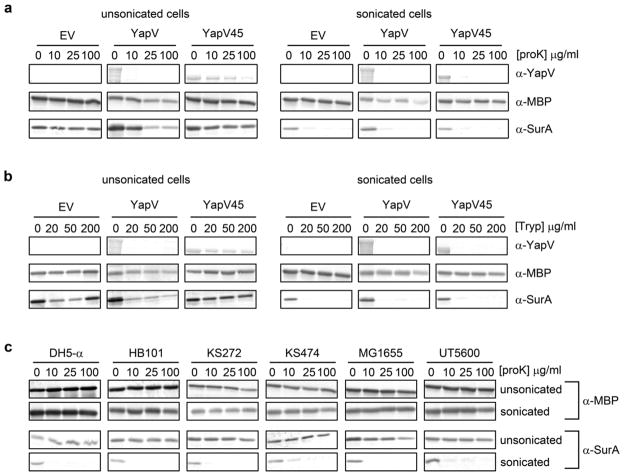
Western blots showing the resistance of YapV45, MBP and SurA to digestion by proteinase K (proK) or trypsin (Tryp) in intact cells or sonicated cell lysates. (a) Proteinase K treatment of E. coli BL21(DE3)pLysS expressing YapV, YapV45 or harboring the empty vector (EV). YapV is digested on the surface of intact cells. When cells are lysed by sonication prior to proK treatment, the cytoplasm localized YapV45 and the periplasmic chaperone SurA are digested, but the periplasmic MBP is not digested. (b) Trypsin treatment results in the same digestion pattern as proK. (c) Proteinase K treatment of several additional strains of E. coli. MBP is resistant to digestion by proK in all strains tested, even after cell lysis by sonication prior to proK treatment. In contrast, SurA remains undigested after proK treatment of intact cells, but is digested by proK when cells are lysed by sonication prior to proK treatment.
Figure 3
Figure 3
MBP is resistant to proK digestion even at high (400 μg/ml) proK concentrations. E. coli BL21(DE3)pLysS expressing the indicated constructs were treated with proK at the indicated concentrations. For intact cells treated with 400 μg/ml proK, the cytoplasm-localized YapV45 is completely digested even though the periplasm-localized MBP remains largely intact.

References

    1. Jose J, Maas RM, Teese MG. Autodisplay of enzymes--molecular basis and perspectives. J Biotechnol. 2012;161:92–103. - PubMed
    1. Jong W, et al. An autotransporter display platform for the development of multivalent recombinant bacterial vector vaccines. Microb Cell Fact. 2014;13:162. - PMC - PubMed
    1. Junker M, Besingi RN, Clark PL. Vectorial transport and folding of an autotransporter virulence protein during outer membrane secretion. Mol Microbiol. 2009;71:1323–32. - PubMed
    1. Lenz JD, et al. Expression during host infection and localization of Yersinia pestis autotransporter proteins. J Bacteriol. 2011;193:5936–49. - PMC - PubMed
    1. Sauri A, et al. Autotransporter beta-domains have a specific function in protein secretion beyond outer-membrane targeting. J Mol Biol. 2011;412:553–67. - PubMed

Publication types

MeSH terms