. 2015 Dec 8;5(6):1109-1118.
doi: 10.1016/j.stemcr.2015.10.009. Epub 2015 Nov 12.

Simultaneous Reprogramming and Gene Correction of Patient Fibroblasts

Affiliations

Simultaneous Reprogramming and Gene Correction of Patient Fibroblasts

Sara E Howden et al. Stem Cell Reports. .

Abstract

The derivation of genetically modified induced pluripotent stem (iPS) cells typically involves multiple steps, requiring lengthy cell culture periods, drug selection, and several clonal events. We report the generation of gene-targeted iPS cell lines following a single electroporation of patient-specific fibroblasts using episomal-based reprogramming vectors and the Cas9/CRISPR system. Simultaneous reprogramming and gene targeting was tested and achieved in two independent fibroblast lines with targeting efficiencies of up to 8% of the total iPS cell population. We have successfully targeted the DNMT3B and OCT4 genes with a fluorescent reporter and corrected the disease-causing mutation in both patient fibroblast lines: one derived from an adult with retinitis pigmentosa, the other from an infant with severe combined immunodeficiency. This procedure allows the generation of gene-targeted iPS cell lines with only a single clonal event in as little as 2 weeks and without the need for drug selection, thereby facilitating "seamless" single base-pair changes.


Figures

Figure 1
Figure 1
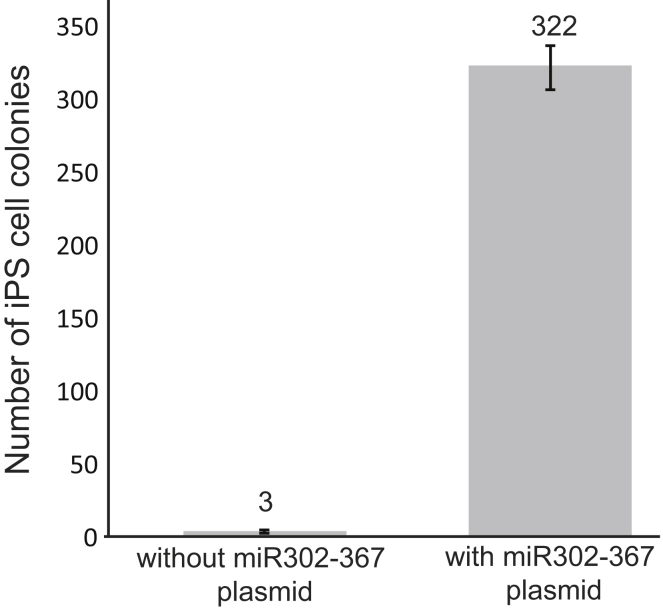
Episomal Reprogramming System Is Enhanced with Inclusion of Plasmid Encoding the miR302/367 Cluster Reprogramming experiments were performed with and without inclusion of the miR302/367 expression plasmid using a normal male fibroblast line. Data represent an average of three independent experiments ± SD.
Figure 2
Figure 2
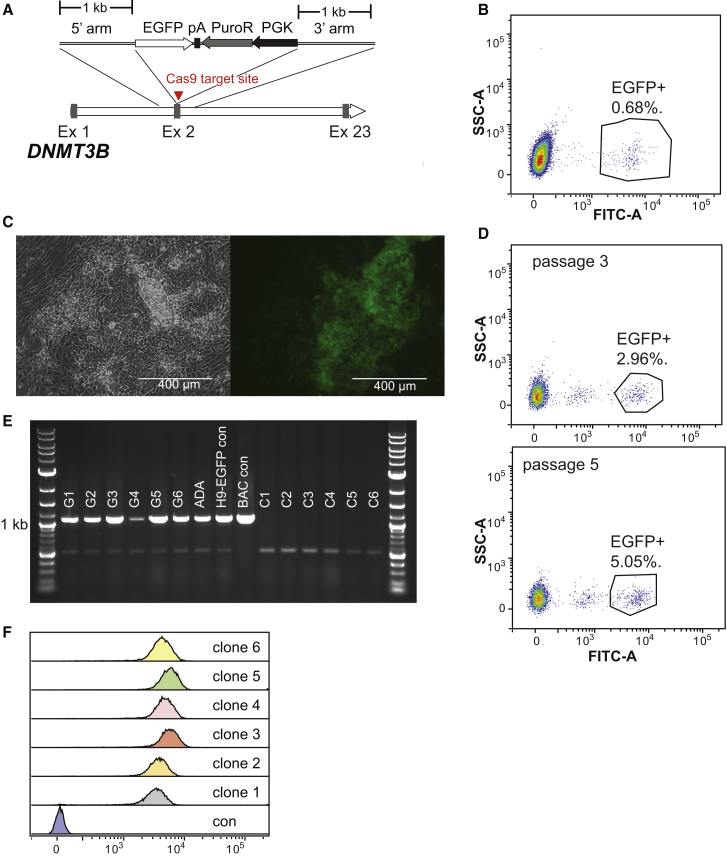
Gene Targeting of the DNMT3B Locus (A) Schematic diagram of the DNMT3B locus and the donor template used for gene targeting. pA, polyA signal; Ex, exon. (B) Flow cytometric analysis of H9 cells 3 days following the transfection of DNMT3B-specific donor template, mRNA encoding Cas9 protein, and plasmid carrying DNMT3B-specific sgRNA. (C) Representative phase contrast and fluorescent images of an iPS cell colony generated after simultaneous reprogramming and gene targeting of DNMT3B in fibroblasts derived from a patient with retinitis pigmentosa, acquired 2.5 weeks post-electroporation. (D) Flow cytometric analysis of the total cell population after EDTA passaging, initiated approximately 3 weeks post-electroporation. Analysis was performed after three and five passages. (E) PCR analysis across recombination junction to confirm gene targeting of DNMT3B, using primers specific to sequence upstream of 3′ homology arm and EGFP. Analysis was performed on 6 EGFP-expressing iPS cell clones (lanes G1–G6) and 6 EGFP-non-expressing iPS cell clones (lanes C1–C6). An H9-derived DNMT3B-EGFP knockin and BAC carrying EGFP inserted at DNMT3B start codon (used to generate donor template) were included as positive controls. (F) Flow cytometric analysis of EGFP-expressing iPS cell lines generated after simultaneous reprogramming and gene targeting of the DNMT3B locus.
Figure 3
Figure 3
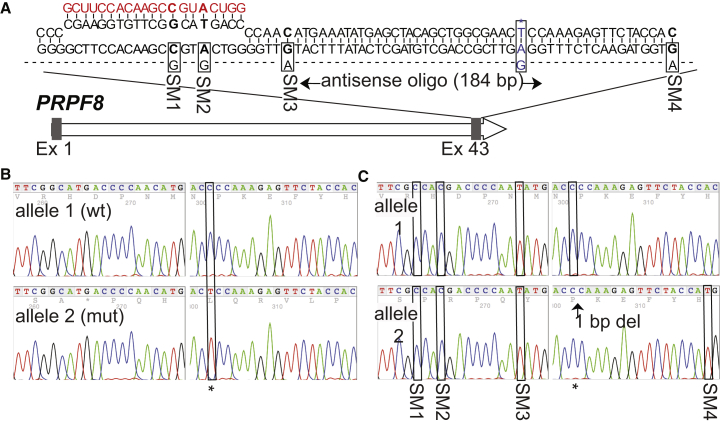
Simultaneous Reprogramming and Genetic Correction of the PRPF8 Gene in Fibroblasts from a Patient with Retinitis Pigmentosa (A) Schematic diagram of the PRPF8 gene, with mutation in exon 42. The Cas9 target site (red), the patient-specific mutation (blue), and antisense single-stranded DNA template used for gene repair are shown. (B) Sequencing analysis of exon 42 of the PRPF8 gene in the genomic DNA from uncorrected patient-specific iPS cells. Both wild-type and mutant alleles are shown. (C) Sequencing analysis of genomic DNA from a single iPS cell clone following successful simultaneous reprogramming and genetic correction of patient-specific fibroblasts. Both alleles appear to have undergone homologous recombination with the corrective ssODN as evidenced by the presence of the ssODN-specific synonymous mutations (SM 1-4) on both alleles. One allele also has a single base-pair deletion, which is most likely caused by an ssODN that was incorrectly synthesized. The location of the patient-specific mutation and synonymous mutations introduced by the repair ssODN are marked by black boxes.
Figure 4
Figure 4
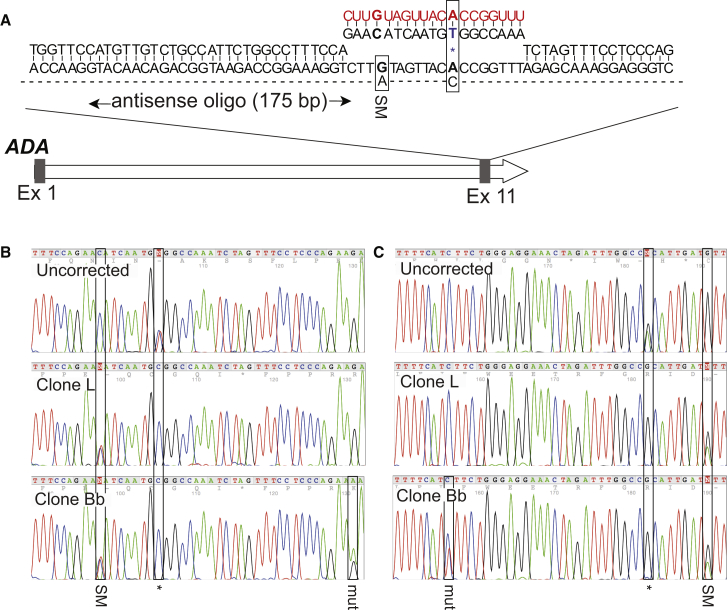
Simultaneous Reprogramming and Genetic Correction of ADA-SCID Fibroblasts (A) Schematic diagram of the ADA gene, with mutation in exon 11. The Cas9 target site (red), the patient-specific mutation (blue), and antisense single-stranded DNA template used for gene repair are shown. (B) Sequencing analysis of exon 11 of the ADA gene in the genomic DNA of an uncorrected and two gene-corrected iPS cell lines derived from ADA-SCID fibroblasts. One of the gene-corrected lines (clone Bb) was also found to carry a G > A transition approximately 35 bp downstream of the intended DNA double-stranded break, and most likely introduced by an incorrectly synthesized ssODN. (C) Sequencing analysis of the ADA transcript amplified from the cDNA of an uncorrected and two gene-corrected iPS cell lines. The location of the patient-specific mutation, synonymous mutation, and G > A transition introduced by the repair ssODN are marked by black boxes.
Figure 5
Figure 5
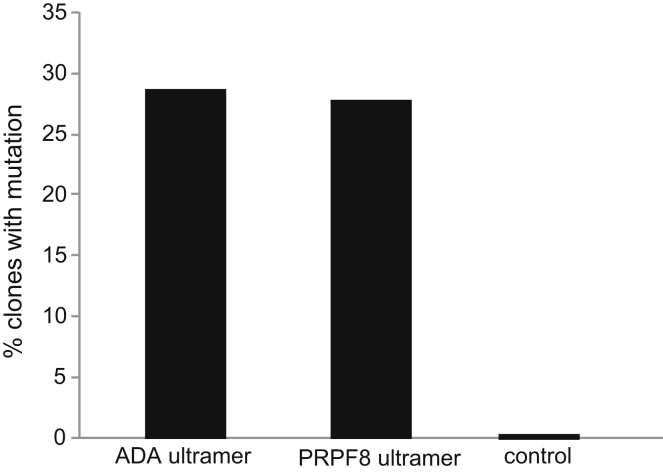
Sequencing Analysis of Oligonucleotides Used in Gene Repair Experiments The number of plasmid clones (expressed as percentage of total clones analyzed) carrying oligonucleotide sequence with at least one mutational event is shown. As a control, the PRPF8-specific oligonucleotide sequence from a single plasmid clone was PCR-amplified and re-cloned to assess polymerase error rate.

References

    1. Abyzov A., Mariani J., Palejev D., Zhang Y., Haney M.S., Tomasini L., Ferrandino A.F., Rosenberg Belmaker L.A., Szekely A., Wilson M. Somatic copy number mosaicism in human skin revealed by induced pluripotent stem cells. Nature. 2012;492:438–442. - PMC - PubMed
    1. Chen G., Ye Z., Yu X., Zou J., Mali P., Brodsky R.A., Cheng L. Trophoblast differentiation defect in human embryonic stem cells lacking PIG-A and GPI-anchored cell-surface proteins. Cell Stem Cell. 2008;2:345–355. - PMC - PubMed
    1. Chen G., Gulbranson D.R., Hou Z., Bolin J.M., Ruotti V., Probasco M.D., Smuga-Otto K., Howden S.E., Diol N.R., Propson N.E. Chemically defined conditions for human iPSC derivation and culture. Nat. Methods. 2011;8:424–429. - PMC - PubMed
    1. Gore A., Li Z., Fung H.L., Young J.E., Agarwal S., Antosiewicz-Bourget J., Canto I., Giorgetti A., Israel M.A., Kiskinis E. Somatic coding mutations in human induced pluripotent stem cells. Nature. 2011;471:63–67. - PMC - PubMed
    1. Guilinger J.P., Thompson D.B., Liu D.R. Fusion of catalytically inactive Cas9 to FokI nuclease improves the specificity of genome modification. Nat. Biotechnol. 2014;32:577–582. - PMC - PubMed

Publication types

Substances