. 2016 Jul;231(7):1621-7.
doi: 10.1002/jcp.25263. Epub 2015 Dec 10.

Stretching Impacts Inflammation Resolution in Connective Tissue

Affiliations

Stretching Impacts Inflammation Resolution in Connective Tissue

Lisbeth Berrueta et al. J Cell Physiol. 2016 Jul.

Abstract

Acute inflammation is accompanied from its outset by the release of specialized pro-resolving mediators (SPMs), including resolvins, that orchestrate the resolution of local inflammation. We showed earlier that, in rats with subcutaneous inflammation of the back induced by carrageenan, stretching for 10 min twice daily reduced inflammation and improved pain, 2 weeks after carrageenan injection. In this study, we hypothesized that stretching of connective tissue activates local pro-resolving mechanisms within the tissue in the acute phase of inflammation. In rats injected with carrageenan and randomized to stretch versus no stretch for 48 h, stretching reduced inflammatory lesion thickness and neutrophil count, and increased resolvin (RvD1) concentrations within lesions. Furthermore, subcutaneous resolvin injection mimicked the effect of stretching. In ex vivo experiments, stretching of connective tissue reduced the migration of neutrophils and increased tissue RvD1 concentration. These results demonstrate a direct mechanical impact of stretching on inflammation-regulation mechanisms within connective tissue.


Conflict of interest statement

C.N.S. is an inventor on patents [resolvins] assigned to BWH and licensed to Resolvyx Pharmaceuticals. C.N.S. is a scientific founder of Resolvyx Pharmaceuticals and owns equity in the company. C.N.S.’ interests were reviewed and are managed by the Brigham and Women’s Hospital and Partners HealthCare in accordance with their conflict of interest policies.

Figures
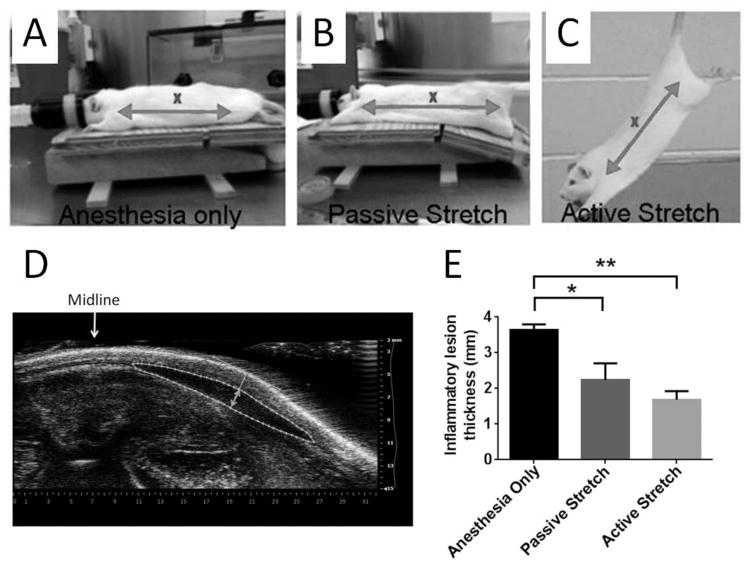
Figure 1
Figure 1. In vivo stretching and subacute inflammation
Methods used for anesthesia only (A), passive stretch (B) and active stretch (C). The distance between shoulder and hip (arrows) is ~25% greater in both passive and active stretch, compared with anesthesia only. “X” indicates location of carrageenan injection. (D) Method of inflammatory lesion measurement on ultrasound images. The inflammatory lesion is outlined with a dashed line and the thickness measurement (double arrow) is taken perpendicular to the skin tangent at the point of maximum subcutaneous tissue thickness. (E) Two weeks after subcutaneous carrageenan injection, there was a reduction in inflammatory lesion thickness with both passive and active stretching, compared with anesthesia alone, (* p<0.05, **p<0.01, N=6 rats/group for active and passive stretch and N=5 rats for anesthesia alone). The difference between active and passive stretching was not statistically significant (p=0.27).
Figure 2
Figure 2. In vivo stretching and acute inflammation
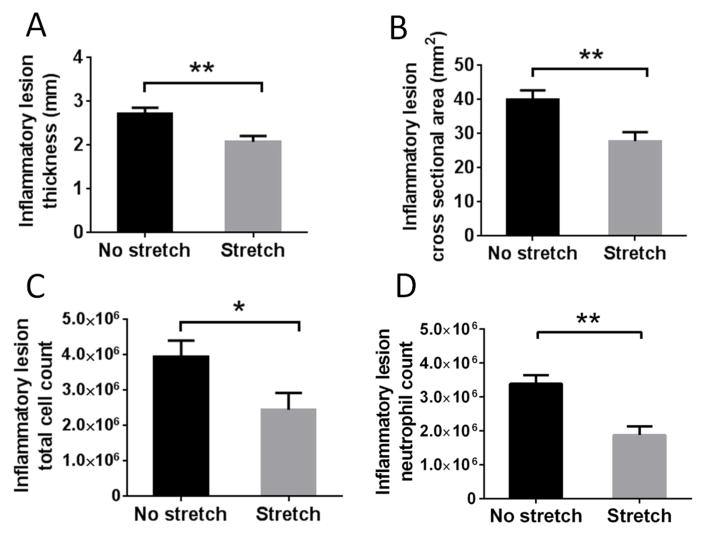
48 hours after subcutaneous carrageenan injection, stretched rats had a smaller inflammatory lesion thickness (A) (N=30), cross sectional area (B) (N=27), total cell count (C) (N=30) and neutrophil count (D) (N=18) compared with the non-stretched rats (* p<0.05, ** p<0.01).
Figure 3
Figure 3. In vivo stretching and SPM production
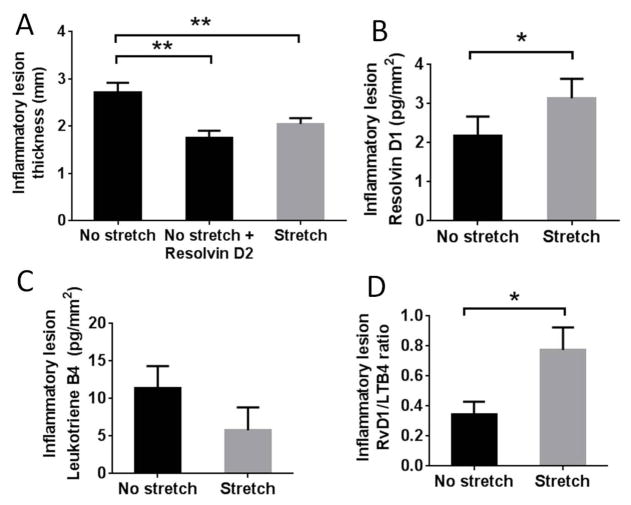
A: 48 hours after carrageenan injection, inflammatory lesion thickness was smaller with both stretching and subcutaneous RvD2 injection (without stretching) compared with no stretching. The difference between RvD2 injection and stretching was not statistically significant (p=0.39) (N=3 for or RvD2 injection and N=10 per group for stretch and no stretch). B: RvD1 concentration was greater in the stretch vs. no stretch group (*p<0.05, N=27). C: Leukotriene B4 (LTB4) was not significantly different between stretched and non-stretched groups (p=0.19). D: the ratio of RvD1 to LTB4 was on average two-fold greater in the stretched compared with non-stretched rats (*p<0.05).
Figure 4
Figure 4. Ex vivo stretching, neutrophil migration and RvD1 production
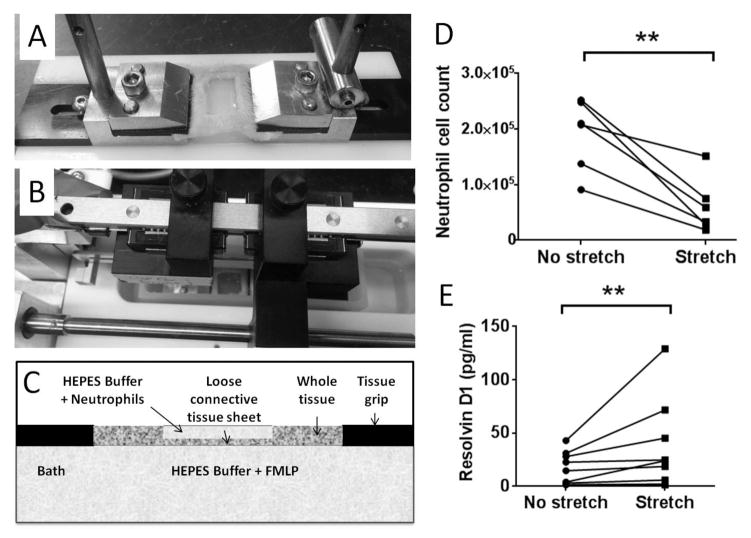
A: Tissue sample (including skin and subcutaneous tissue) showing cut out “window” exposing the subcutaneous tissue layer. B: Tissue sample mounted in stretching apparatus. C: Schematic of tissue with HEPES buffer+neutrophils above the tissue, and HEPES buffer+chemoattractant (fMLF) in the bath below. D: Neutrophil cell count in the lower bath was smaller in stretched vs. non-stretched tissue (*p<0.05, N=6 experiments). (E) In subcutaneous tissue samples stretched ex vivo, tissue RvD1 concentration was greater in stretched vs. non-stretched samples (**p<0.01, N=9 experiments).

References

    1. Benjamin M. The fascia of the limbs and back--a review. J Anat. 2009;214(1):1–18. - PMC - PubMed
    1. Bhattacharyya S, Tobacman JK. Molecular signature of kappa-carrageenan mimics chondroitin-4-sulfate and dermatan sulfate and enables interaction with arylsulfatase B. J Nutr Biochem. 2012;23(9):1058–1063. - PubMed
    1. Bouffard N, Cutroneo K, Badger G, White S, Buttolph T, Ehrlich H, Stevens-Tuttle D, Langevin H. Tissue stretch decreases soluble TGF-beta1 and type-1 procollagen in mouse subcutaneous connective tissue: Evidence from ex vivo and in vivo models. Journal of cellular physiology. 2008;214(2):389–395. - PMC - PubMed
    1. Cholkar K, Trinh HM, Vadlapudi AD, Wang Z, Pal D, Mitra AK. Interaction Studies of Resolvin E1 Analog (RX-10045) with Efflux Transporters. Journal of ocular pharmacology and therapeutics : the official journal of the Association for Ocular Pharmacology and Therapeutics. 2015;31(4):248–255. - PMC - PubMed
    1. Colas RA, Shinohara M, Dalli J, Chiang N, Serhan CN. Identification and signature profiles for pro-resolving and inflammatory lipid mediators in human tissue. American journal of physiology Cell physiology. 2014;307(1):C39–54. - PMC - PubMed

Publication types