. 2015 Nov 20;11(11):e1005308.
doi: 10.1371/journal.ppat.1005308. eCollection 2015 Nov.

Global Analysis of the Fungal Microbiome in Cystic Fibrosis Patients Reveals Loss of Function of the Transcriptional Repressor Nrg1 as a Mechanism of Pathogen Adaptation

Affiliations

Global Analysis of the Fungal Microbiome in Cystic Fibrosis Patients Reveals Loss of Function of the Transcriptional Repressor Nrg1 as a Mechanism of Pathogen Adaptation

Sang Hu Kim et al. PLoS Pathog. .

Abstract

The microbiome shapes diverse facets of human biology and disease, with the importance of fungi only beginning to be appreciated. Microbial communities infiltrate diverse anatomical sites as with the respiratory tract of healthy humans and those with diseases such as cystic fibrosis, where chronic colonization and infection lead to clinical decline. Although fungi are frequently recovered from cystic fibrosis patient sputum samples and have been associated with deterioration of lung function, understanding of species and population dynamics remains in its infancy. Here, we coupled high-throughput sequencing of the ribosomal RNA internal transcribed spacer 1 (ITS1) with phenotypic and genotypic analyses of fungi from 89 sputum samples from 28 cystic fibrosis patients. Fungal communities defined by sequencing were concordant with those defined by culture-based analyses of 1,603 isolates from the same samples. Different patients harbored distinct fungal communities. There were detectable trends, however, including colonization with Candida and Aspergillus species, which was not perturbed by clinical exacerbation or treatment. We identified considerable inter- and intra-species phenotypic variation in traits important for host adaptation, including antifungal drug resistance and morphogenesis. While variation in drug resistance was largely between species, striking variation in morphogenesis emerged within Candida species. Filamentation was uncoupled from inducing cues in 28 Candida isolates recovered from six patients. The filamentous isolates were resistant to the filamentation-repressive effects of Pseudomonas aeruginosa, implicating inter-kingdom interactions as the selective force. Genome sequencing revealed that all but one of the filamentous isolates harbored mutations in the transcriptional repressor NRG1; such mutations were necessary and sufficient for the filamentous phenotype. Six independent nrg1 mutations arose in Candida isolates from different patients, providing a poignant example of parallel evolution. Together, this combined clinical-genomic approach provides a high-resolution portrait of the fungal microbiome of cystic fibrosis patient lungs and identifies a genetic basis of pathogen adaptation.


Conflict of interest statement

The authors have declared that no competing interests exist.

Figures
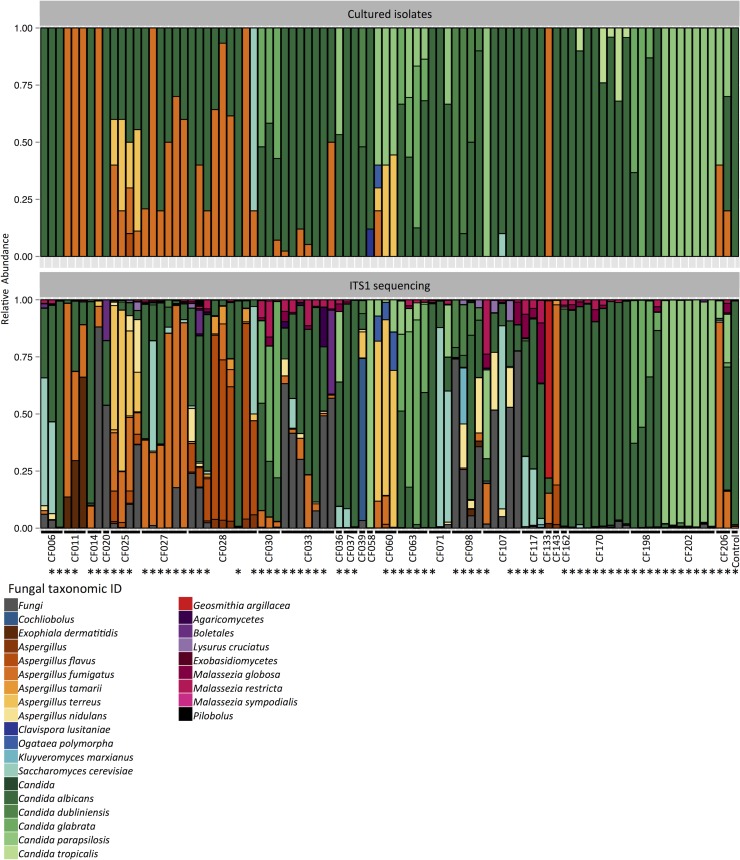
Fig 1
Fig 1. Portrait of the cystic fibrosis lung mycobiome.
Relative abundance of fungal species in 89 sputum samples from 28 patients, identified by culture (top) and ITS1 sequencing (bottom). *: Pearson correlation > 0.5.
Fig 2
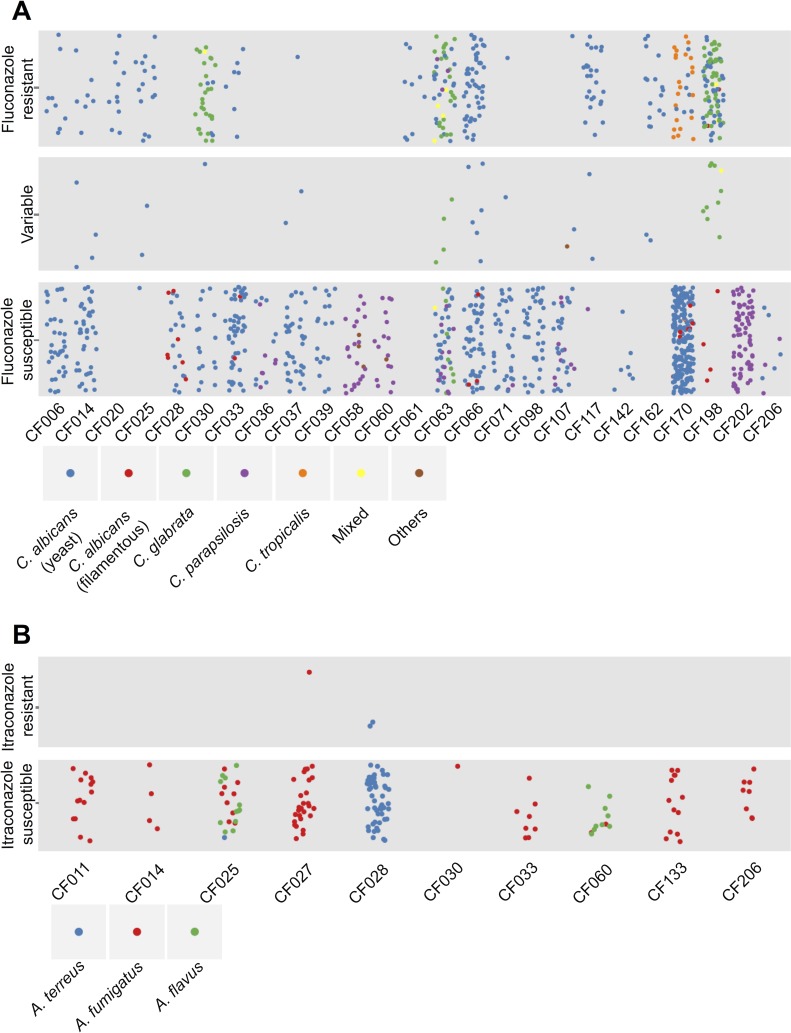
Fig 2. Diversity of species and antifungal resistance profiles of 1,603 fungal isolates from cystic fibrosis patients.
Each dot represents an isolate from the corresponding cystic fibrosis patient and colours represent species identity. The vertical dispersion of isolates within each phenotypic class is simply for visual clarity, as with the horizontal dispersion of isolates from an individual patient. (A) Summary of yeast isolates. The isolates are categorized as: “Fluconazole resistant” if their relative growth with fixed concentration of fluconazole at 128 μg/ml was greater than 2 times that of the relative growth of reference C. albicans strain SN95; “Fluconazole susceptible” if their relative growth was less than 2 times the relative growth of SN95; and “Variable” if their resistance profiles were variable over biological and technical duplicates. C. albicans is divided into two groups: isolates that show standard yeast morphology in rich medium at 30°C are in blue; and isolates that show filamentous growth under these conditions are in red. (B) Summary of mold isolates. The isolates are categorized as: “Itraconazole resistant” if their relative growth with fixed concentration of itraconazole at 0.5 μg/ml was greater than 2 times that of the relative growth of reference A. fumigatus strain AF293; and “Itraconazole susceptible” if their relative growth was less than 2 times the relative growth of AF293
Fig 3
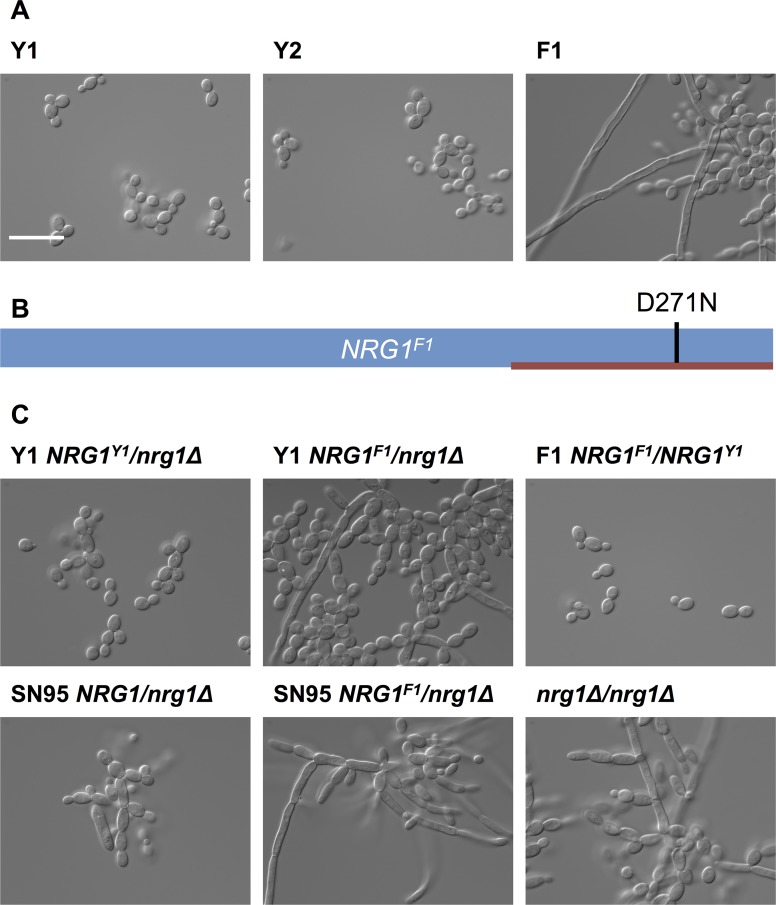
Fig 3. Filamentous growth of C. albicans clinical isolates is caused by non-synonymous mutation in NRG1.
(A) DIC images of C. albicans isolates from patient CF170 cultured in YPD at 30°C. C. albicans isolates Y1 and Y2 grow in the yeast form, while the filamentous isolate F1 grow as a mixture of yeast and filaments. Scale bar represents 20 μm. (B) Schematic representation of NRG1 F1, showing the homozygous D271N mutation in the C2H2 zinc finger DNA binding domain (red bar). (C) Functional validation that NRG1 F1 confers filamentous growth. Deletion of one allele of NRG1 in Y1 (Y1 NRG1 Y1 /nrg1Δ) does not alter yeast growth morphology, while replacement of the remaining NRG1 allele in this background with the F1 NRG1 allele (Y1 NRG1 F1 /nrg1Δ) causes a filamentation phenotype comparable to that observed in F1. This was also true in an independent laboratory strain, SN95 [38]. Replacing one NRG1 allele of F1 with the Y1 allele restores yeast form growth. Finally, a homozygous NRG1 deletion mutant (nrg1Δ/nrg1Δ) in an independent background [39] also has comparable growth morphology to F1.
Fig 4
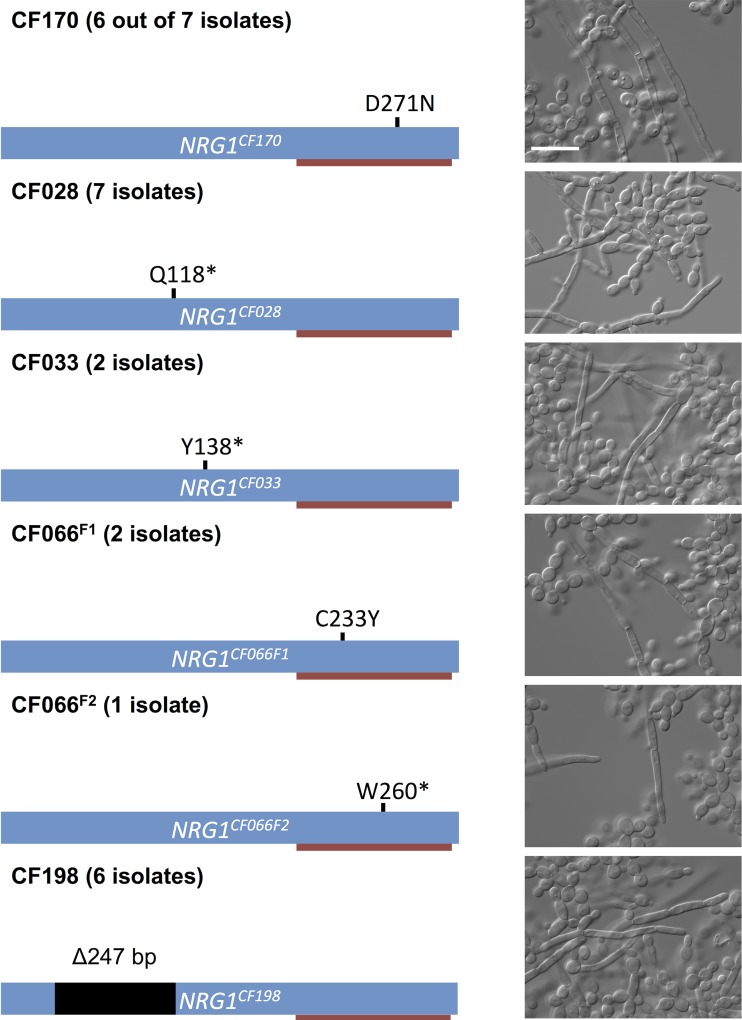
Fig 4. Prevalence of NRG1 mutations in filamentous C. albicans isolates from multiple patients.
Schematic representation of NRG1, the C2H2 zinc finger DNA binding domain (red bar), and the mutations found in different filamentous isolates and the corresponding microscopy images of representative isolates. Scale bar represents 20 μm.
Fig 5
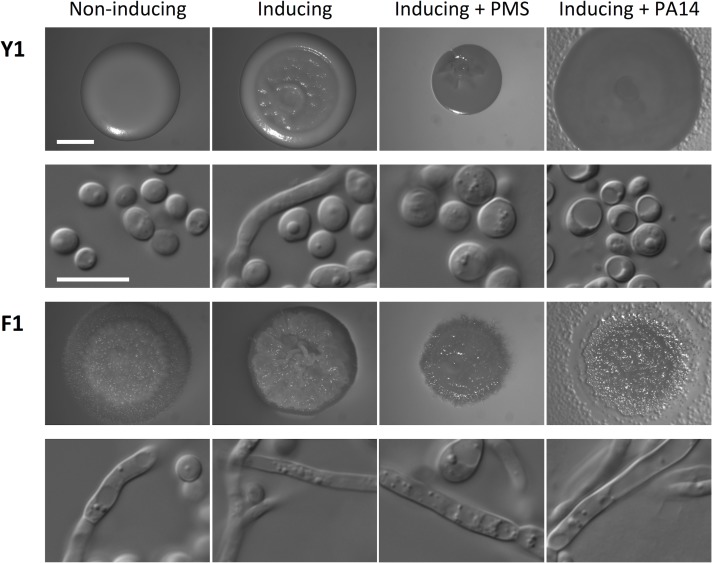
Fig 5. Phenazine methosulfate (PMS) or P. aeruginosa inhibits filamentation of C. albicans with standard growth morphology (Y1), but not of filamentous isolate F1.
The non-inducing condition is synthetic defined (SD) medium at 30°C and the inducing condition is SD + 5 mM N-acetylglucosamine at 37°C for 48 h. Treatments included 5 μM PMS or 100 μl of PA14 P. aeruginosa overnight culture, as indicated. Images of colonies are provided in the first and third rows, and DIC microscopy images of cells from the colony are in the second and fourth rows. Scale bar on spot image represents 2 mm, and scale bar on DIC image represents 10 μm.

References

    1. Nguyen LDN, Viscogliosi E, Delhaes L. The lung mycobiome: an emerging field of the human respiratory microbiome. Front Microbiol. 2015;6: 1–9. 10.3389/fmicb.2015.00089 - DOI - PMC - PubMed
    1. Surette MG. The cystic fibrosis lung microbiome. Ann Am Thorac Soc. 2014;11 Suppl 1: S61–5. 10.1513/AnnalsATS.201306-159MG - DOI - PubMed
    1. LiPuma JJ. The changing microbial epidemiology in cystic fibrosis. Clinical Microbiology Reviews. 2010. pp. 299–323. 10.1128/CMR.00068-09 - DOI - PMC - PubMed
    1. Sibley CD, Parkins MD, Rabin HR, Duan K, Norgaard JC, Surette MG. A polymicrobial perspective of pulmonary infections exposes an enigmatic pathogen in cystic fibrosis patients. Proc Natl Acad Sci U S A. 2008;105: 15070–15075. 10.1073/pnas.0804326105 - DOI - PMC - PubMed
    1. Brown GD, Denning DW, Gow N a R, Levitz SM, Netea MG, White TC. Hidden killers: human fungal infections. Sci Transl Med. 2012;4: 165rv13 10.1126/scitranslmed.3004404 - DOI - PubMed

Publication types