


Artificial Pancreas Device Systems for the Closed-Loop Control of Type 1 Diabetes: What Systems Are in Development?
- PMID: 26589628
- PMCID: PMC5038530
- DOI: 10.1177/1932296815617968
Artificial Pancreas Device Systems for the Closed-Loop Control of Type 1 Diabetes: What Systems Are in Development?
Abstract
Background: Closed-loop artificial pancreas device (APD) systems are externally worn medical devices that are being developed to enable people with type 1 diabetes to regulate their blood glucose levels in a more automated way. The innovative concept of this emerging technology is that hands-free, continuous, glycemic control can be achieved by using digital communication technology and advanced computer algorithms.
Methods: A horizon scanning review of this field was conducted using online sources of intelligence to identify systems in development. The systems were classified into subtypes according to their level of automation, the hormonal and glycemic control approaches used, and their research setting.
Results: Eighteen closed-loop APD systems were identified. All were being tested in clinical trials prior to potential commercialization. Six were being studied in the home setting, 5 in outpatient settings, and 7 in inpatient settings. It is estimated that 2 systems may become commercially available in the EU by the end of 2016, 1 during 2017, and 2 more in 2018.
Conclusions: There are around 18 closed-loop APD systems progressing through early stages of clinical development. Only a few of these are currently in phase 3 trials and in settings that replicate real life.
Keywords: algorithm; artificial pancreas; closed-loop control; device system; glycemic control; type 1 diabetes.
© 2015 Diabetes Technology Society.
Conflict of interest statement
The author(s) declared no potential conflicts of interest with respect to the research, authorship, and/or publication of this article.
Figures
Comment in
-
Safety of a Hybrid Closed-Loop Insulin Delivery System in Patients With Type 1 Diabetes.JAMA. 2016 Oct 4;316(13):1407-1408. doi: 10.1001/jama.2016.11708. JAMA. 2016. PMID: 27629148 No abstract available.
References
-
- Kowalski A. Pathway to artificial pancreas systems revisited: moving downstream. Diabetes Care. 2015;28:1036-1043. - PubMed
-
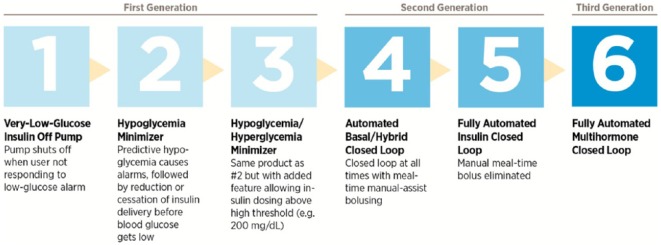
- JDRF. Artificial pancreas project research: artificial pancreas project plan. Reproduced with permission. Available at: http://jdrf.org/research/treat/artificial-pancreas-project/.
Publication types
MeSH terms
Substances
LinkOut - more resources
Full Text Sources
Other Literature Sources
Medical
