. 2016 Jan 4;44(D1):D717-25.
doi: 10.1093/nar/gkv1275. Epub 2015 Nov 20.

The UCSC Genome Browser database: 2016 update

Affiliations

The UCSC Genome Browser database: 2016 update

Matthew L Speir et al. Nucleic Acids Res. .

Abstract

For the past 15 years, the UCSC Genome Browser (http://genome.ucsc.edu/) has served the international research community by offering an integrated platform for viewing and analyzing information from a large database of genome assemblies and their associated annotations. The UCSC Genome Browser has been under continuous development since its inception with new data sets and software features added frequently. Some release highlights of this year include new and updated genome browsers for various assemblies, including bonobo and zebrafish; new gene annotation sets; improvements to track and assembly hub support; and a new interactive tool, the "Data Integrator", for intersecting data from multiple tracks. We have greatly expanded the data sets available on the most recent human assembly, hg38/GRCh38, to include updated gene prediction sets from GENCODE, more phenotype- and disease-associated variants from ClinVar and ClinGen, more genomic regulatory data, and a new multiple genome alignment.


Figures

Figure 1.
Figure 1.
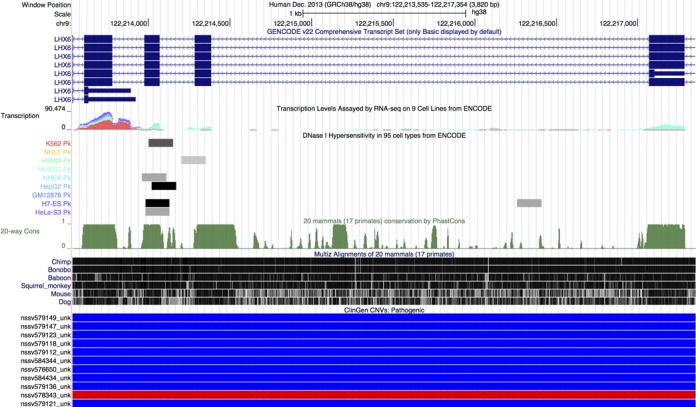
Genome Browser screenshot focused on a region of the LHX6 gene that highlights a selection of the new tracks added in the previous year for the hg38/GRCh38 human assembly. The tracks shown in this display (from top to bottom) include GENCODE Genes V22, transcription levels assayed across 9 ENCODE cell lines, DNase hypersensitive regions based on data from 95 ENCODE cell lines, genome-wide conservation scores calculated using phastCons, a multiple genome alignment created using Lastz and Multiz, and pathogenic CNVs from the ClinGen database. This screenshot demonstrates how one can use the ENCODE transcription levels and DNase hypersensitive regions in the Genome Browser to identify expression of different transcripts in different cells. The multiple alignment and conservation scores can be used to look for other potential regions of importance. Lastly, one can use the ClinGen CNVs and other pathogenicity data in the browser to determine what role, if any, a particular gene plays in disease.

References

    1. Kent W.J., Sugnet C.W., Furey T.S., Roskin K.M., Pringle T.H., Zahler A.M., Haussler D. The human genome browser at UCSC. Genome Res. 2002;12:996–1006. - PMC - PubMed
    1. Rosenbloom K.R., Armstrong J., Barber G.P., Casper J., Clawson H., Diekhans M., Dreszer T.R., Fujita P.A., Guruvadoo L., Haeussler M., et al. The UCSC Genome Browser database: 2015 update. Nucleic Acids Res. 2015;43:D670–D681. - PMC - PubMed
    1. Benson D.A., Clark K., Karsch-Mizrachi I., Lipman D.J., Ostell J., Sayers E.W. GenBank. Nucleic Acids Res. 2015;43:D30–D35. - PMC - PubMed
    1. Burge C., Karlin S. Prediction of complete gene structures in human genomic DNA. J. Mol. Biol. 1997;268:78–94. - PubMed
    1. Gardiner-Garden M., Frommer M. CpG Islands in vertebrate genomes. J. Mol. Biol. 1987;196:261–282. - PubMed

Publication types