


miRTarBase 2016: updates to the experimentally validated miRNA-target interactions database
- PMID: 26590260
- PMCID: PMC4702890
- DOI: 10.1093/nar/gkv1258
miRTarBase 2016: updates to the experimentally validated miRNA-target interactions database
Abstract
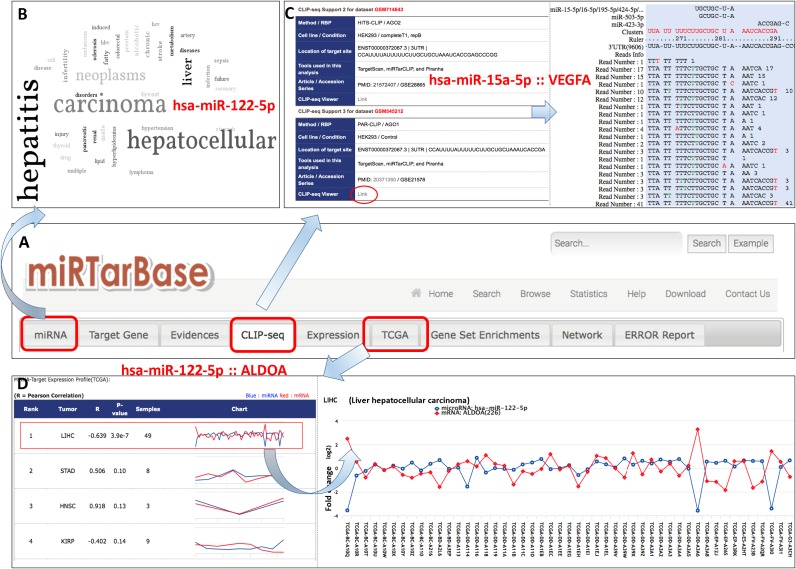
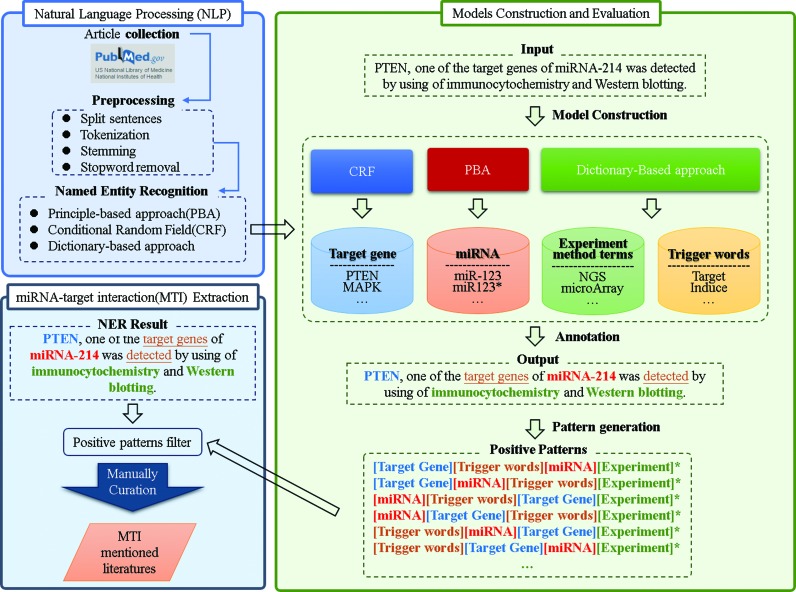
MicroRNAs (miRNAs) are small non-coding RNAs of approximately 22 nucleotides, which negatively regulate the gene expression at the post-transcriptional level. This study describes an update of the miRTarBase (http://miRTarBase.mbc.nctu.edu.tw/) that provides information about experimentally validated miRNA-target interactions (MTIs). The latest update of the miRTarBase expanded it to identify systematically Argonaute-miRNA-RNA interactions from 138 crosslinking and immunoprecipitation sequencing (CLIP-seq) data sets that were generated by 21 independent studies. The database contains 4966 articles, 7439 strongly validated MTIs (using reporter assays or western blots) and 348 007 MTIs from CLIP-seq. The number of MTIs in the miRTarBase has increased around 7-fold since the 2014 miRTarBase update. The miRNA and gene expression profiles from The Cancer Genome Atlas (TCGA) are integrated to provide an effective overview of this exponential growth in the miRNA experimental data. These improvements make the miRTarBase one of the more comprehensively annotated, experimentally validated miRNA-target interactions databases and motivate additional miRNA research efforts.
© The Author(s) 2015. Published by Oxford University Press on behalf of Nucleic Acids Research.
Figures
References
-
- Bartel D.P. MicroRNAs: genomics, biogenesis, mechanism, and function. Cell. 2004;116:281–297. - PubMed
-
- Engels B.M., Hutvagner G. Principles and effects of microRNA-mediated post-transcriptional gene regulation. Oncogene. 2006;25:6163–6169. - PubMed
-
- Carleton M., Cleary M.A., Linsley P.S. MicroRNAs and cell cycle regulation. Cell Cycle. 2007;6:2127–2132. - PubMed
-
- Harfe B.D. MicroRNAs in vertebrate development. Curr. Opin. Genet. Dev. 2005;15:410–415. - PubMed
-
- Lynam-Lennon N., Maher S.G., Reynolds J.V. The roles of microRNA in cancer and apoptosis. Biol. Rev. Camb. Philos. Soc. 2009;84:55–71. - PubMed
Publication types
MeSH terms
Substances
LinkOut - more resources
Full Text Sources
Other Literature Sources
