


Calcium signalling in salivary gland physiology and dysfunction
- PMID: 26592972
- PMCID: PMC4887685
- DOI: 10.1113/JP271143
Calcium signalling in salivary gland physiology and dysfunction
Abstract
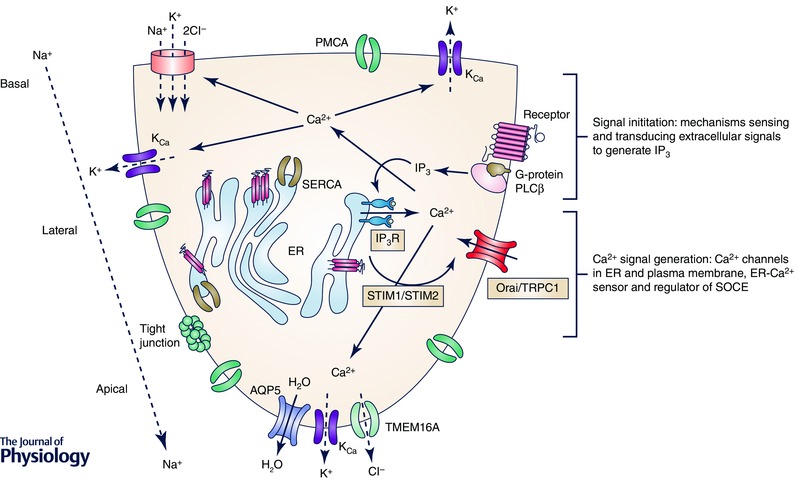
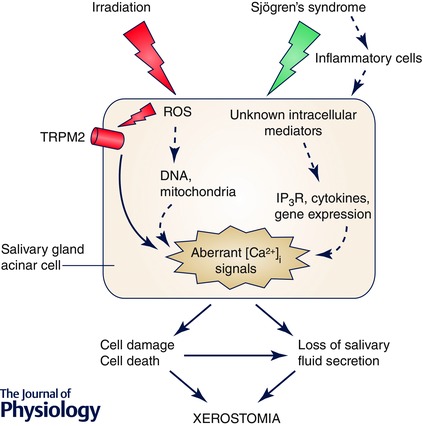
Studies over the past four decades have established that Ca(2+) is a critical factor in control of salivary gland function and have led to identification of the critical components of this process. The major ion transport mechanisms and ion channels that are involved in fluid secretion have also been established. The key event in activation of fluid secretion is an increase in [Ca(2+) ]i triggered by inositol 1,4,5-trisphosphate (IP3 )-induced release of Ca(2+) from ER via the IP3 receptor (IP3 R). IP3 Rs determine the site of initiation and the pattern of the [Ca(2+) ]i signal in the cell. However, Ca(2+) entry into the cell is required to sustain the elevation of [Ca(2+) ]i and fluid secretion and is mediated by the store-operated Ca(2+) entry (SOCE) mechanism. Orai1, TRPC1, TRPC3 and STIM1 have been identified as critical components of SOCE in these cells. Cells finely tune the generation and amplification of [Ca(2+) ]i signals for regulation of cell function. An important emerging area is the concept that unregulated [Ca(2+) ]i signals in cells can directly cause cell damage, dysfunction and disease. Alternatively, aberrant [Ca(2+) ]i signals can also amplify and increase the rates of cell damage. Such defects in Ca(2+) signalling have been described in salivary glands in conjunction with radiation-induced loss of salivary gland function as well as in the salivary defects associated with the autoimmune exocrinopathy Sjögren's syndrome. Such defects have been associated with altered function or expression of key Ca(2+) signalling components, such as STIM proteins and TRP channels. These studies offer new avenues for examining the mechanisms underlying the disease and development of novel clinical targets and therapeutic strategies.
Published 2015. This article is a U.S. Government work and is in the public domain in the USA.
Figures
References
-
- Ando H, Kawaai K & Mikoshiba K (2014). IRBIT: a regulator of ion channels and ion transporters. Biochim Biophys Acta 1843, 2195–2204. - PubMed
Publication types
MeSH terms
Substances
Grants and funding
LinkOut - more resources
Full Text Sources
Medical
Miscellaneous
