


Mechanisms Underlying Dysregulation of Electrolyte Absorption in Inflammatory Bowel Disease-Associated Diarrhea
- PMID: 26595422
- PMCID: PMC4662046
- DOI: 10.1097/MIB.0000000000000504
Mechanisms Underlying Dysregulation of Electrolyte Absorption in Inflammatory Bowel Disease-Associated Diarrhea
Abstract
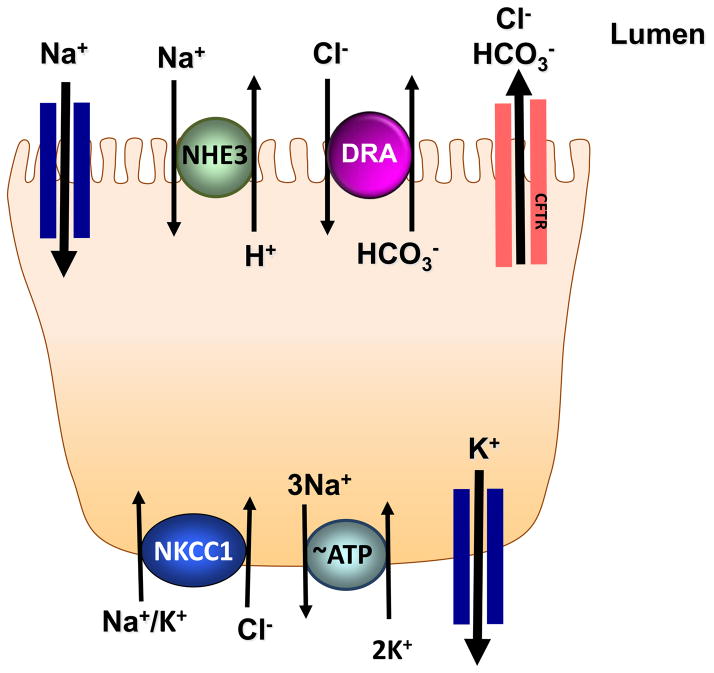
Inflammatory bowel diseases (IBDs), including Crohn's disease and ulcerative colitis, are chronic relapsing inflammatory disorders of the gastrointestinal tract. Chronic inflammation of the intestine affects the normal fluid and electrolyte absorption leading to diarrhea, the hallmark symptom of IBD. The management of IBD-associated diarrhea still remains to be a challenge, and extensive studies over the last 2 decades have focused on investigating the molecular mechanisms underlying IBD-associated diarrhea. These studies have shown that the predominant mechanism of diarrhea in IBD involves impairment of electroneutral NaCl absorption, with very little role if any played by anion secretion. The electroneutral NaCl absorption involves coupled operation of Na/H exchanger 3 (NHE3 or SLC9A3) and Cl/HCO3 exchanger DRA (Down Regulated in Adenoma, or SLC26A3). Increasing evidence now supports the critical role of a marked decrease in NHE3 and DRA function and/or expression in IBD-associated diarrhea. This review provides a detailed analysis of the current knowledge related to alterations in NHE3 and DRA function and expression in IBD including the mechanisms underlying these observations and highlights the potential of these transporters as important and novel therapeutic targets.
Figures
Comment in
-
Mechanisms Underlying Dysregulation of Electrolyte Absorption in Inflammatory Bowel Disease-Associated Diarrhea.Inflamm Bowel Dis. 2016 Jun;22(6):E17-8. doi: 10.1097/MIB.0000000000000778. Inflamm Bowel Dis. 2016. PMID: 27104826 No abstract available.
References
-
- Molodecky NA, Soon IS, Rabi DM, et al. Increasing incidence and prevalence of the inflammatory bowel diseases with time, based on systematic review. Gastroenterology. 2012;142:46–54. e42. quiz e30. - PubMed
-
- Ellinghaus D, Bethune J, Petersen BS, et al. The genetics of Crohn’s disease and ulcerative colitis--status quo and beyond. Scand J Gastroenterol. 2015;50:13–23. - PubMed
-
- Engelhardt KR, Grimbacher B. IL-10 in humans: lessons from the gut, IL-10/IL-10 receptor deficiencies, and IL-10 polymorphisms. Curr Top Microbiol Immunol. 2014;380:1–18. - PubMed
-
- O’Toole A, Korzenik J. Environmental triggers for IBD. Curr Gastroenterol Rep. 2014;16:396. - PubMed
-
- Wenzl HH. Diarrhea in chronic inflammatory bowel diseases. Gastroenterol Clin North Am. 2012;41:651–675. - PubMed
Publication types
MeSH terms
Substances
Grants and funding
- DK 98170/DK/NIDDK NIH HHS/United States
- R01 DK071596/DK/NIDDK NIH HHS/United States
- R21 DK096254/DK/NIDDK NIH HHS/United States
- R01 DK092441/DK/NIDDK NIH HHS/United States
- I01 BX000152/BX/BLRD VA/United States
- DK92441/DK/NIDDK NIH HHS/United States
- R56 DK092441/DK/NIDDK NIH HHS/United States
- DK 71596/DK/NIDDK NIH HHS/United States
- DK96254/DK/NIDDK NIH HHS/United States
- DK54016/DK/NIDDK NIH HHS/United States
- R01 DK081858/DK/NIDDK NIH HHS/United States
- DK81858/DK/NIDDK NIH HHS/United States
- IK6 BX005243/BX/BLRD VA/United States
- R01 DK054016/DK/NIDDK NIH HHS/United States
- R01 DK098170/DK/NIDDK NIH HHS/United States
- R56 DK071596/DK/NIDDK NIH HHS/United States
- I01 BX002011/BX/BLRD VA/United States
LinkOut - more resources
Full Text Sources
Medical
