


Quantitative H2S-mediated protein sulfhydration reveals metabolic reprogramming during the integrated stress response
- PMID: 26595448
- PMCID: PMC4733038
- DOI: 10.7554/eLife.10067
Quantitative H2S-mediated protein sulfhydration reveals metabolic reprogramming during the integrated stress response
Abstract
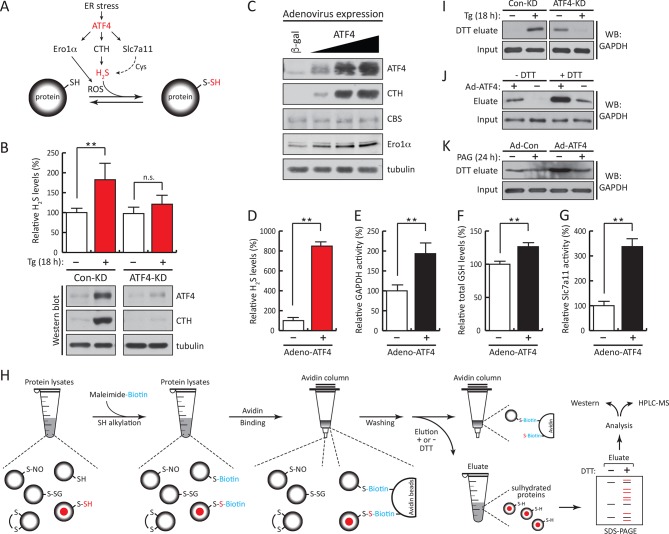
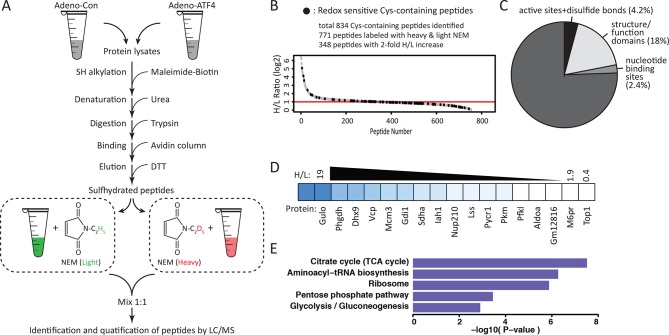
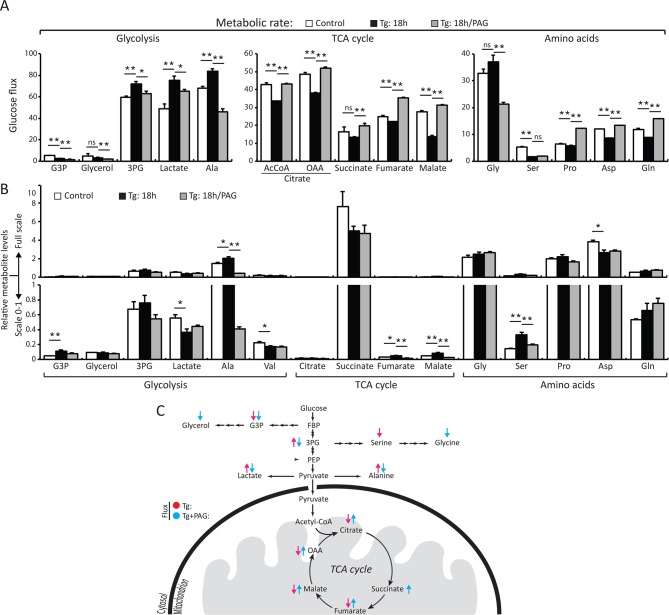
The sulfhydration of cysteine residues in proteins is an important mechanism involved in diverse biological processes. We have developed a proteomics approach to quantitatively profile the changes of sulfhydrated cysteines in biological systems. Bioinformatics analysis revealed that sulfhydrated cysteines are part of a wide range of biological functions. In pancreatic β cells exposed to endoplasmic reticulum (ER) stress, elevated H2S promotes the sulfhydration of enzymes in energy metabolism and stimulates glycolytic flux. We propose that transcriptional and translational reprogramming by the integrated stress response (ISR) in pancreatic β cells is coupled to metabolic alternations triggered by sulfhydration of key enzymes in intermediary metabolism.
Keywords: Cystathionine gamma-lyase (CSE); Integrated Stress Response; biochemistry; cell biology; hydrogen sulfide; metabolic reprogramming; mouse; protein sulfhydration; quantitative proteomics.
Conflict of interest statement
The authors declare that no competing interests exist.
Figures
References
-
- Anastasiou D, Poulogiannis G, Asara JM, Boxer MB, Jiang J.-k., Shen M, Bellinger G, Sasaki AT, Locasale JW, Auld DS, Thomas CJ, Vander Heiden MG, Cantley LC. Inhibition of pyruvate kinase M2 by reactive oxygen species contributes to cellular antioxidant responses. Science. 2011;334:1278–1283. doi: 10.1126/science.1211485. - DOI - PMC - PubMed
-
- Dickhout JG, Carlisle RE, Jerome DE, Mohammed-Ali Z, Jiang H, Yang G, Mani S, Garg SK, Banerjee R, Kaufman RJ, Maclean KN, Wang R, Austin RC. Integrated stress response modulates cellular redox state via induction of cystathionine -lyase: cross-talk between integrated stress response and thiol metabolism. Journal of Biological Chemistry. 2012;287:7603–7614. doi: 10.1074/jbc.M111.304576. - DOI - PMC - PubMed
Publication types
MeSH terms
Substances
Grants and funding
- S10 RR031537/RR/NCRR NIH HHS/United States
- R01-DK053307/DK/NIDDK NIH HHS/United States
- R01 DK053307/DK/NIDDK NIH HHS/United States
- 1S10RR031537-01/RR/NCRR NIH HHS/United States
- R01 DK088856/DK/NIDDK NIH HHS/United States
- R37 DK060596/DK/NIDDK NIH HHS/United States
- R01 DK048280/DK/NIDDK NIH HHS/United States
- R01 DK013499/DK/NIDDK NIH HHS/United States
- R01 GM112455/GM/NIGMS NIH HHS/United States
- R01-DK013499/DK/NIDDK NIH HHS/United States
- R01 HL058984/HL/NHLBI NIH HHS/United States
- R37-DK060596/DK/NIDDK NIH HHS/United States
- P30 DK020572/DK/NIDDK NIH HHS/United States
- R01-HL58984/HL/NHLBI NIH HHS/United States
- DK48280/DK/NIDDK NIH HHS/United States
- U24 DK097153/DK/NIDDK NIH HHS/United States
LinkOut - more resources
Full Text Sources
Other Literature Sources
Molecular Biology Databases
