. 2015 Nov 23:16:992.
doi: 10.1186/s12864-015-2131-y.

Genetic associations and shared environmental effects on the skin microbiome of Korean twins

Affiliations

Genetic associations and shared environmental effects on the skin microbiome of Korean twins

Jiyeon Si et al. BMC Genomics. .

Abstract

Background: The skin is the outermost layer of the human body and one of the key sites for host-microbe interactions. Both environmental and host genetic factors influence microbial communities in distinct anatomical niches, but little is known about their interplay in shaping the skin microbiome. Here, we investigate the heritable components of the skin microbiome and their association with host genetic factors.

Results: Based on our analysis of the microbiota from 45 individuals including monozygotic and dizygotic twins aged 26-55 years and their mothers, we found that skin microbial diversity was significantly influenced by age and skin pigmentation. Heritability analysis revealed genetic and shared environmental impacts on the skin microbiome. Furthermore, we observed a strong association between the abundance of Corynebacterium jeikeium and single nucleotide polymorphisms (SNPs) in the host FLG gene related to epidermal barrier function.

Conclusion: This study reveals an intimate association of the human skin microbiome and host genes, and increases our understanding of the role of human genetic factors in establishing a microbial ecosystem on the body surface.


Figures
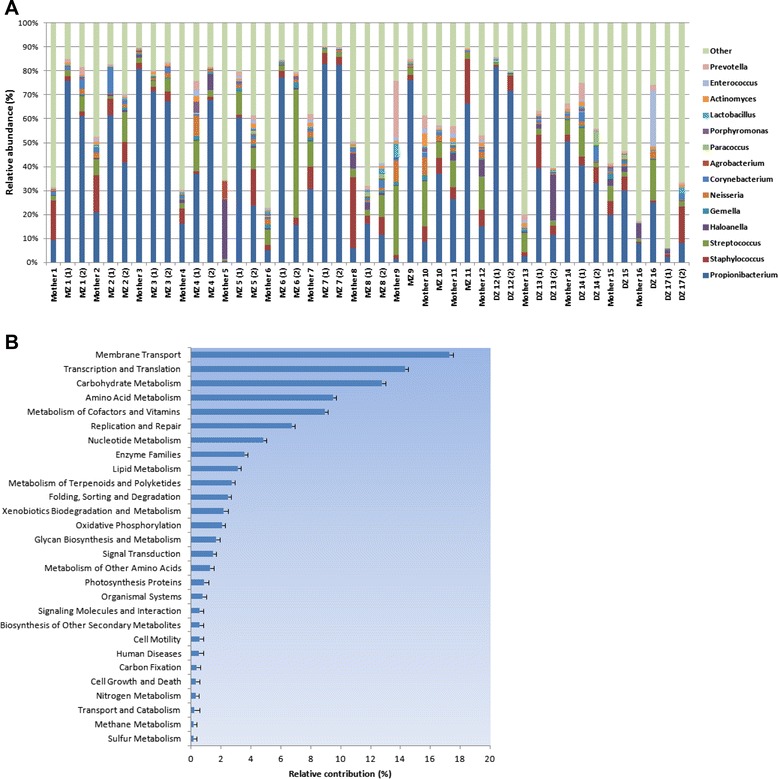
Fig. 1
Fig. 1
Diversity of the skin microbiota and functional traits of the microbial communities. a Taxonomic classification of the skin microbiome at the genus level. Relative bacterial abundance for each individual is shown. A familial relationship is indicated among those individuals represented by the same number. Twin pairs are presented in the parenthesis. b Skin metagenomes predicted using PICRUSt (Methods). Relative contribution of each functional pathway is determined for the collective microbiota of all subjects. Error bars, SEM
Fig. 2
Fig. 2
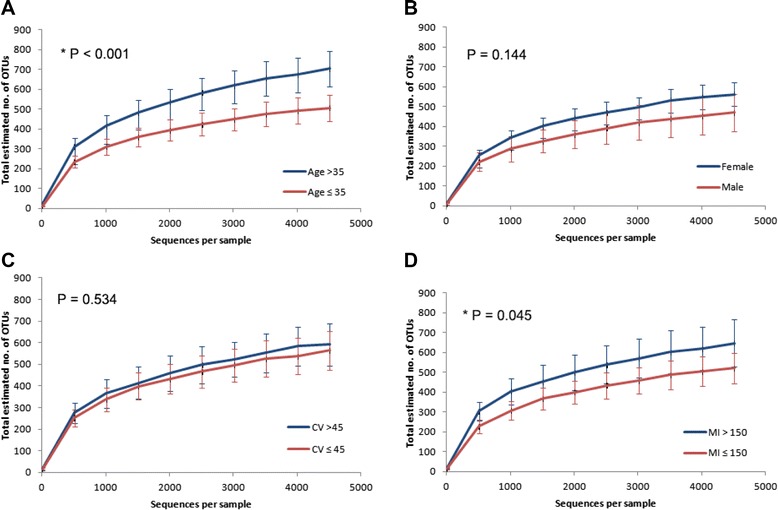
Differences in skin microbial diversity analyzed using rarefaction curves a Age. b Gender. c Skin humidity (CV, Corneomerty Value). d Pigmentation (MI, Melanin Index). Error bars indicate 95 % confidence intervals. * Significance is based on the Wilcoxon rank-sum test
Fig. 3
Fig. 3
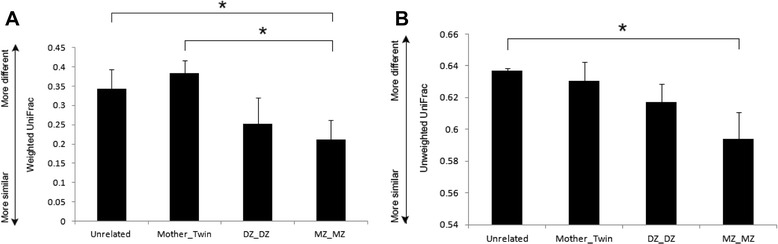
Comparison of the skin microbiota of twins and their families in terms of heritability and environmental effects. a Weighted and b unweighted UniFrac distance between twin pairs (4 UniFrac distance values for DZ pairs and 8 for MZ pairs), twins and mothers (25 UniFrac distance values), and unrelated individuals (909 UniFrac distance values). The error bars represent the standard error. *,P< 0.05 based on Wilcoxon rank sum test
Fig. 4
Fig. 4
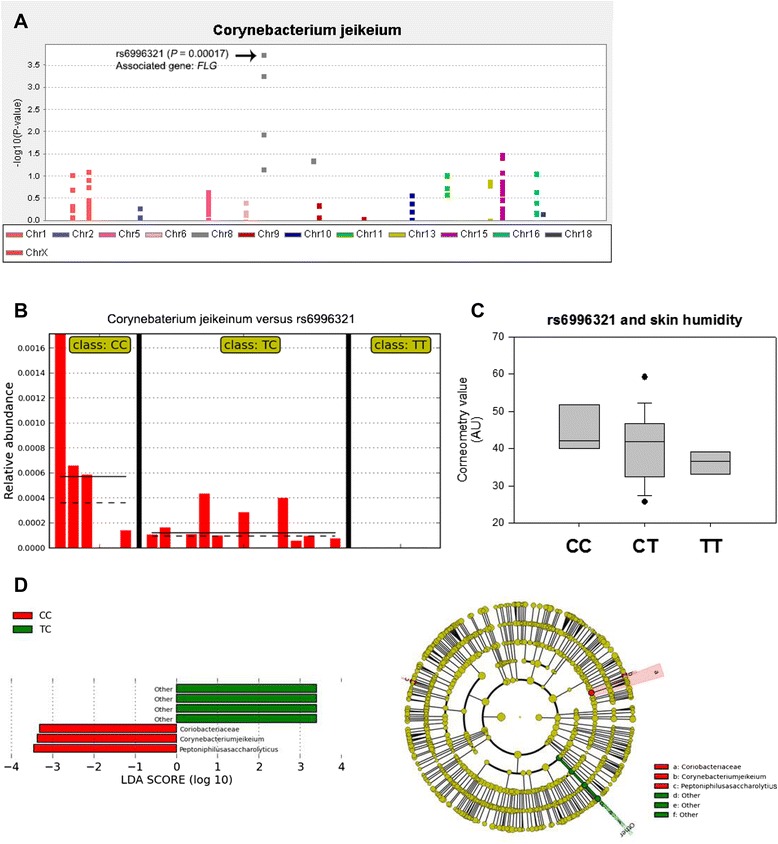
Effect of the host genotype on skin traits. a Manhattan plot summarizing the results of an association analysis of 275 candidate SNPs with Corynebacterium jeikeium. Each dot represents the candidate SNP plotted across the genome. b Relative abundance of C. jeikeium with respect to rs6996321. The means and standard errors are indicated by solid and dashed bars, respectively. c Level of skin humidity by genotype at rs6996321. Boxes represent the 25th percentile, median, and 75th percentile. Whiskers represent the lowest values and the highest values of skin humidity. Filled circles represent outliers. AU: arbitrary unit. d LDA (linear discriminant analysis) plot of skin bacteria found by LEfSe showing their association with the host genotype at rs6996321. Cladogram on the right indicates the phylogenetic distribution of the skin bacteria. Each color represents host genotype: CC genotype in red and CT in green. Circles are arranged by phylogenetic levels from kingdom, phylum, class, family, genus, and species from inside out

References

    1. Staudinger T, Pipal A, Redl B. Molecular analysis of the prevalent microbiota of human male and female forehead skin compared to forearm skin and the influence of make-up. J Appl Microbiol. 2011;110(6):1381–1389. doi: 10.1111/j.1365-2672.2011.04991.x. - DOI - PubMed
    1. Fierer N, Hamady M, Lauber CL, Knight R. The influence of sex, handedness, and washing on the diversity of hand surface bacteria. Proc Natl Acad Sci U S A. 2008;105(46):17994–17999. doi: 10.1073/pnas.0807920105. - DOI - PMC - PubMed
    1. Grice EA, Kong HH, Conlan S, Deming CB, Davis J, Young AC, et al. Topographical and temporal diversity of the human skin microbiome. Science. 2009;324(5931):1190–1192. doi: 10.1126/science.1171700. - DOI - PMC - PubMed
    1. Kong HH. Skin microbiome: genomics-based insights into the diversity and role of skin microbes. Trends Mol Med. 2011;17(6):320–328. doi: 10.1016/j.molmed.2011.01.013. - DOI - PMC - PubMed
    1. Dominguez-Bello MG, Costello EK, Contreras M, Magris M, Hidalgo G, Fierer N, et al. Delivery mode shapes the acquisition and structure of the initial microbiota across multiple body habitats in newborns. Proc Natl Acad Sci U S A. 2010;107(26):11971–11975. doi: 10.1073/pnas.1002601107. - DOI - PMC - PubMed

Publication types

Substances

LinkOut - more resources