


Lifetime Risk of Venous Thromboembolism in Two Cohort Studies
- PMID: 26597668
- PMCID: PMC4771407
- DOI: 10.1016/j.amjmed.2015.10.014
Lifetime Risk of Venous Thromboembolism in Two Cohort Studies
Abstract
Background: Greater public awareness of venous thromboembolism may be an important next step for optimizing venous thromboembolism prevention and treatment. "Lifetime risk" is an easily interpretable way of presenting risk information. Therefore, we sought to calculate the lifetime risk of venous thromboembolism (deep vein thrombosis or pulmonary embolism) using data from 2 large, prospective cohort studies: the Cardiovascular Health Study (CHS) and the Atherosclerosis Risk in Communities (ARIC) study.
Methods: We followed participants aged 45-64 years in ARIC (n = 14,185) and ≥65 in CHS (n = 5414) at baseline visits (1987-1989 in ARIC, 1989-1990 and 1992-1993 in CHS) for incident venous thromboembolism (n = 728 in ARIC through 2011 and n = 172 in CHS through 2001). We estimated lifetime risks and 95% confidence intervals of incident venous thromboembolism using a modified Kaplan-Meier method, accounting for the competing risk of death from other causes.
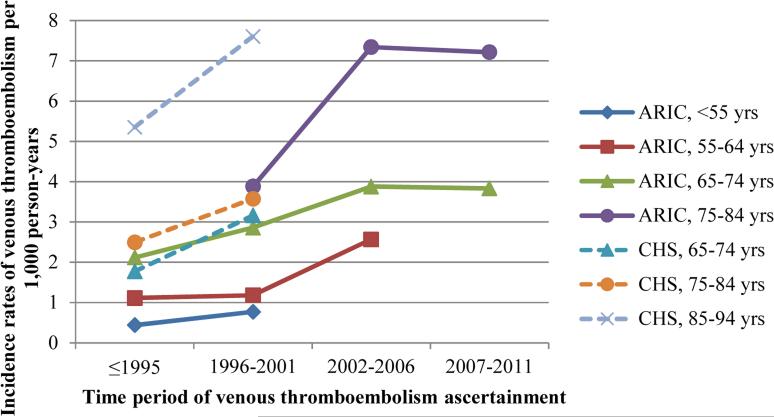
Results: At age 45 years, the remaining lifetime risk of venous thromboembolism in ARIC was 8.1% (95% confidence interval, 7.1-8.7). High-risk groups were African Americans (11.5% lifetime risk), those with obesity (10.9%), heterozygous for the factor V Leiden (17.1%), or with sickle cell trait or disease (18.2%). Lifetime risk estimates differed by cohort; these differences were explained by differences in time period of venous thromboembolism ascertainment.
Conclusions: At least 1 in 12 middle-aged adults will develop venous thromboembolism in their remaining lifetime. This estimate of lifetime risk may be useful to promote awareness of venous thromboembolism and guide decisions at both clinical and policy levels.
Keywords: Embolism; Epidemiology; Risk factors; Thrombosis.
Copyright © 2016 Elsevier Inc. All rights reserved.
Figures
References
-
- Office of the Surgeon General (US) The Surgeon General's Call to Action to Prevent Deep Vein Thrombosis and Pulmonary Embolism. Rockville, MD: 2008. - PubMed
-
- American Public Health Association Deep-Vein Thrombosis: Advancing Awareness to Protect Patient Lives. Public Health Leadership Conference on Deep-Vein Thrombosis. White Paper.
-
- Raskob GE, Angchaisuksiri P, Blanco AN, et al. Thrombosis : A major contributor to global disease burden #2729 ISTH Steering Committee for World Thrombosis Day The members of the ISTH Steering Committee for World Thrombosis Day : Thromb Res. 2014;134(5):931–938. doi:10.1016/j.thromres.2014.08.014. - PubMed
-
- Sasieni PD, Adams J. Standardized lifetime risk. Am J Epidemiol. 1999;149(9):869–875. - PubMed
Publication types
MeSH terms
Substances
Grants and funding
- HHSN268201100012C/HL/NHLBI NIH HHS/United States
- HHSN268201100010C/HL/NHLBI NIH HHS/United States
- HHSN268201100011C/HL/NHLBI NIH HHS/United States
- HHSN268201100010C/HL/NHLBI NIH HHS/United States
- UL1 TR001422/TR/NCATS NIH HHS/United States
- HHSN268201100007C/HL/NHLBI NIH HHS/United States
- HHSN268200800007C/HL/NHLBI NIH HHS/United States
- U01HL080295/HL/NHLBI NIH HHS/United States
- N01 HC085081/HL/NHLBI NIH HHS/United States
- T32HL007779/HL/NHLBI NIH HHS/United States
- HHSN268201100009I/HL/NHLBI NIH HHS/United States
- N01 HC085080/HL/NHLBI NIH HHS/United States
- HHSN268201100008C/HL/NHLBI NIH HHS/United States
- U01 HL080295/HL/NHLBI NIH HHS/United States
- HHSN268201100008I/HL/NHLBI NIH HHS/United States
- HHSN268201100005G/HL/NHLBI NIH HHS/United States
- N01 HC085082/HL/NHLBI NIH HHS/United States
- HHSN268201100005C/HL/NHLBI NIH HHS/United States
- R01 HL059367/HL/NHLBI NIH HHS/United States
- HHSN268201100007C/HL/NHLBI NIH HHS/United States
- HHSN268200800007C/HL/NHLBI NIH HHS/United States
- N01 HC085086/HL/NHLBI NIH HHS/United States
- N01 HC085083/HL/NHLBI NIH HHS/United States
- HHSN268201100009C/HL/NHLBI NIH HHS/United States
- HHSN268201100011I/HL/NHLBI NIH HHS/United States
- T32 HL007779/HL/NHLBI NIH HHS/United States
- HHSN268201100006C/HL/NHLBI NIH HHS/United States
- HHSN268201200036C/HL/NHLBI NIH HHS/United States
- HHSN268201100008C/HL/NHLBI NIH HHS/United States
- HHSN268201100012C/HL/NHLBI NIH HHS/United States
- N01 HC055222/HL/NHLBI NIH HHS/United States
- HHSN268201100005I/HL/NHLBI NIH HHS/United States
- N01 HC085079/HL/NHLBI NIH HHS/United States
- R01AG023629/AG/NIA NIH HHS/United States
- HHSN268201100009C/HL/NHLBI NIH HHS/United States
- HHSN268201100011C/HL/NHLBI NIH HHS/United States
- HHSN268201100005C/HL/NHLBI NIH HHS/United States
- HHSN268201100007I/HL/NHLBI NIH HHS/United States
- HHSN268201200036C/HL/NHLBI NIH HHS/United States
- HHSN268201100006C/HL/NHLBI NIH HHS/United States
- R01 AG023629/AG/NIA NIH HHS/United States
LinkOut - more resources
Full Text Sources
Other Literature Sources
