


Short-Term Tolvaptan Increases Water Intake and Effectively Decreases Urinary Calcium Oxalate, Calcium Phosphate and Uric Acid Supersaturations
- PMID: 26598423
- PMCID: PMC4870116
- DOI: 10.1016/j.juro.2015.11.027
Short-Term Tolvaptan Increases Water Intake and Effectively Decreases Urinary Calcium Oxalate, Calcium Phosphate and Uric Acid Supersaturations
Abstract
Purpose: Some patients cannot effectively increase water intake and urine volume to prevent urinary stones. Tolvaptan, a V2 receptor antagonist, blocks water reabsorption in the collecting duct and should decrease urinary supersaturation of stone forming solutes, although this action has never been proved.
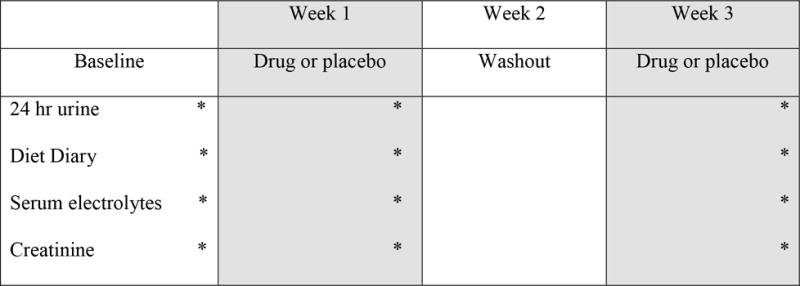
Materials and methods: We conducted a double-blind, randomized, placebo controlled, crossover study of 21 calcium urinary stone formers stratified into majority calcium oxalate (10 patients) and calcium phosphate (11) groups. Patients received 45 mg tolvaptan per day or placebo for 1 week, followed by a washout week and crossover to tolvaptan or placebo for week 3. A 24-hour urine sample was collected at the end of weeks 1 and 3.
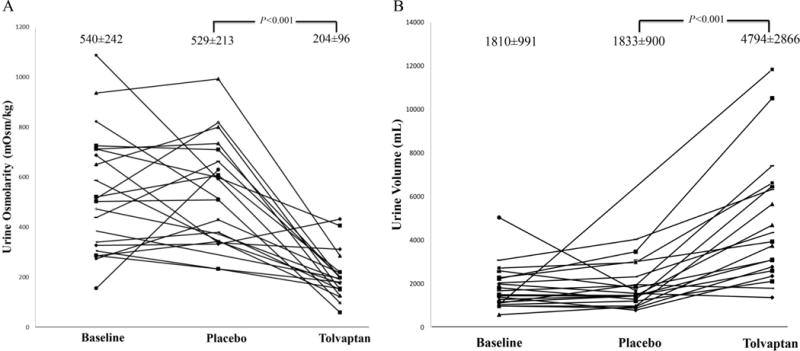
Results: Tolvaptan vs placebo decreased urinary osmolality (mean ± SD 204 ± 96 vs 529 ± 213 mOsm/kg, p <0.001) and increased urinary volume (4.8 ± 2.9 vs 1.8 ± 0.9 L, p <0.001). The majority of urinary solute excretion rates, including sodium and calcium, did not change significantly, although oxalate secretion increased slightly (from mean ± SD 15 ± 8 to 23 ± 8 mg per 24 hours, p = 0.009). Mean ± SD urinary calcium oxalate supersaturation (-0.01 ± 1.14 vs 0.95 ± 0.87 dG, p <0.001), calcium phosphate supersaturation (-1.66 ± 1.17 vs -0.13 ± 1.02 dG, p <0.001) and uric acid supersaturation (-2.05 ± 4.05 vs -5.24 ± 3.12 dG, p = 0.04) all dramatically decreased. Effects did not differ between the calcium oxalate and calcium phosphate groups (p >0.05 for all interactions).
Conclusions: Tolvaptan increases urine volume and decreases urinary supersaturation in calcium stone formers. Further study is needed to determine if long-term use of V2 receptor antagonists results in fewer stone events.
Keywords: kidney calculi; osmolar concentration; vasopressins; water-electrolyte balance.
Copyright © 2016 American Urological Association Education and Research, Inc. Published by Elsevier Inc. All rights reserved.
Conflict of interest statement
All the authors declared no competing interests.
Figures
Comment in
-
Stones: Tolvaptan might prevent kidney stone formation.Nat Rev Urol. 2016 Mar;13(3):130-1. doi: 10.1038/nrurol.2016.11. Epub 2016 Feb 2. Nat Rev Urol. 2016. PMID: 26832161 No abstract available.
References
-
- Lieske JC, Pena de la Vega LS, Slezak JM, et al. Renal stone epidemiology in Rochester, Minnesota: An update. Kidney Int. 2006;69:760. - PubMed
-
- Litwin MS, Saigal CS. Urologic Diseases in America. p. 313.p. 2012. (NIH Publication No 12-7865).
-
- Hesse A, Brändle E, Wilbert D, et al. Study on the prevalence and incidence of urolithiasis in Germany comparing the years 1979 vs. 2000. European Urol. 2003;44:709. - PubMed
Publication types
MeSH terms
Substances
Grants and funding
LinkOut - more resources
Full Text Sources
Other Literature Sources
