


Breast implant-associated anaplastic large cell lymphoma: two distinct clinicopathological variants with different outcomes
- PMID: 26598546
- PMCID: PMC4722894
- DOI: 10.1093/annonc/mdv575
Breast implant-associated anaplastic large cell lymphoma: two distinct clinicopathological variants with different outcomes
Abstract
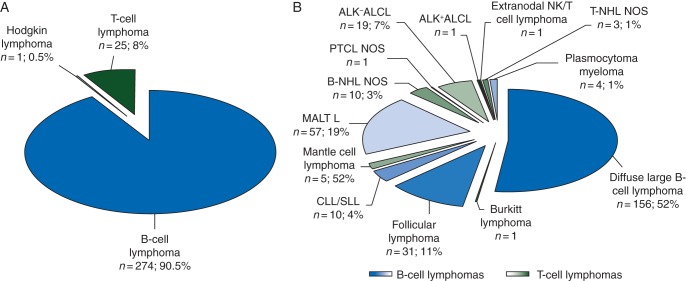
Background: ALK-negative anaplastic large cell lymphoma associated with breast implant (i-ALCL) has been recently recognized as a distinct entity. Among 43 830 lymphomas registered in the French Lymphopath network since 2010, 300 breast lymphomas comprising 25 peripheral T-cell lymphomas (PTCL) were reviewed. Among PTCL, ALK-negative ALCL was the most frequent and all of them were associated with breast implants.
Patients and methods: Since 2010, all i-ALCL cases were collected from different institutions through Lymphopath. Immuno-morphologic features, molecular data and clinical outcome of 19 i-ALCLs have been retrospectively analyzed.
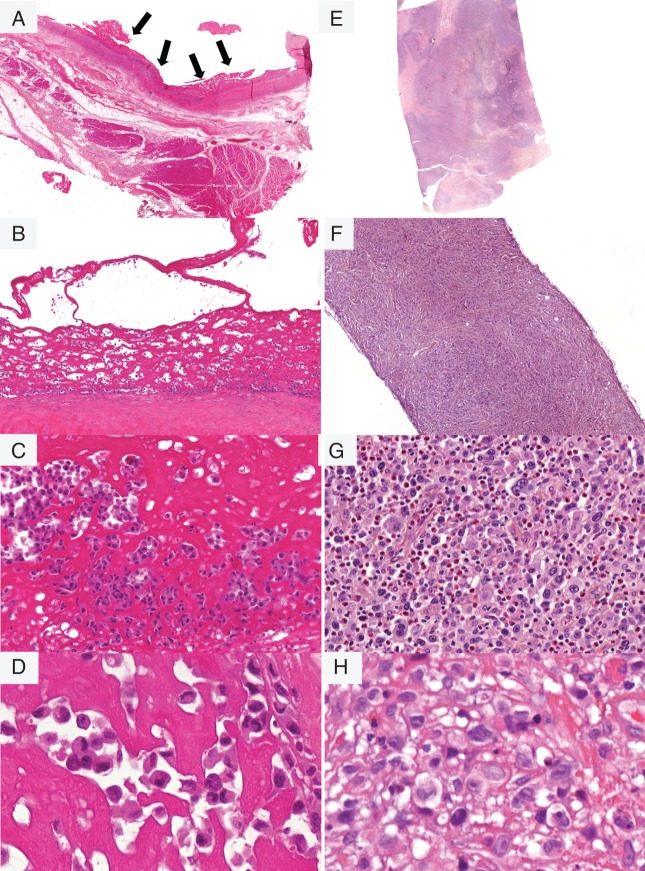
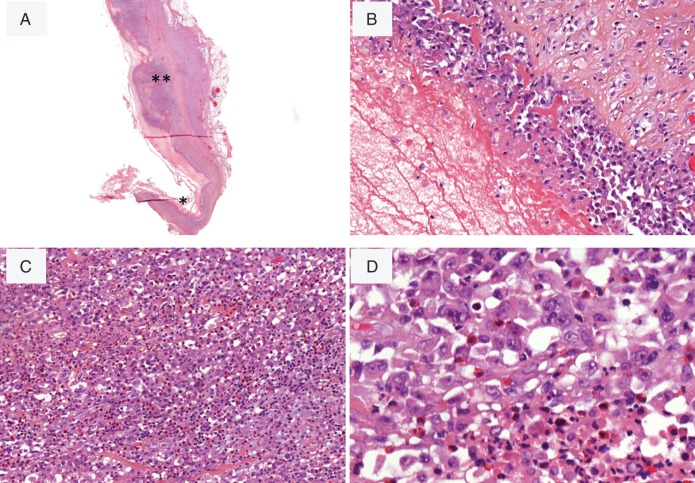
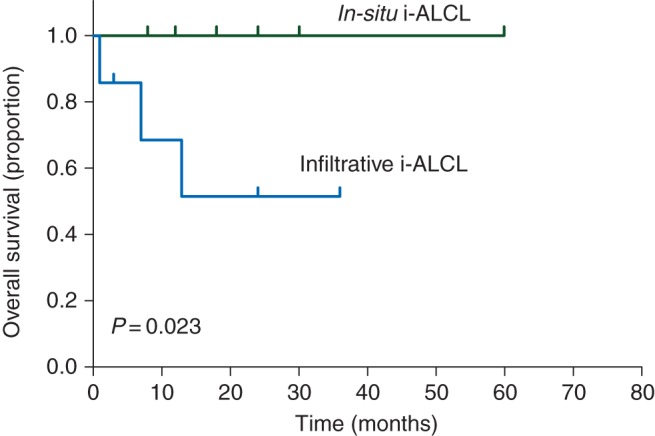
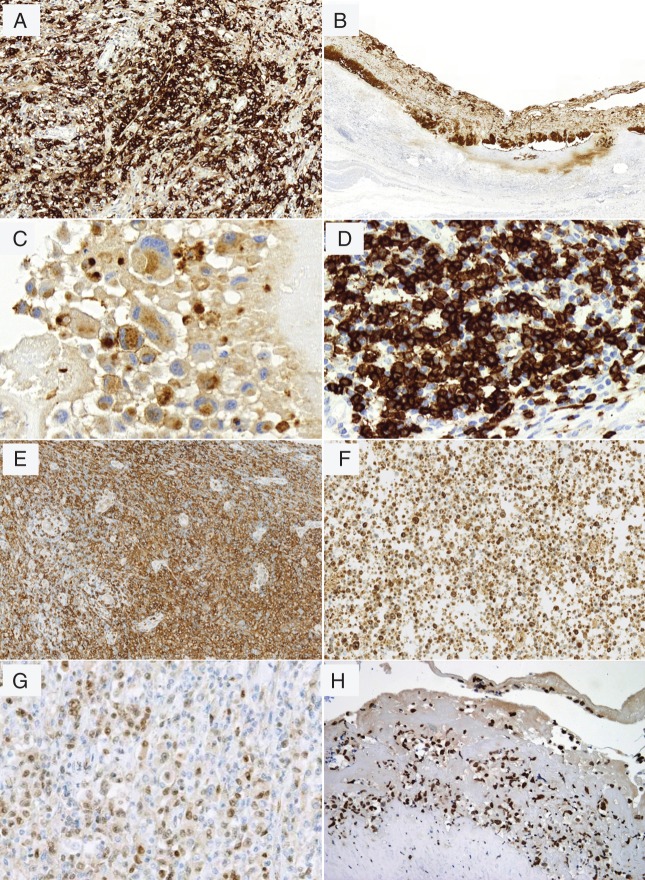
Results: The median age of the patients was 61 years and the median length between breast implant and i-ALCL was 9 years. Most implants were silicone-filled and textured. Implant removal was performed in 17 out of 19 patients with additional treatment based on mostly CHOP or CHOP-like chemotherapy regimens (n = 10/19) or irradiation (n = 1/19). CHOP alone or ABVD following radiation without implant removal have been given in two patients. The two clinical presentations, i.e. effusion and less frequently tumor mass correlated with distinct histopathologic features: in situ i-ALCL (anaplastic cell proliferation confined to the fibrous capsule) and infiltrative i-ALCL (pleomorphic cells massively infiltrating adjacent tissue with eosinophils and sometimes Reed-Sternberg-like cells mimicking Hodgkin lymphoma). Malignant cells were CD30-positive, showed a variable staining for EMA and were ALK negative. Most cases had a cytotoxic T-cell immunophenotype with variable T-cell antigen loss and pSTAT3 nuclear expression. T-cell receptor genes were clonally rearranged in 13 out of 13 tested cases. After 18 months of median follow-up, the 2-year overall survival for in situ and infiltrative i-ALCL was 100% and 52.5%, respectively.
Conclusions: In situ i-ALCLs have an indolent clinical course and generally remain free of disease after implant removal. However, infiltrative i-ALCLs could have a more aggressive clinical course that might require additional therapy to implant removal.
Keywords: anaplastic/Hodgkin-like subtypes; cytotoxic T-cell; implant-ALCL; mass; seroma.
© The Author 2015. Published by Oxford University Press on behalf of the European Society for Medical Oncology. All rights reserved. For permissions, please email: journals.permissions@oup.com.
Figures
References
-
- Talwalkar SS, Miranda RN, Valbuena JR et al. Lymphomas involving the breast: a study of 106 cases comparing localized and disseminated neoplasms. Am J Surg Pathol 2008; 32: 1299–1309. - PubMed
-
- Giardini R, Piccolo C, Rilke F. Primary non-Hodgkin's lymphomas of the female breast. Cancer 1992; 69: 725–735. - PubMed
-
- Validire P, Capovilla M, Asselain B et al. Primary breast non-Hodgkin's lymphoma: a large single center study of initial characteristics, natural history, and prognostic factors. Am J Hematol 2009; 84: 133–139. - PubMed
-
- Martinelli G, Ryan G, Seymour JF et al. Primary follicular and marginal-zone lymphoma of the breast: clinical features, prognostic factors and outcome: a study by the International Extranodal Lymphoma Study Group. Ann Oncol 2009; 20: 1993–1999. - PubMed
Publication types
MeSH terms
Substances
LinkOut - more resources
Full Text Sources
Other Literature Sources
Medical
Molecular Biology Databases
Research Materials
Miscellaneous
