Review
. 2015 Dec:35:66-72.
doi: 10.1016/j.gde.2015.10.003. Epub 2015 Nov 18.

Microbial diversity--exploration of natural ecosystems and microbiomes

Affiliations
Review

Microbial diversity--exploration of natural ecosystems and microbiomes

Sean M Gibbons et al. Curr Opin Genet Dev. 2015 Dec.

Abstract

Microorganisms are the pillars of life on Earth. Over billions of years, they have evolved into every conceivable niche on the planet. Microbes reshaped the oceans and atmosphere and gave rise to conditions conducive to multicellular organisms. Only in the past decade have we started to peer deeply into the microbial cosmos, and what we have found is amazing. Microbial ecosystems behave, in many ways, like large-scale ecosystems, although there are important exceptions. We review recent advances in our understanding of how microbial diversity is distributed across environments, how microbes influence the ecosystems in which they live, and how these nano-machines might be harnessed to advance our understanding of the natural world.


Figures

Figure 1
Figure 1
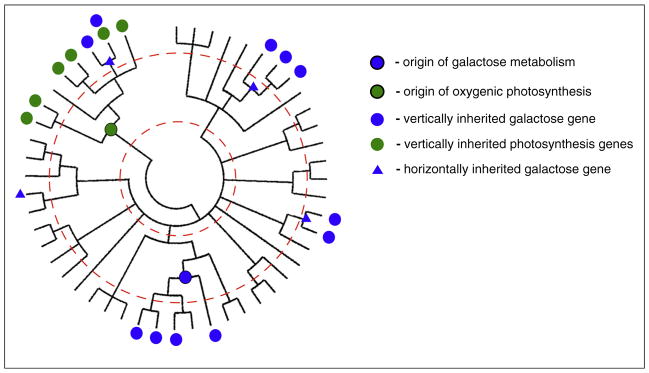
The hypothetical tree pictured above shows the phylogenetic distribution of two arbitrary functional traits across bacterial genera. The colored symbols denote the identity and origin of each function (see key). Both functions originated within a single clade. However, ‘oxygenic photosynthesis’ remained confined to a deeply-rooted group, while ‘galactose metabolism’ has been passed around via horizontal gene transfer. If phylotypes were assigned at the phylum level (red inner circle), the distribution of phylotypes across light and dark environments would yield a clear pattern, with a single phylotype enriched by the light. However, if response to galactose concentration were assessed at the phylum level, the result might be unclear, as many phylotypes would contain a mixture of taxa with and without galactose genes. If phylotypes were assigned at the family level (red outer circle), the changing abundances of phylotypes along a galactose gradient would yield more coherent patterns. However, there would be a variety of behaviors in response to galactose in the photosynthetic clade due to horizontal gene transfer and gene loss.
Figure 2
Figure 2
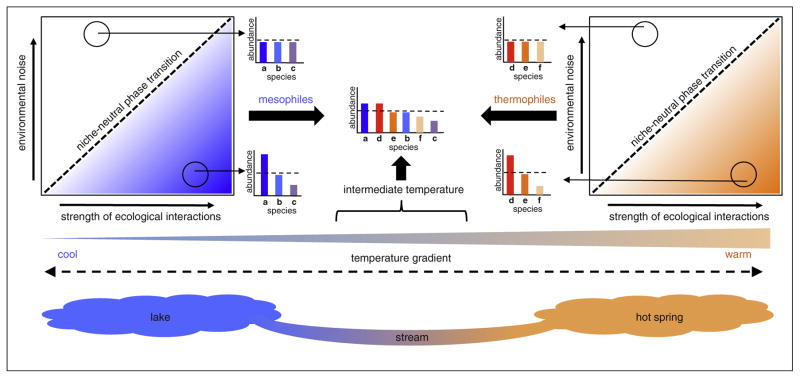
Both deterministic and stochastic processes are important for shaping microbial diversity. Each environment selects for a particular set of taxa (e.g. 3 ‘mesophiles’ in the lake and 3 ‘thermophiles’ in the hot spring). These different sets of taxa inhabit incompatible ecological niches that are widely separated along an environmental gradient (i.e. temperature). The structure of each community (i.e. the relative abundances of species) is determined by competition for niche space, unless environmental noise is too high or ecological interactions are too weak, in which case no species will have an advantage (see phase diagrams, modeled after Figure 2 in Fisher and Mehta, 2014). As such, niche-structured communities will tend to have a highly uneven rank-abundance pattern (i.e. there will be winners and losers in the competition for niche-space), while neutral communities should, on average, have a more even rank-abundance distribution (i.e. no species has an advantage). When the two communities are forced to mix along an environmental gradient (see the ‘stream’ above), ecological diversity is increased — both in terms of community richness and evenness — independent of niche/neutral dynamics. This maximum in diversity has been described before in many systems (e.g. the Intermediate Disturbance Hypothesis). The diversity maximum in the stream is a non-equilibrium state that would dissipate if the environmental mixing were to stop. The above picture can be further complicated by further dispersal from outside the system (i.e. meta-communities and island biogeography models), speciation, and extinction.

References

    1. Stahl D. The natural history of microorganisms. ASM News. 1993;59:609–613.
    1. Whitman WB, Coleman DC, Wiebe WJ. Prokaryotes: the unseen majority. Proc Natl Acad Sci USA. 1998;95:6578–6583. This review article describes how microbial communities, although invisible to the naked eye, are essential components of the Earth’s biota. They provide estimates of the total number of prokaryotes living in various environments and suggest that most of the biomass and diversity present in the biosphere is bound up in the microbial world. - PMC - PubMed
    1. Fierer N, Lennon JT. The generation and maintenance of diversity in microbial communities. Am J Bot. 2011;98:439–448. - PubMed
    1. Rinke C, Schwientek P, Sczyrba A, Ivanova NN, Anderson IJ, Cheng J-F, Darling A, Malfatti S, Swan BK, Gies EA. Insights into the phylogeny and coding potential of microbial dark matter. Nature. 2013;499:431–437. - PubMed
    1. Falkowski PG, Fenchel T, Delong EF. The microbial engines that drive earth’s biogeochemical cycles. Science. 2008;320:1034–1039. This review article describes the intimate connection between geochemistry and microbial life, and how microbial metabolism maintains the redox state of Earth’s oceans and atmosphere. - PubMed

Publication types