


Rising United States Hospital Admissions for Acute Bacterial Skin and Skin Structure Infections: Recent Trends and Economic Impact
- PMID: 26599005
- PMCID: PMC4657980
- DOI: 10.1371/journal.pone.0143276
Rising United States Hospital Admissions for Acute Bacterial Skin and Skin Structure Infections: Recent Trends and Economic Impact
Abstract
Background: The number of ambulatory patients seeking treatment for skin and skin structure infections (SSSI) are increasing. The objective of this study is to determine recent trends in hospital admissions and healthcare resource utilization and identify covariates associated with hospital costs and mortality for hospitalized adult patients with a primary SSSI diagnosis in the United States.
Methods: We performed a retrospective cross-sectional analysis (years 2005-2011) of data from the US Healthcare Cost and Utilization Project National Inpatient Sample. Recent trends, patient characteristics, and healthcare resource utilization for patients hospitalized with a primary SSSI diagnosis were evaluated. Descriptive and bivariate analyses were conducted to assess patient and hospital characteristics.
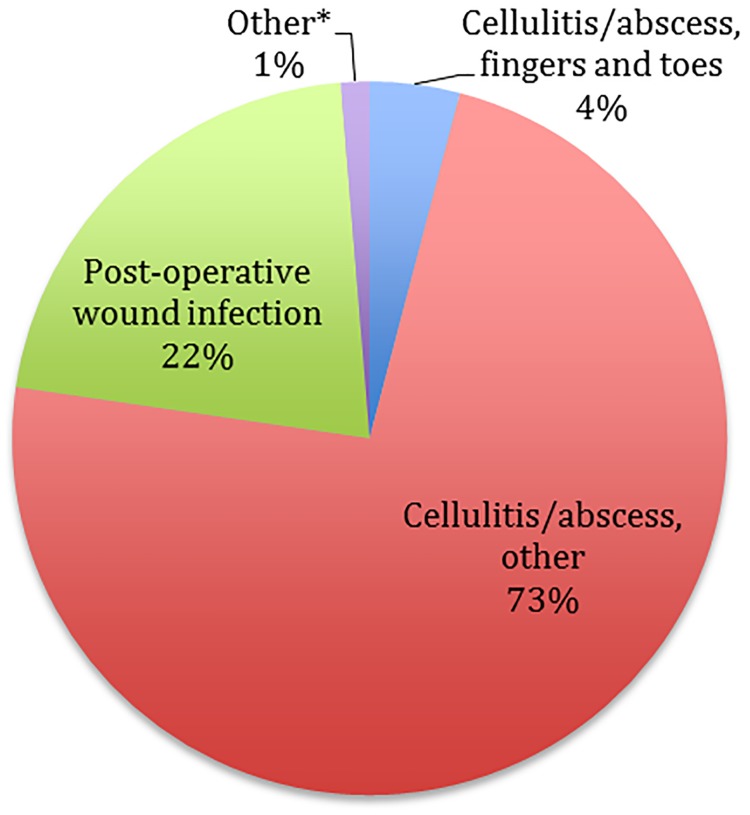
Results: A total of 1.8% of hospital admissions for the years 2005 through 2011 were for adult patients with a SSSI primary diagnosis. SSSI-related hospital admissions significantly changed during the study period (P < .001 for trend) ranging from 1.6% (in 2005) to 2.0% (in 2011). Mean hospital length of stay (LOS) decreased from 5.4 days in the year 2005 to 5.0 days in the year 2011 (overall change, P < .001) with no change in hospital costs. Patients with postoperative wound infections had the longest hospital stays (adjusted mean, 5.81 days; 95% confidence interval (CI), 5.80-5.83) and highest total costs (adjusted mean, $9388; 95% CI, $9366-$9410). Year of hospital admission was strongly associated with mortality; infection type, all patient refined diagnosis related group severity of illness level, and LOS were strongly associated with hospital costs.
Conclusions: Hospital admissions for adult patients in the United States with a SSSI primary diagnosis continue to increase. Decreasing hospital inpatient LOS and mortality rate may be due to improved early treatment. Future research should focus on identifying alternative treatment processes for patients with SSSI that could shift management from inpatient to outpatient treatment settings.
Conflict of interest statement
Figures

References
-
- Guidance for industry acute bacterial skin and skin structure infections: developing drugs for treatment Silver Spring, MD: US Department of Health and Human Services, Food and Drug Administration, Center for Drug Evaluation and Research (CDER); 2013 [cited 2014 April 28]. Available: http://www.fda.gov/downloads/Drugs/GuidanceComplianceRegulatoryInformati....
-
- Liu C, Bayer A, Cosgrove SE, Daum RS, Fridkin SK, Gorwitz RJ, et al. Clinical practice guidelines by the infectious diseases society of america for the treatment of methicillin-resistant Staphylococcus aureus infections in adults and children: executive summary. Clin Infect Dis. 2011;52(3):285–92. Epub 2011/01/11. cir034 [pii] 10.1093/cid/cir034 . - DOI - PubMed
-
- Stevens DL, Bisno AL, Chambers HF, Dellinger EP, Goldstein EJC, Gorbach SL, et al. Practice Guidelines for the Diagnosis and Management of Skin and Soft Tissue Infections: 2014 Update by the Infectious Diseases Society of America. Clinical Infectious Diseases. 2014. 10.1093/cid/ciu296 - DOI - PubMed
-
- Pallin DJ, Egan DJ, Pelletier AJ, Espinola JA, Hooper DC, Camargo CA Jr. Increased US emergency department visits for skin and soft tissue infections, and changes in antibiotic choices, during the emergence of community-associated methicillin-resistant Staphylococcus aureus. Ann Emerg Med. 2008;51(3):291–8. 10.1016/j.annemergmed.2007.12.004 . - DOI - PubMed
Publication types
MeSH terms
LinkOut - more resources
Full Text Sources
Other Literature Sources
