. 2015 Nov 23;10(11):e0143393.
doi: 10.1371/journal.pone.0143393. eCollection 2015.

Changes in Blood B Cell-Activating Factor (BAFF) Levels in Multiple Sclerosis: A Sign of Treatment Outcome

Affiliations

Changes in Blood B Cell-Activating Factor (BAFF) Levels in Multiple Sclerosis: A Sign of Treatment Outcome

Karin Kannel et al. PLoS One. .

Abstract

Multiple sclerosis (MS) is mediated primarily by autoreactive T cells. However, evidence suggesting the involvement of humoral immunity in brain diseases has increased interest in the role of B cells and their products during MS pathogenesis. The major survival factor for B cells, BAFF has been shown to play a role in several autoimmune conditions. Elevated BAFF levels have been reported in MS animal model and during MS relapse in patients. Moreover, disease-modifying treatments (DMT) reportedly influence blood BAFF levels in MS patients, but the significance of these changes remains unclear. The present study addresses how blood BAFF levels are associated with the clinical course of relapsing-remitting MS and the effectiveness of DMT and short-term steroid treatment. During a prospective longitudinal follow-up of 2.3 years, BAFF was measured in the blood of 170 MS patients in the stable phase and within 186 relapses. BAFF levels were significantly higher in MS patients compared to healthy controls. However, stable MS patients without relapses exhibited significantly higher BAFF levels than relapsing patients. Treatment with interferon-β and immunosuppressants raised BAFF blood levels. Interestingly, a similar effect was not seen in patients treated with glatiramer acetate. Short-term treatment with high doses of intravenous methylprednisolone did not significantly alter plasma BAFF levels in 65% of relapsing-remitting MS patients. BAFF were correlated weakly but significantly with monocyte and basophil counts, but not with other blood cell types (neutrophils, lymphocytes, or eosinophils) or inflammatory biomarkers. To our knowledge, this is the first report demonstrating that higher blood BAFF levels may reflect a more stable and effective MS treatment outcome. These results challenge hypotheses suggesting that elevated blood BAFF levels are associated with more severe disease presentation and could explain the recent failure of pharmaceutical trials targeting BAFF with soluble receptor for MS treatment.


Conflict of interest statement

Competing Interests: The authors have declared that no competing interests exist.

Figures

Fig 1
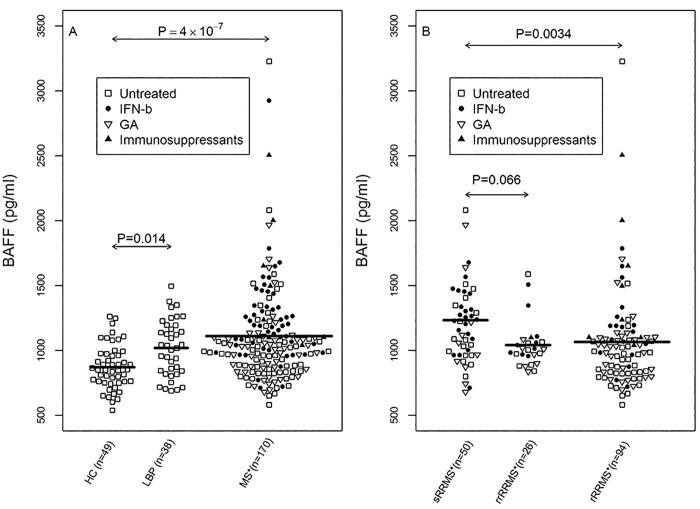
Fig 1. Average B cell-activating factor (BAFF) levels in the plasma of multiple sclerosis (MS) patients and controls.
Bee Swarm plot of: (A) Plasma BAFF levels in healthy controls (HC group), patients with lower back pain (LBP group), and all MS patients. (B) Plasma BAFF levels in MS patient subgroups: stable MS patients (sRRMS), remission-relapsing MS patients (rrRRMS), and relapsing MS patients (rRRMS). Means and the results of Tukey HSD test are shown. Untreated (□) and IFN-β (●), GA (▽) or immunosuppressant (▲) treated individuals. *Average concentration of BAFF in patients during the follow-up period.
Fig 2
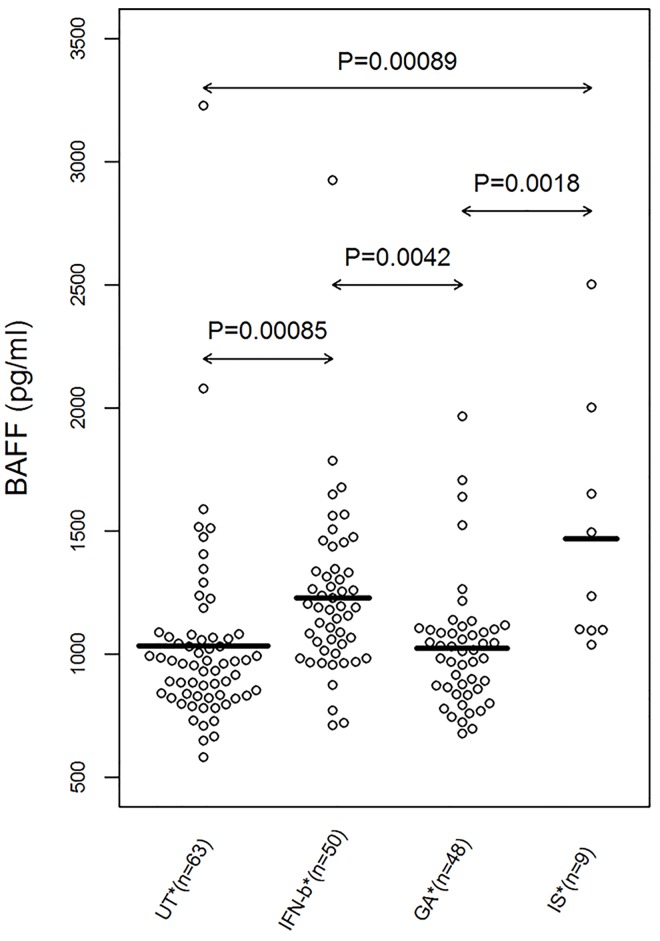
Fig 2. Average BAFF plasma levels and disease-modifying treatments (DMT).
Bee Swarm plot of BAFF level in untreated (UT), IFN-β, glatiramer acetate (GA) and immunosuppressant (IS)-treated groups were shown. Means and the results of Tukey HSD test are shown. *Average BAFF values during treatment were used. In case of medication change, the new average BAFF was analysed separately.
Fig 3
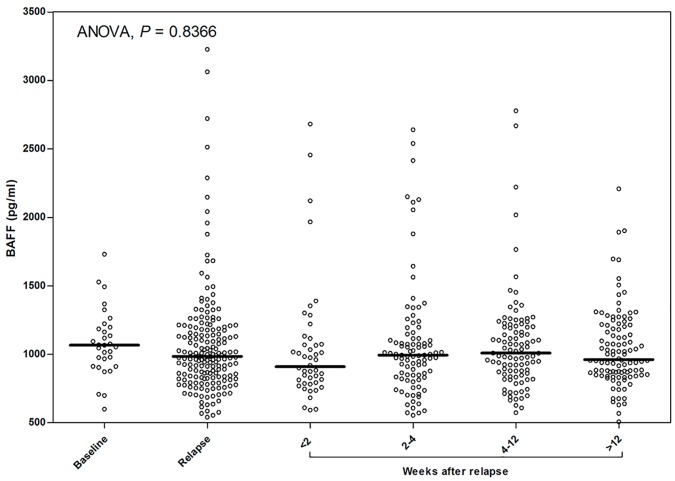
Fig 3. Changes in plasma BAFF levels during follow-up visits in the MS group.
Bee Swarm plot and means of BAFF levels at baseline (n = 31), during relapse (n = 186) and 1–2 weeks (n = 46), 2–4 weeks (n = 93), 4–12 weeks (n = 99) or 12–24 weeks (n = 104) after the relapse were presented.
Fig 4
Fig 4. Examples of different patterns of plasma BAFF level changes during acute relapse in four patients with RRMS.
(A) Patient with a uniform BAFF level pattern. (B) Patient with increased BAFF levels before steroid treatment. (C) Patient with decreased BAFF levels during acute relapse (before steroid treatment). (D) Patient with different patterns of BAFF levels during different relapse episodes.

References

    1. Tremlett H, Yousefi M, Devonshire V, Rieckmann P, Zhao Y. Impact of multiple sclerosis relapses on progression diminishes with time. Neurology 2009; 73: 1616–23. 10.1212/WNL.0b013e3181c1e44f - DOI - PMC - PubMed
    1. Hirst CL, Ingram G, Pickersgill TP, Robertson NP. Temporal evolution of remission following multiple sclerosis relapse and predictors of outcome. Mult Scler 2012; 18: 1152–8. 10.1177/1352458511433919 - DOI - PubMed
    1. Frota ER, Rodrigues DH, Donadi EA, Brum DG, Maciel DR, Teixeira AL. Increased plasma levels of brain derived neurotrophic factor (BDNF) after multiple sclerosis relapse. Neurosci Lett 2009; 460:130–2. 10.1016/j.neulet.2009.05.057 - DOI - PubMed
    1. Tremlett H, Zhao Y, Joseph J, Devonshire V, the UBCMS Clinic Neurologists. Relapses in multiple sclerosis are age- and time-dependent. J Neurol Neurosurg Psychiatry 2008; 79: 1368–74. 10.1136/jnnp.2008.145805 - DOI - PubMed
    1. Gran B, Rostami A. T cells, cytokines, and autoantigens in multiple sclerosis. Curr Neurol Neurosci Rep 2001; 1(3): 263–70. - PubMed

Publication types