High-precision geochronology confirms voluminous magmatism before, during, and after Earth's most severe extinction
- PMID: 26601239
- PMCID: PMC4643808
- DOI: 10.1126/sciadv.1500470
High-precision geochronology confirms voluminous magmatism before, during, and after Earth's most severe extinction
Abstract
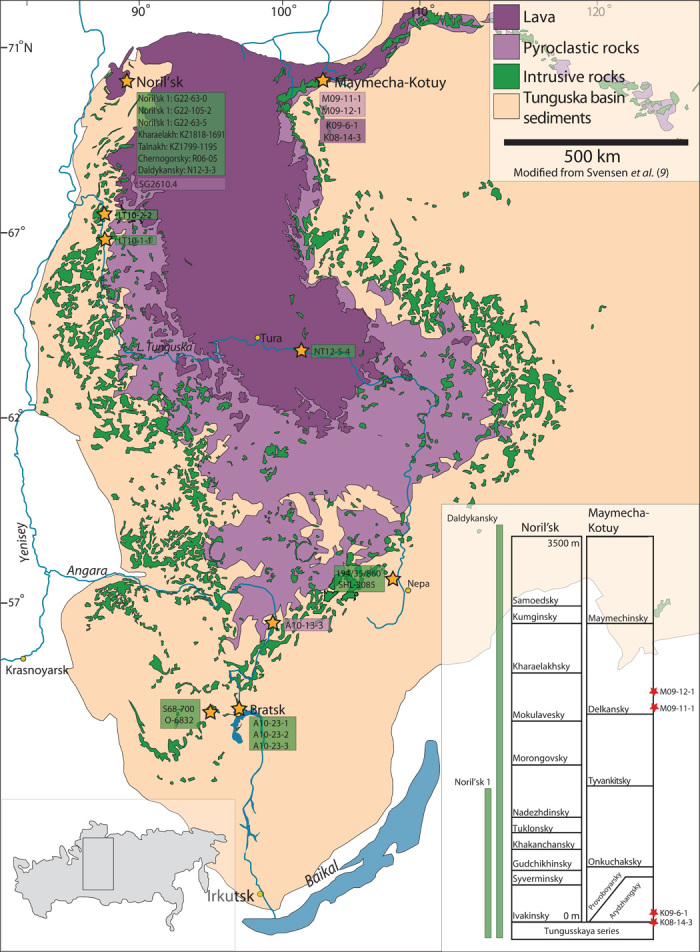
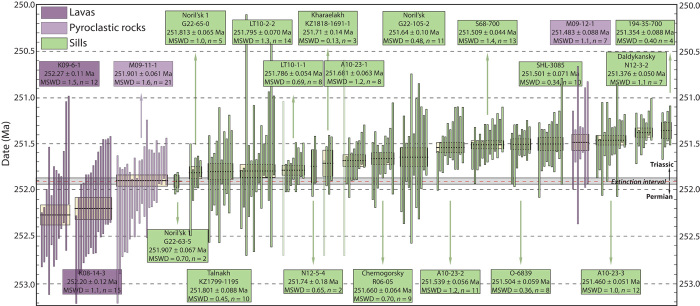
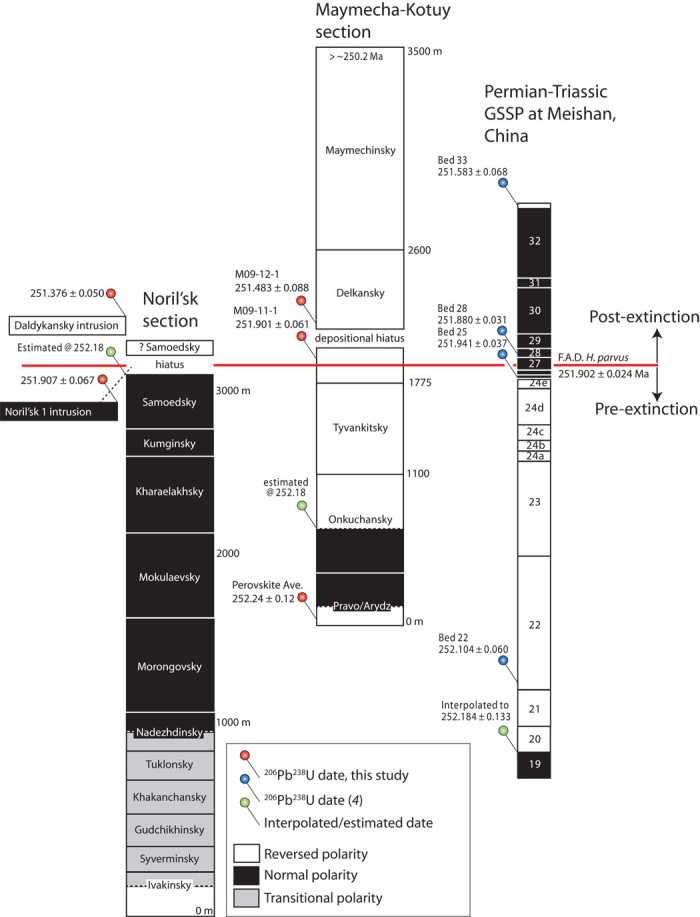
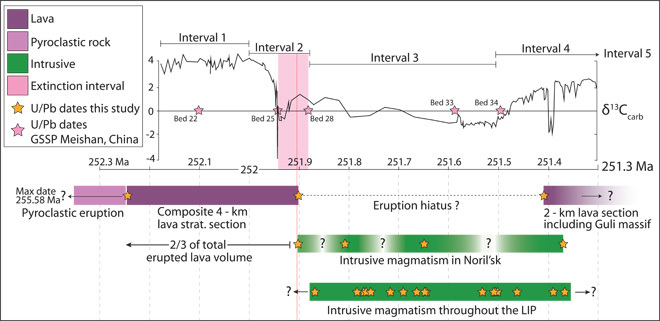
The end-Permian mass extinction was the most severe in the Phanerozoic, extinguishing more than 90% of marine and 75% of terrestrial species in a maximum of 61 ± 48 ky. Because of broad temporal coincidence between the biotic crisis and one of the most voluminous continental volcanic eruptions since the origin of animals, the Siberian Traps large igneous province (LIP), a causal connection has long been suggested. Magmatism is hypothesized to have caused rapid injection of massive amounts of greenhouse gases into the atmosphere, driving climate change and subsequent destabilization of the biosphere. Establishing a causal connection between magmatism and mass extinction is critically dependent on accurately and precisely knowing the relative timing of the two events and the flux of magma. New U/Pb dates on Siberian Traps LIP lava flows, sills, and explosively erupted rocks indicate that (i) about two-thirds of the total lava/pyroclastic volume was erupted over ~300 ky, before and concurrent with the end-Permian mass extinction; (ii) eruption of the balance of lavas continued for at least 500 ky after extinction cessation; and (iii) massive emplacement of sills into the shallow crust began concomitant with the mass extinction and continued for at least 500 ky into the early Triassic. This age model is consistent with Siberian Traps LIP magmatism as a trigger for the end-Permian mass extinction and suggests a role for magmatism in suppression of post-extinction biotic recovery.
Keywords: Biosphere; Biotic Crisis; Geochronology; Large Igneous Province; Magmatism; Mass Extinction; Siberian Traps; climate change; end-Permian; evolution.
Figures
References
-
- Courtillot V. E., Renne P. R., On the ages of flood basalt events. C. R. Geosci. 335, 113–140 (2003).
-
- Vogt P. R., Evidence for global synchronism in mantle plume convection, and possible significance for geology. Nature 240, 338–342 (1972).
-
- D. H. Erwin, Extinction: How Life on Earth Nearly Ended 250 Million Years Ago (Princeton Univ. Press, Princeton, NJ, 2006), 296 pp.
-
- Knoll A. H., Bambach R. K., Payne J. L., Pruss S., Fischer W. W., Paleophysiology and end-Permian mass extinction. Earth Planet. Sci. Lett. 256, 295–313 (2007).
LinkOut - more resources
Full Text Sources
Other Literature Sources
Molecular Biology Databases