


Human papillomavirus genotype and oropharynx cancer survival in the United States of America
- PMID: 26602016
- PMCID: PMC4666760
- DOI: 10.1016/j.ejca.2015.09.005
Human papillomavirus genotype and oropharynx cancer survival in the United States of America
Abstract
Background: The presence of human papillomavirus (HPV) DNA in oropharyngeal squamous cell cancer (OPSCC) tissue appears to be a strong predictor of improved prognosis, but this observation has not been explored in a population-based sample with generalisable findings.
Methods: Follow-up data from a large sample of OPSCC patients identified through six population-based cancer registries in the United States of America (USA) were used to characterise the association of tumour HPV status with survival.
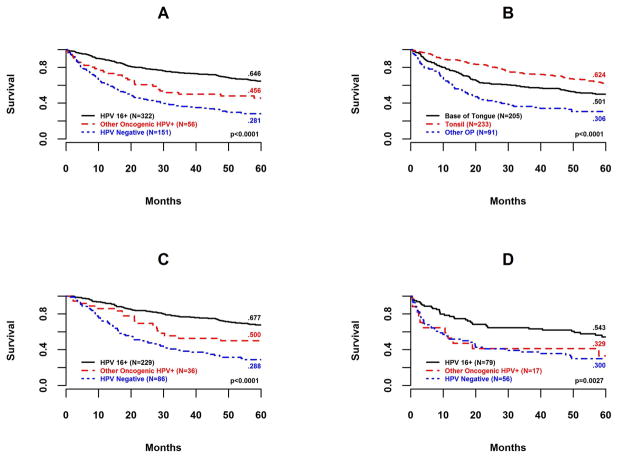
Results: HPV DNA was detected in tumour tissue from 71% (378 in 529) of the OPSCC patients. A total of 65% of patients with HPV16-associated tumours survived 5 years compared to 46% of patients with other HPV types and 28% of patients with HPV-negative tumours (p log-rank test <0.0001). The OPSCC patients with detectable HPV16 DNA had a 62% reduced hazard of death at 5 years, and patients with other HPV types had a 42% reduced hazard of death at 5 years compared to HPV-negative patients. Compared to non-Hispanic Whites, Blacks with OPSCC had a 2.6-fold greater risk of death at 5 years after adjustment for HPV status and other prognostic variables. Both surgery and radiation therapy were associated with a reduced 5-year risk of death, but no evidence was found for an interaction between HPV status and radiotherapy or surgery on survival time.
Conclusions: Data from this US study suggest that HPV16-positive OPSCC patients survive longer than HPV-negative patients regardless of treatment, highlighting the prognostic importance of HPV status for this malignancy. Optimal treatment regimens for OPSCC could be tailored to each patient's HPV status and prognostic profile.
Keywords: Archived tissue; Cancer of the oropharynx; Cancer registry; Human papillomavirus; Survival.
Copyright © 2015 Elsevier Ltd. All rights reserved.
Conflict of interest statement
Figures
References
-
- Zandberg DP, Bhargava R, Badin S, Cullen KJ. The role of human papillomavirus in nongenital cancers. CA Cancer J Clin. 2013;63:57–81. - PubMed
-
- Syrjänen KJ, Pyrhönen S, Syrjänen SM, Lamberg MA. Immunohistochemical demonstration of human papilloma virus (HPV) antigens in oral squamous cell lesions. Br J Oral Surg. 1983;21:147–53. - PubMed
-
- Gillison ML, Koch WM, Capone RB, Spafford M, Westra WH. Evidence for a causal association between human papillomavirus and a subset of head and neck cancers. J Natl Cancer Inst. 2000;92:702–20. - PubMed
-
- Kreimer AR, Clifford GM, Boyle P, Franceschi S. Human papillomavirus types in head and neck squamous cell carcinomas worldwide: a systematic review. Cancer Epidemiol Biomarkers Prev. 2005;14:467–75. - PubMed
-
- D’Souza G, Kreimer AR, Viscidi R, et al. Case-control study of human papillomavirus and oropharyngeal cancer. N Engl J Med. 2007;356:1944–56. - PubMed
Publication types
MeSH terms
Substances
Grants and funding
- U58 DP000769/DP/NCCDPHP CDC HHS/United States
- R01 CA077318/CA/NCI NIH HHS/United States
- U58 DP000810/DP/NCCDPHP CDC HHS/United States
- 5U58DP000769-5/DP/NCCDPHP CDC HHS/United States
- N01 PC035137/CA/NCI NIH HHS/United States
- 5U58DP000810-5/DP/NCCDPHP CDC HHS/United States
- P30 CA177558/CA/NCI NIH HHS/United States
- 5U58DP000812-5/DP/NCCDPHP CDC HHS/United States
- P30 CA071789/CA/NCI NIH HHS/United States
- N01 PC035137/PC/NCI NIH HHS/United States
- N01-PC-35137/PC/NCI NIH HHS/United States
- N01 PC035143/CA/NCI NIH HHS/United States
- P30 CA086862/CA/NCI NIH HHS/United States
- U58 DP000844/DP/NCCDPHP CDC HHS/United States
- U58 DP000812/DP/NCCDPHP CDC HHS/United States
- ImNIH/Intramural NIH HHS/United States
- N01-PC-35143/PC/NCI NIH HHS/United States
- 5U58DP000844-5/DP/NCCDPHP CDC HHS/United States
LinkOut - more resources
Full Text Sources
Other Literature Sources
Medical
